
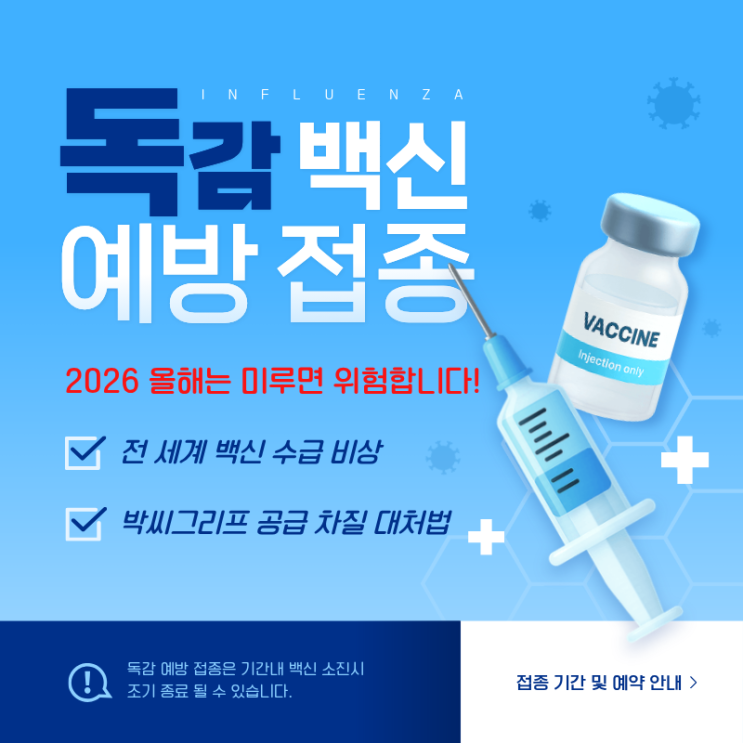
2026 Influenza Shot Alert! A Vaccine Supply Shortage? Don’t Put Off This Year’s Influenza Vaccination!
Hello, this is Director Dr. An Sehwan of SONGDO ANSHIN.
Around this time every year, “When is the best time to get the influenza shot?” is a question we hear a great deal. Usually we answered, “Whenever is convenient for you during October–November,” but this year the answer is different.
To start with the conclusion — this year the influenza vaccine supply may not be what it has been in previous years.
We recommend not putting it off and being vaccinated as soon as vaccination becomes possible.
“A vaccine shortage? What does that mean?” you may well be wondering. In fact, an unprecedented combination of factors has converged on global influenza vaccine production this year, and in the UK large-scale order cancellations have already taken place. Let me lay it out step by step, based on overseas reporting and official announcements.
How it began: all three strains in this year’s influenza vaccine were changed
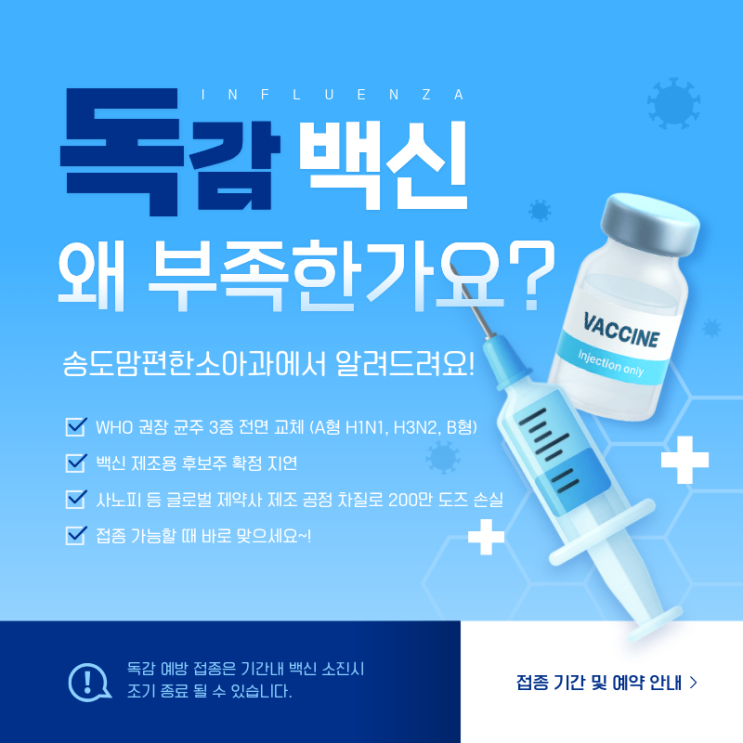
Each year the World Health Organization (WHO) predicts that “these viruses will circulate this winter” and designates the strains (virus types) accordingly; pharmaceutical companies worldwide then manufacture their vaccines from those strains.
In the WHO’s recommendation for the 2026-2027 Northern Hemisphere influenza vaccine, announced on February 27, 2026, all three strains (influenza A H1N1, influenza A H3N2 and influenza B) were replaced. The main reason for the complete strain replacement was a new H3N2 variant (J.2.4.1, the so-called ‘subclade K’) that emerged in August 2025 and spread rapidly around the world. Many of you will remember how unusually severe last winter’s outbreak was. This is that very variant.
Even when only one strain changes, manufacturers have to retool their production process, so changing three at once is a far greater burden. On top of that, the candidate vaccine virus for the influenza B strain was confirmed later than usual, delaying the very schedule on which the standard strain is delivered to manufacturers worldwide. Global vaccine production, in effect, started late off the blocks.
In the UK, “order cancellations” have already happened
That this is not a theoretical concern is confirmed by overseas reporting.
According to an August 2026 report by the UK’s Dispensing Doctors’ Association (DDA), Sanofi acknowledged that the replacement of three strains and the delayed confirmation of the influenza B candidate virus, compounded by problems in its own manufacturing process, resulted in a production loss of roughly 2 million doses of influenza vaccine. In the fallout, some UK medical practices had their entire Sanofi orders cancelled, and at some sites about 80% of the expected supply is reported to have been affected.
The Surrey and Sussex Local Medical Committee (LMC) in the UK also issued an urgent notice to member practices. It stated that these vaccine order cancellations are a nationwide problem in the UK, and that if replacement supply is delayed, the vaccination program beginning in September could be disrupted.
It was also noted that another manufacturer (Viatris) has decided not to supply influenza vaccine to the UK at all this season, so the industry as a whole is seeing supply shortages and a rush of demand toward alternatives. Even the high-dose vaccine that Sanofi offered as a substitute is said to be available only in November, and then on a first-come, first-served waiting basis.
In short, this is not the problem of one company or one country: a shared cause, “a complete strain replacement plus a delayed candidate virus,” is squeezing vaccine production worldwide, and the race to secure the reduced supply first has already begun.
In Korea, too, “early-season supply” is the key issue
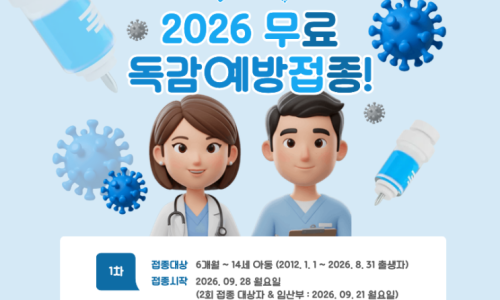
The national immunization program (NIP) schedule in Korea itself is on track. The Korea Disease Control and Prevention Agency announced that influenza national immunization will run from September 21, 2026 to April 30, 2027, and from this year the free vaccination group for children has been expanded to ages 6 months through 14 years (up to the second year of middle school).
That said, on the supply side there are clear signals in Korea as well. According to reports from the domestic pharmaceutical distribution industry, the gap between the strain used to manufacture the vaccine (the J lineage) and the strain actually dominant in circulation (the K lineage) delayed the WHO-designated laboratories in securing the manufacturing reference standards, and this is affecting the bulk antigen production and shipping schedules of major Korean manufacturers as well.
One domestic manufacturer officially stated that its bulk antigen production schedule had been adjusted, pushing some shipments into the next quarter, and within the industry there is concern about the possibility that early-season supply will be reduced, or that demand will pile up all at once in the specific periods when supply is released. Distributors have begun pre-selling vaccines earlier than in previous years precisely because of this uncertainty.
“Why isn’t VaxiGrip available?”
Early this season, vaccination with it will be difficult
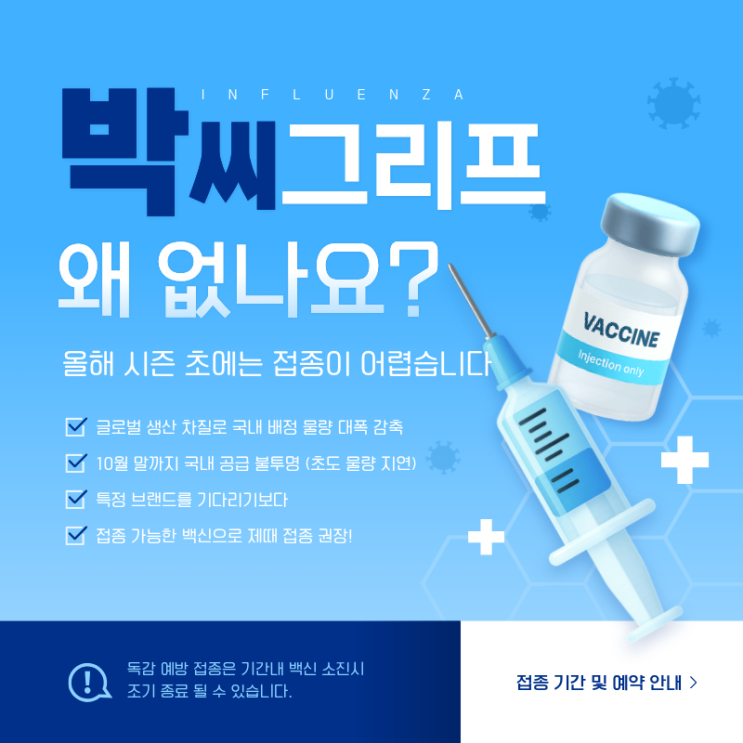
I would like to address this point separately. Every year many parents look for Sanofi’s VaxiGrip in the free national immunization program (NIP) for children. Because it is an imported vaccine produced as a finished product in France, a steady number of families prefer it. Many of you may come in for vaccination this autumn and ask, “Why isn’t VaxiGrip available?” so let me explain it in advance.
As a consequence of Sanofi’s global production disruption described above, this year’s domestic allocation of VaxiGrip has been reduced by about 50% compared with before, and normal supply is not expected until the end of October, according to the guidance we have received. Even the supplier has not yet been able to confirm exactly when it will arrive after that.
In previous years it could be given as early as September, but this year choosing VaxiGrip for early-season NIP vaccination is effectively impossible. This is not the problem of any one clinic; it is a global supply-chain issue.
The problem is timing. Given that it takes about 2 weeks for influenza antibodies to form, if you wait until VaxiGrip arrives before being vaccinated, the point at which antibodies develop may coincide with the start of the outbreak, or come too late. That is all the more true if the outbreak arrives as large and as fast as it did last season. Waiting for a vaccine with no confirmed arrival date means, this year, postponing vaccination indefinitely.
The influenza vaccines supplied in Korea this year are all trivalent vaccines containing the same WHO-recommended strains, regardless of manufacturer, and free NIP vaccination will proceed normally with these vaccines. Even if you prefer VaxiGrip, for this year at least, we recommend going ahead with your child’s vaccination on time using an available vaccine, rather than waiting for a particular brand.
📌 [Recommended reading]
If you would like the detailed schedule by age group (children, pregnant women, seniors) for the free 2026-2027 season influenza vaccination (NIP), and what to prepare before your visit, please see the post below!
👉 2026 Free Influenza Vaccination Schedule: Complete Guide (Vaccination Timing, Period and Symptoms for Children, Pregnant Women, Seniors)
💡 In summary : here is what to do
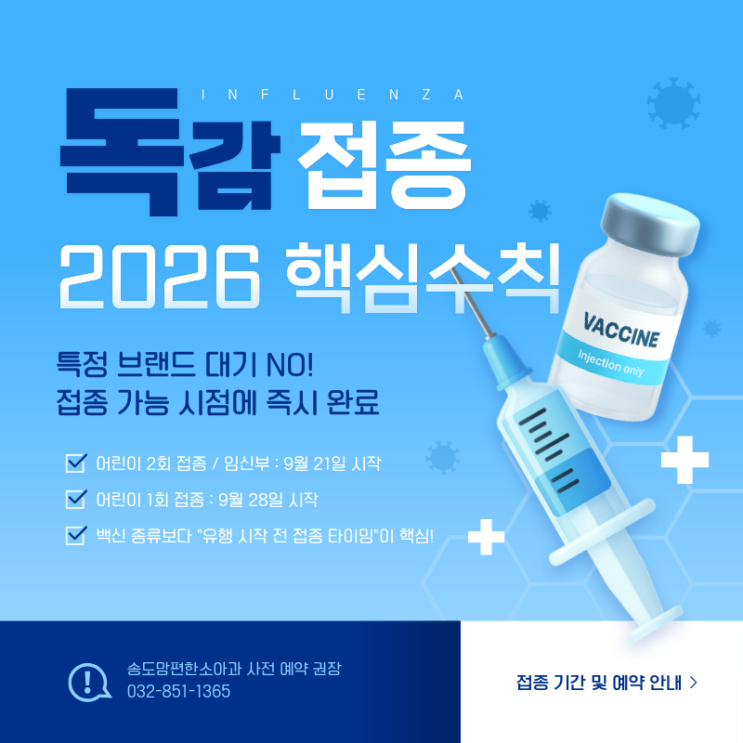
1️⃣ First, “when you are vaccinated” matters far more than the vaccine brand.
All influenza vaccines supplied in Korea this year are trivalent vaccines containing the WHO-recommended strains, and whichever manufacturer’s product it is, it was made to match this season’s outbreak forecast. The scenario most to be avoided this year is missing your vaccination window while waiting for a particular vaccine such as VaxiGrip.
2️⃣ Second, the goal is to be vaccinated before the outbreak.
Influenza antibodies form over about 2 weeks after vaccination. Last season (2024-2025), the outbreak in Korea was 20~30% larger than the year before and the largest since 2016, and there was also a second wave centered on school-age children and adolescents around the start of the school term. Before the outbreak begins, finish your vaccination during October–November; and this year, when supply may bunch up in particular periods, being vaccinated as soon as vaccination becomes possible is the safest approach.
3️⃣ Third, if you are eligible for free vaccination, move promptly according to the schedule.
Children requiring 2 doses and pregnant women can start from September 21, and children requiring 1 dose from September 28. Children receiving an influenza vaccine for the first time in their lives need 2 doses 4 weeks apart, so if you have the first dose on the start date, you can comfortably finish the second dose before the November outbreak.
2026 Influenza Vaccination Guide

SONGDO ANSHIN, Director Dr. An Sehwan
Don’t put off your influenza shot this year!
Vaccine supply may run short.
Our clinic is a designated NIP (national immunization program) provider, offering free vaccination for children (6 months–14 years), pregnant women and adults aged 65 and over, together with general (paid) influenza vaccination as well, so the whole family can be vaccinated together.
This year, however, as described above, demand is expected to concentrate early in the season, so we recommend booking in advance for a smooth visit.
📞 Phone inquiries : 032-851-1365
📱 How to book : Phone, KakaoTalk, Ddocdoc app
As soon as VaxiGrip supply resumes (the timing is undetermined at present), we will announce it separately through the clinic’s channels.
If you have any questions, please feel free to ask when you visit. Thank you.
✅ References
1. Dispensing Doctors’ Association (UK), “Sanofi admits massive flu vaccine batch loss” (2026.8.)
https://www.dispensingdoctor.org/news/sanofi-admits-massive-flu-vaccine-batch-loss/
2. Surrey and Sussex LMCs (UK), “Update to Flu Vaccine Supply disruption affecting the 2026/27 season” (2026.8.)
https://www.sslmcs.co.uk/news/update-flu-vaccine-supply-2026-27/
3. WHO, “Recommendations for influenza vaccine composition for the 2026-2027 northern hemisphere season” (2026.2.27.)
https://www.who.int/news/item/27-02-2026-recommendations-for-influenza-vaccine-composition-for-the-2026-2027-northern-hemisphere-season
4. EMJ Reviews, “WHO Updates Influenza Vaccine Strains for 2026–27 Season” (2026.3.)
https://www.emjreviews.com/microbiology-infectious-diseases/news/who-updates-influenza-vaccine-strains-for-2026-27-season/
5. MediPharm Health News, “Bluepharm Korea opens pre-sales of 2026-2027 season influenza vaccines… supply from 7 companies and 12 products” (2026.8.)
https://medipharmhealth.co.kr/news/article.html?no=118668
6. Based on a Korea Disease Control and Prevention Agency press release: BabyNews, “2026-2027 season influenza vaccination begins September 21… free vaccination for children expanded to age 14” (2026.8.25.)
https://www.ibabynews.com/news/articleView.html?idxno=153980
7. MediPana News, “Sanofi supplies the influenza vaccine VaxiGrip nationwide” (2025.9.)
https://www.medipana.com/article/view.php?page=1&sch_menu=1&sch_date=2024-10-03&news_idx=346979
※ This article is based on public reporting and official announcements as of the time of writing (2026.8.), and the vaccine supply situation may change thereafter. Please discuss vaccination directly with your medical team.
