
It’s the same 2mg, so why is it different? The real difference between supplement melatonin and prescription melatonin [Part 3, Final]
[Our Child’s Growth & Sleep Stories] Melatonin Trilogy, Part 3 (Final)
It’s the same 2mg, so why is it so different?
The real difference between supplement melatonin and prescription melatonin
|
💡Key points of this article
|
It’s the same 2mg, so why do the effects differ?
Many parents tell us they tried a melatonin supplement and saw little effect. We also often hear that switching to melatonin prescribed at a clinic made a clear difference.
It is the same “2mg”, so why does such a difference appear? There are two reasons.
Reason 1 – The 2mg on the label may not really be 2mg
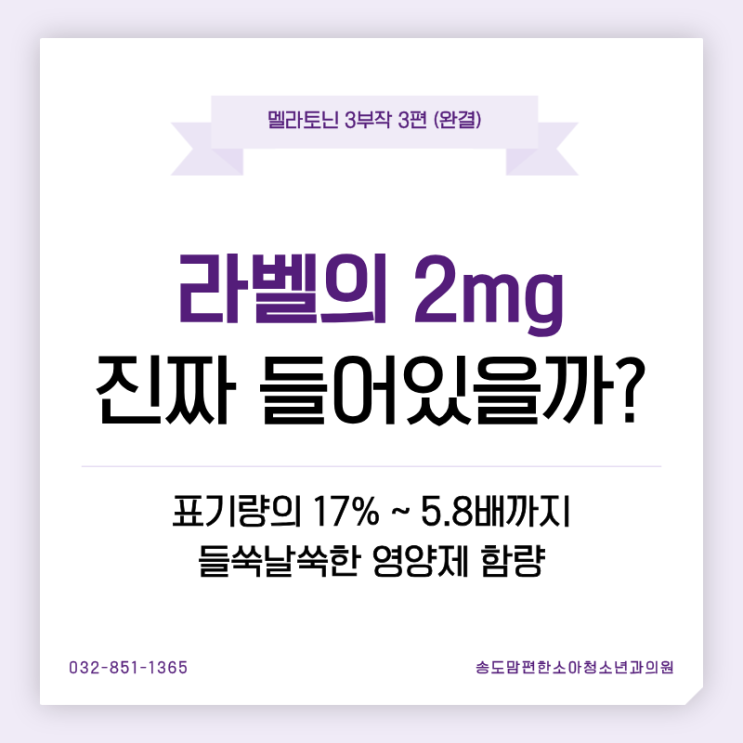
Most melatonin sold over the counter is classified as a health functional food. Such products do not always have to control their content as strictly as medicines do. In fact, when researchers measured products on the market, the amount stated on the label and the amount actually contained differed greatly.
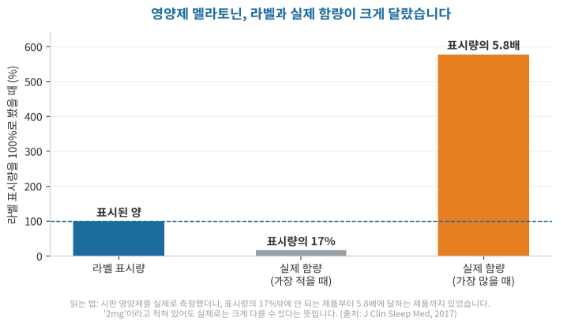
Figure 1. Label vs. actual content of commercial melatonin supplements (J Clin Sleep Med, 2017)
|
💡Key point One product contained only 17% of the labeled amount, while another contained 5.8 times as much. In other words, you may trust the “2mg” on the label and still be giving a completely different amount. |
Reason 2 – “Falling asleep” and “sleeping through the night” are different

Melatonin is cleared from the body quickly. So an ordinary supplement (immediate-release) rises sharply right after it is taken and disappears within a few hours. It helps with falling asleep, but it is hard for it to prevent waking in the early morning hours.
By contrast, the extended-release tablet(a slowly releasing formulation) prescribed at a clinic is designed to release melatonin little by little through the night, mimicking the curve our body normally secretes at night. So it helps with not only falling asleep but also maintaining sleep.
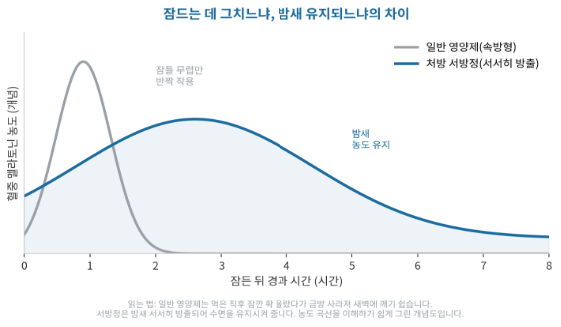
Figure 2. Conceptual comparison of blood levels: immediate-release (supplement) vs. extended-release (prescription)
Comparison at a glance
|
Category |
Over-the-counter supplement |
Prescription melatonin (extended-release tablet) |
|
Classification |
health functional food |
Prescription drug |
|
Content reliability |
Variation between products can be large |
Controlled to be uniform |
|
Duration of action |
Briefly, right after it is taken |
Slowly, through the night |
|
Mainly helps with |
Falling asleep |
Falling asleep + staying asleep |
|
Decision to use |
Purchased on one’s own judgment |
Prescribed after diagnosis |

|
💡The most important message This article is not saying that “supplements are bad and prescription drugs are good”. The point is that diagnosing why a child cannot sleep and then deciding on the right formulation and dose is far better than starting with a supplement without knowing the cause. Even with the same melatonin, it works as it should only when it matches the child’s underlying cause and sleep pattern. Making that judgment is exactly the role of a medical consultation. |
Closing the melatonin trilogy

Part 1 showed that melatonin is a relatively safe, evidence-based option; Part 2 showed that it works especially well for children whose cause fits, such as autism or ADHD; and Part 3 showed that even the same ingredient can give different results depending on the product and its formulation.
One conclusion runs through all three parts —“why and how you give it” matters more than “what you give”. If your child’s sleep is wearing out the whole family, we encourage you to look for the cause together with a specialist rather than choosing a supplement on your own.
👉 Is it safe to give kids melatonin?
A research review of sleep benefits and side effects in children and adolescents [Part 1]

👉 Melatonin’s effect: why it works better for insomnia in children with autism or ADHD
(Pediatric sleep disorder research review, Part 2)

📖 References
Esposito S, Laino D, D’Alonzo R, et al. Pediatric sleep disturbances and treatment with melatonin. Journal of Translational Medicine. 2019;17:77.
Wei S, Smits MG, Tang X, et al. Efficacy and safety of melatonin for sleep onset insomnia in children and adolescents: a meta-analysis of randomized controlled trials. Sleep Medicine. 2019.
Edemann-Callesen H, Andersen HK, Ussing A, et al. Use of melatonin for children and adolescents with chronic insomnia attributable to disorders beyond indication: a systematic review, meta-analysis and clinical recommendation. eClinicalMedicine. 2023;61:102064.
Reference: variability in the content of commercial melatonin — Erland LAE, Saxena PK. Melatonin natural health products and supplements: presence of serotonin and significant variability of melatonin content. J Clin Sleep Med. 2017;13(2):275-281.

SONGDO ANSHIN
※ This article explains academic research in plain language for a general audience and does not replace medical advice.
Whether to use it and at what dose must be decided after consulting a specialist.
