
My Baby’s Fever Is Gone. Can I Stop the Antibiotics? Why Stopping Early Causes Resistance (How Long to Take Antibiotics for Ear Infections and Colds)
Hello. Located in Songdo District 8, this is SONGDO ANSHIN.
With the October change of seasons, if your child has been seen at a pediatric clinic for a cold, otitis media (middle ear infection), laryngitis, or a urinary tract infection, you have probably wondered about this at least once:
“My child’s fever is completely gone and they’re full of energy again. Do I really have to give every last dose of these strong antibiotics?”
In fact, after giving the medicine for just 2~3 days, the fever comes down and the child bounces back, “What if giving strong antibiotics for so long makes my child resistant to them?” and out of this worry, a great many parents stop the medicine on their own.
Today, SONGDO ANSHIN will explain the clear medical reasons why your baby’s antibiotic course must be completed, and how stopping on your own allows resistant bacteria to develop, neatly summarized from the perspective of a board-certified pediatrician!
|
💡[Key Summary] Stopping antibiotics on your own: please remember this! 1️⃣ Myth vs. Fact : Resistance does not come from taking antibiotics for a long time; it comes from ‘taking them halfway and stopping too early.’ That is how resistant bacteria arise. 2️⃣ The Cause of Resistance : When the medicine is stopped early, the toughest, most powerful surviving bacteria (10~20%) multiply again and evolve into truly resistant bacteria. 3️⃣ The Rule for Taking Antibiotics : The duration a pediatrician prescribes is the minimum safe period needed to completely kill the bacteria. Even if symptoms improve, it is only safe to finish the full course for the number of days prescribed. |
My child’s symptoms have improved, so why should I keep giving antibiotics?
This is the point parents most often misunderstand. Many believe that “giving strong medicine for a long time breeds resistant bacteria in a child’s body,” but the medical fact is exactly the opposite.
Let’s imagine there are 10,000 harmful bacteria causing inflammation in your child’s body.
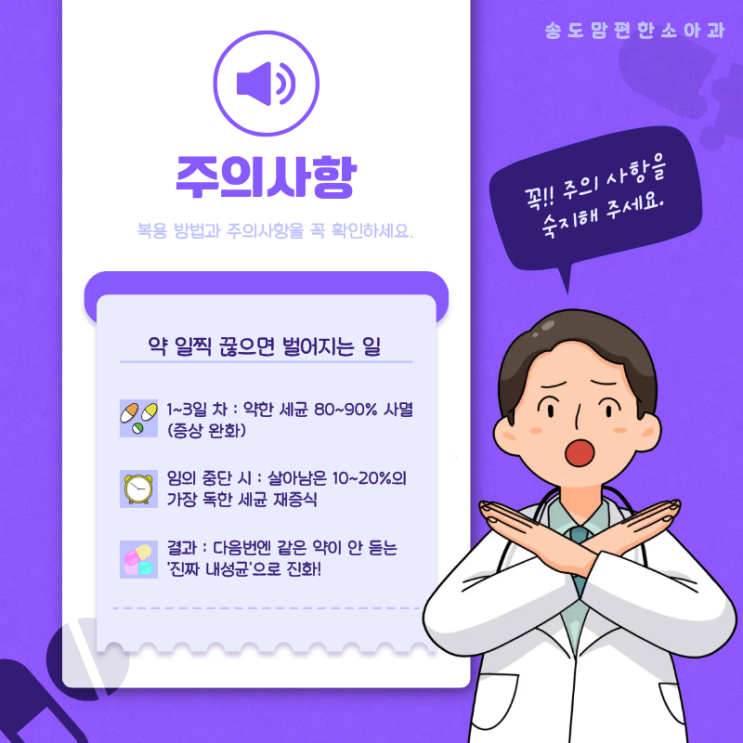
1️⃣ Days 1~3 of Treatment
Once antibiotics are started, the 80~90% of bacteria that are weak against the drug die off quickly. At this point the child’s fever drops, their energy returns, and on the surface they look completely cured.
2️⃣ The Trap of Stopping Early
If parents stop the medicine on their own at this point, the ‘toughest, strongest 10~20% of bacteria’ remaining deep within the organs survive.
3️⃣ The Birth of Resistant Bacteria
When these tough bacteria, having had a ‘taste’ of the drug and survived, multiply again, they evolve into ‘truly resistant bacteria’ that the same antibiotic can no longer kill next time. In other words, incomplete treatment is the main culprit that breeds resistance.
Why you need to finish the full prescribed course of antibiotics
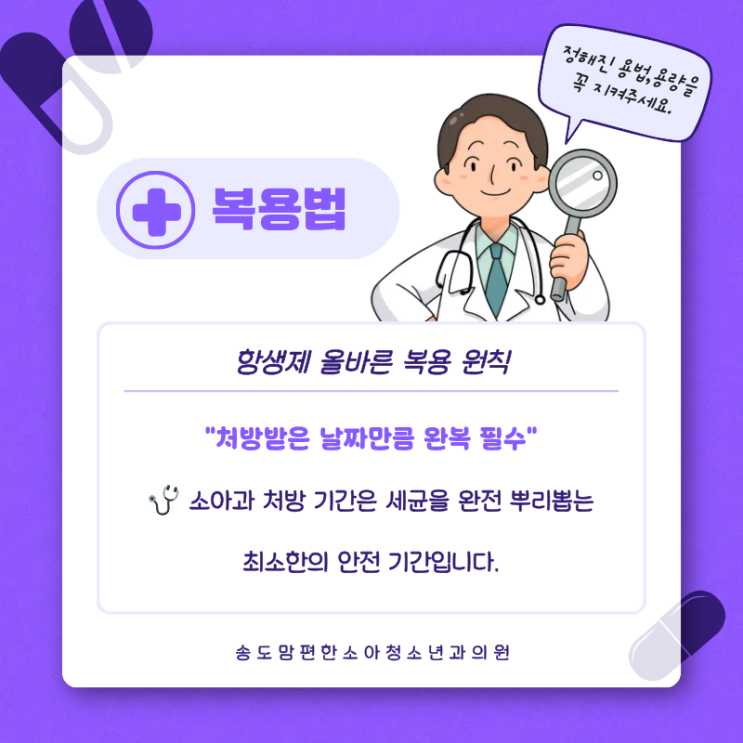
When a pediatrician prescribes antibiotics, they carefully calculate the child’s weight, the severity of symptoms, and the bacteria’s kill cycle to set ‘the minimum safe period needed to eradicate the bacteria completely.’
With bacterial illnesses such as otitis media or urinary tract infections, bacteria can remain deep in the tissues even after visible symptoms have disappeared. So rather than stopping the medicine early out of vague fear, following the prescribed dosage and duration exactly and finishing the full course is the wisest way to protect your child from resistant bacteria.
💡[Recommended Reading]
💊 “Are you storing your prescribed antibiotics and fever reducers correctly?”
If you’d like to know the proper way to store antibiotic syrups that need refrigeration and fever-reducer syrups that should be kept at room temperature because they can thicken and clump, be sure to check out the post below!
🔗 [Should Baby Syrup Medicine Go in the Fridge? A Complete Guide to Storing Antibiotics and Fever Reducers]
A word of advice from SONGDO ANSHIN
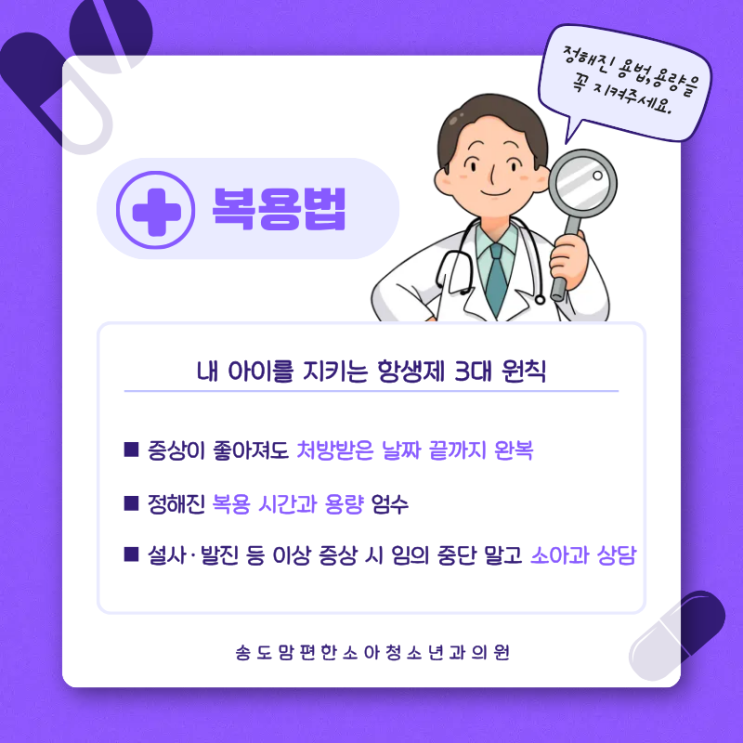
Antibiotics are not a poison to be avoided at all costs. They are a valuable treatment that protects children safely and quickly from bacterial illnesses.
If your child shows side effects such as diarrhea or a rash while taking the medicine, or has a very hard time taking it, please don’t stop the medicine on your own. Visit us anytime.
A board-certified pediatrician will carefully re-examine your child’s condition and adjust the medication in the safest and most effective way.
For our children’s health and proper medication use, SONGDO ANSHIN will always be a reliable mentor for parents!
