
Barking Cough vs. Wheezing in Babies: Croup vs. Bronchiolitis and How to Handle Nighttime Coughing

As we move into mid-October, the temperature gap between morning, evening, and daytime is widening sharply to more than 10 degrees. During this cold, dry seasonal transition, children’s respiratory linings become more vulnerable, and the number of children coming to the clinic with coughs rises rapidly.
Lately, one of the concerns we hear most often from parents visiting the clinic is: “My child’s cough sounds different from a usual cold.”
“When my child woke up this morning, the cough sounded like a dog barking.”
“Every breath comes with a wheezing sound, the breathing is rough, and my child is breathing fast.”
Depending on what a child’s cough and breathing sound like, the respiratory illness to suspect can be completely different.
Today, we’ll clearly explain the differences between two common pediatric respiratory illnesses of the changing seasons, acute laryngitis (croup) and bronchiolitis, along with what to do about sudden coughing at night and helpful home-care tips.
A “barking” cough like a dog? ➔ Acute laryngitis in children (croup)
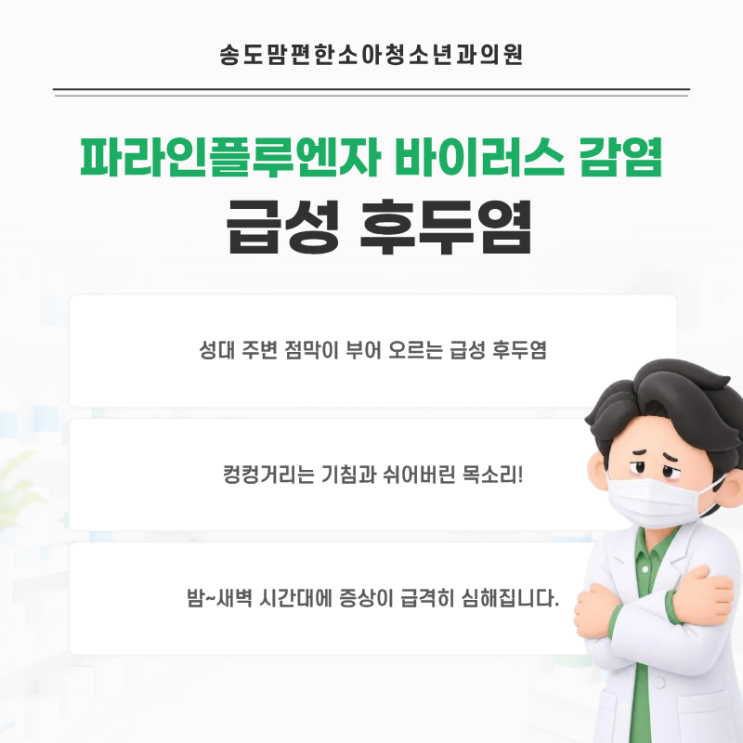
✅ Causes and characteristics
Acute laryngitis is mainly caused by parainfluenza virus (Parainfluenza virus) infection, which causes the vocal cords and the surrounding laryngeal lining to swell. When the larynx swells, the airway through which air passes becomes narrower, producing a characteristic cough sound.
-
Typical symptoms:a barking cough like a dog, or a hollow cough that sounds like it is echoing in a jar; a hoarse voice; and a harsh sound when breathing in (inspiratory stridor)
-
Points to watch: Croup tends to get worse at night or in the early morning hours. When a child wakes up crying or gets upset, the laryngeal lining can swell even more and make breathing harder, so keeping the child calm and reassured is more important than anything.
A “wheezing” breath with a harsh cough? ➔ Bronchiolitis (RSV)
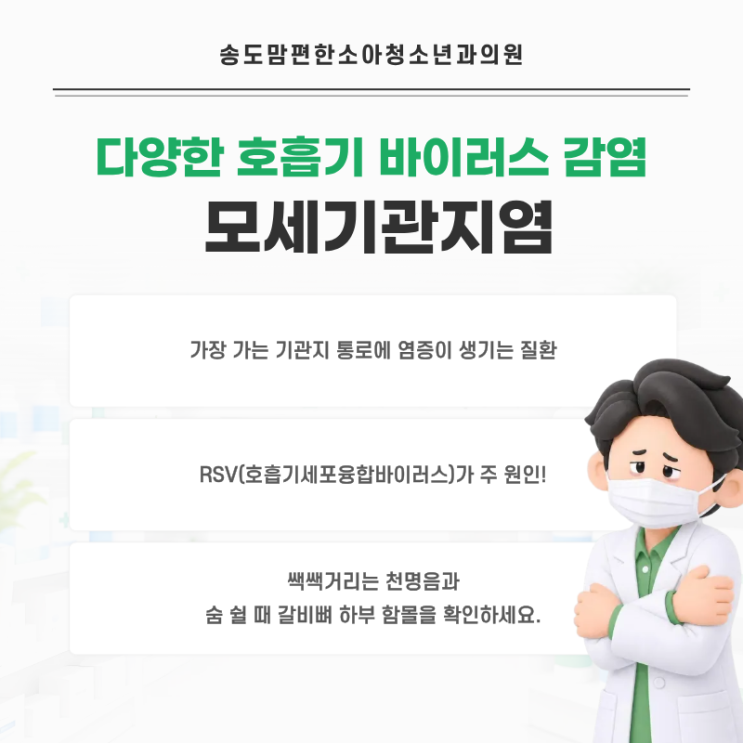
✅ Causes and characteristics
Bronchiolitis is an inflammation of the bronchioles, the smallest airways leading into the lungs. Many different respiratory viruses cause it, and among them, RSV (respiratory syncytial virus) infection is the most common cause. (It mainly affects infants under 24 months of age.)
-
Typical symptoms: It starts with a clear runny nose and fever, and after 2~3 days the cough gets worse, with a wheezing sound when breathing and a harsh, phlegmy cough.
-
Points to watch: When the bronchioles swell and become blocked with phlegm, the child may breathe faster (tachypnea), or chest retractions (the skin below the ribs or above the collarbone sinking in deeply with each breath) may appear.
[At a Glance] Acute laryngitis (croup) vs. bronchiolitis in children

|
Category |
Acute laryngitis (croup) |
bronchiolitis |
|
Main cause |
Parainfluenza virus, etc. |
RSV (respiratory syncytial virus), rhinovirus, etc. |
|
Affected area |
Upper airway (vocal cords and larynx) |
Lower airway (bronchioles inside the lungs) |
|
Characteristic cough and breathing sounds |
Barking cough, like a dog’s bark |
Wheezing breath sounds with a harsh, phlegmy cough |
|
Main age group |
Children aged 6 months to 3 years |
Infants under 24 months |
|
When it tends to worsen |
Mainly at night to early morning |
Needs close monitoring on days 3~5 after onset |
When your child suddenly starts coughing at night! Emergency care at home

1️⃣ Let your child breathe cool, moist air (for croup coughs)
When your child is coughing with a barking sound and struggling at night, briefly open a window to let them breathe the cool outdoor air, or run a humidifier to provide cool mist. This helps calm the swollen laryngeal lining.
2️⃣ Keep indoor humidity at an appropriate level (50~60%) and offer fluids
Keep indoor humidity comfortably at 50~60%. Even without a fever, giving small sips of warm water or barley tea frequently is a big help in protecting the respiratory lining and clearing phlegm.
3️⃣ Hold your child with the upper body upright
Lying flat can let secretions drain down the back of the throat and make breathing feel even harder. Holding your child with the upper body slightly upright keeps the airway open so they can breathe much more comfortably.
⚠️ In these cases, seek medical care immediately (emergency room / pediatrician)!
-
If your child struggles to breathe in and the lips or fingertips turn blue (cyanosis)
-
If the area above the collarbone or below the ribs sinks in deeply with each breath (chest retractions)
-
If a high fever persists, your child is listless, cannot drink any fluids, and is urinating much less than usual
💡Related reading: a seasonal cough guide
“Worried because your child seems fine during the day but wakes up coughing every night?”
▽ Check out the post below for the detailed causes of nighttime coughing and how to manage it at home!
👉 Read about the causes of severe nighttime coughing in children, how to stop it, and how to manage it

Cough care at SONGDO ANSHIN
A cough that gets worse at night may simply be a cold, but it can also be a sign of acute laryngitis, bronchiolitis, or pediatric rhinitis or asthma.
It is important to have a board-certified pediatrician carefully review your child’s symptom history through thorough auscultation and examination and, when needed, treat the root cause of the cough with nebulizer (respiratory) treatment and appropriate prescriptions.
If your child’s cough sounds different from usual or you are worried because their breathing is uncomfortable through the night, we recommend not putting it off and seeing a specialist.
