
Beyfortus Effects and Side Effects (Fever, Rash) Explained | Clinical Data on RSV Prevention for Newborns
Solid protection through the first RSV season with a single dose!
Beyfortus (nirsevimab): results of large clinical trials and real-world data (RWE)
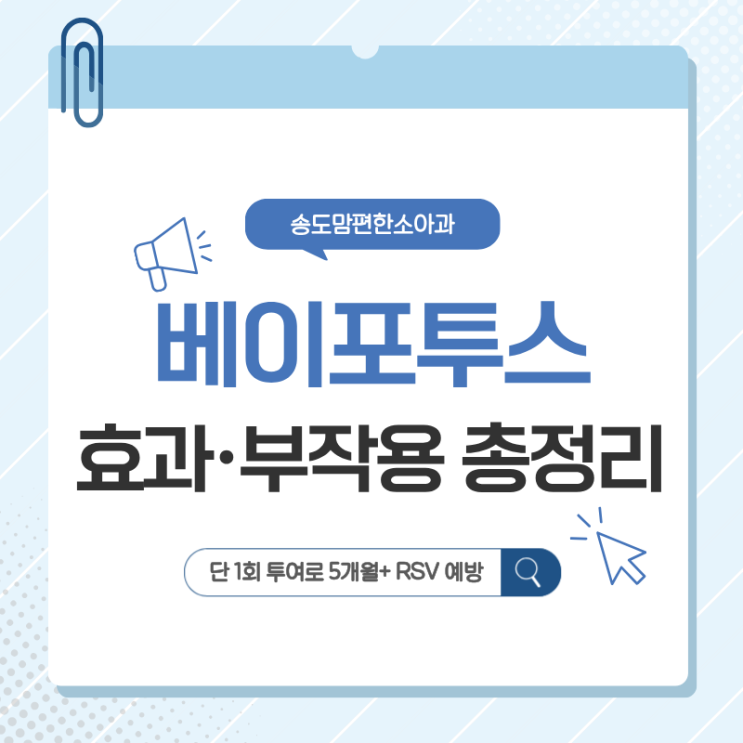
Recently, parents raising young infants often ask us “What kind of shot is Beyfortus, the RSV prevention shot for babies?” and “Will my baby get a fever or other side effects after the shot?” before the vaccination. We get these questions a lot.
This year Enflonsia, a new antibody injection, has also been released for RSV prevention in infants, so parents are even more interested in their prevention options.
Among them, Beyfortus (nirsevimab), whose effectiveness and safety have been proven over many years by large clinical trials and real-world data worldwide, is a long-acting monoclonal antibody injection that gives the baby RSV-preventing antibodies directly.
Today we have put together, in plain words, the key features of Beyfortus, its large clinical trial data, and the adverse events after the shot (safety) that parents ask about most.
|
💡Beyfortus key summary ✔︎ Direct and immediate protection (Direct & Rapid): There is no waiting for the baby to build immunity on their own. The preventive antibodies start working as soon as the shot is given. ✔︎ One dose, lasting 5+ months: A single shot keeps protection against lower respiratory tract infection throughout the RSV season (about 5–6 months). ✔︎ High protection against hospitalization: In a large phase 3 trial and a real-world study (HARMONIE), it lowered the risk of hospitalization from RSV lower respiratory tract infection by more than 80%. |
3 key features of Beyfortus (nirsevimab)
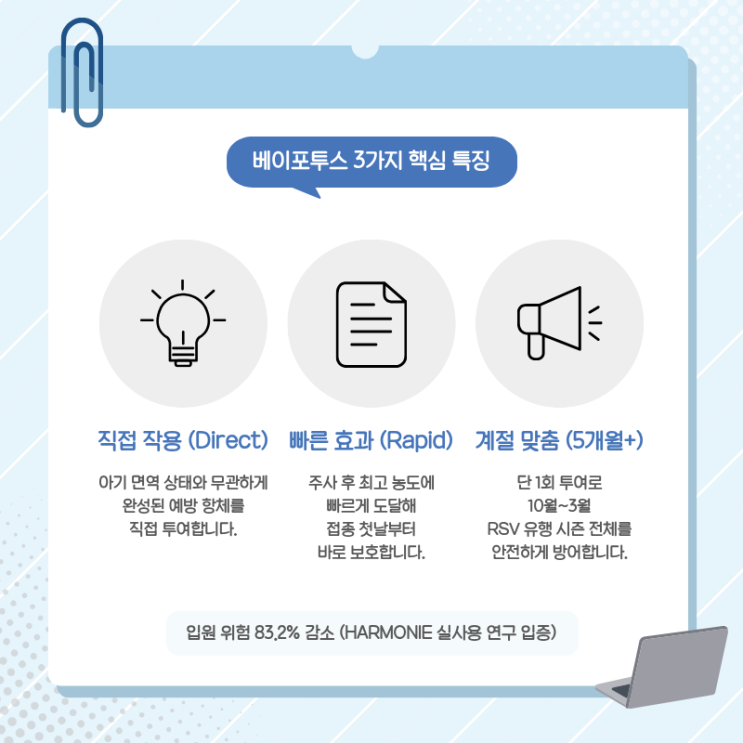
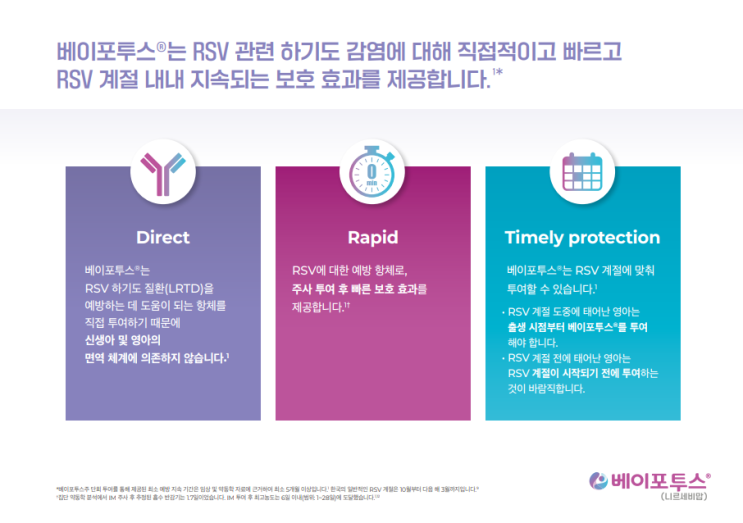
1️⃣ Direct (direct action)
Newborns and young infants still have immature immune systems, so even with a regular vaccine it takes time for them to make antibodies on their own. Beyfortus gives the finished antibody itself, which neutralizes the RSV virus, so it does not depend on the baby’s ability to build immunity.
2️⃣ Rapid (fast effect)
After the injection it quickly reaches its peak level in the body, giving protection from the very first day.
3️⃣ Timely Protection (protection matched to the season)
A single dose keeps protecting for at least 5 months, so it keeps the baby safe through the first winter, across Korea’s RSV season from October to March of the following year.
Source: sanofi
Effectiveness proven by large clinical trials and real-world data (RWE)
Source: sanofi
📊 Key Beyfortus clinical results at a glance
|
Study |
Study type and population |
Main endpoint |
Preventive effect (reduction) |
|
MELODY (phase 3 trial) |
Randomized controlled trial in healthy full-term and late preterm infants |
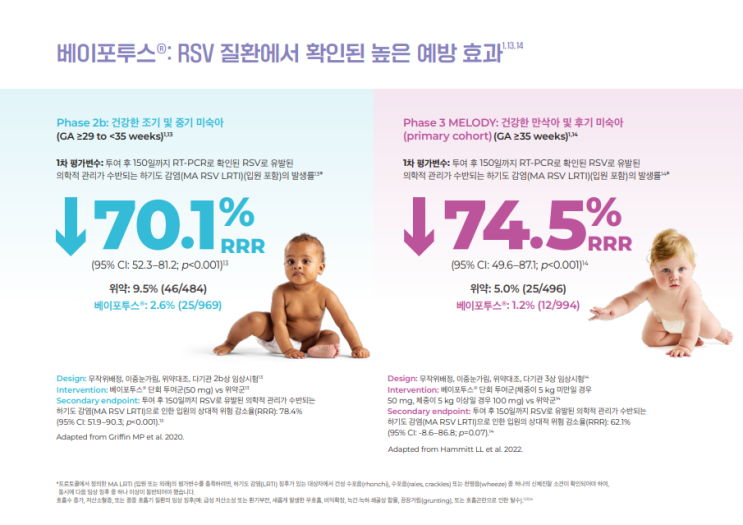
Rate of medically attended RSV lower respiratory tract infection |
74.5% lower (vs. placebo) |
|
HARMONIE (phase 3b RWE) |
Large real-world (RWE) study in 3 European countries |
Hospitalization rate from RSV lower respiratory tract infection |
83.2% lower (vs. standard care) |
Beyfortus has been given to millions of infants around the world, and its strong preventive effect and safety have been proven.
-
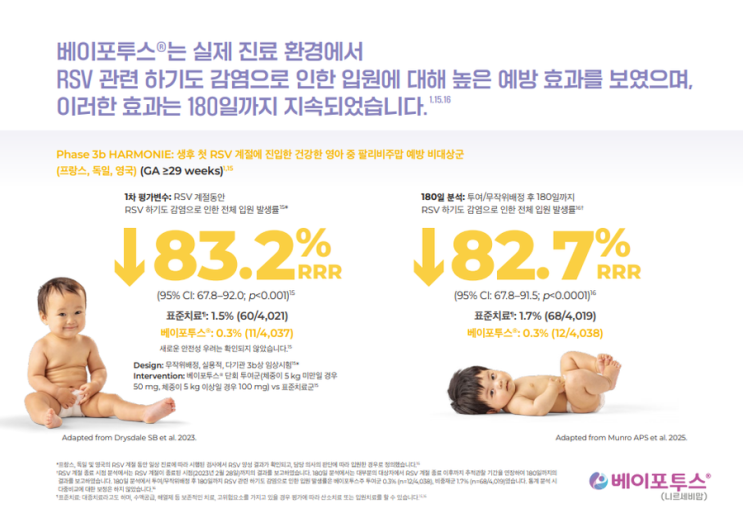
Healthy full-term infants (MELODY phase 3 trial): Compared with placebo, the rate of medically attended RSV lower respiratory tract infection was 74.5% lower.
-
Real-world data (HARMONIE phase 3b study): In a large real-world study in Europe (France, Germany and the UK), the hospitalization rate from RSV lower respiratory tract infection in the Beyfortus group, compared with standard care, was 83.2% lower.
🔗 [Related reading: RSV prevention guide by birth timing]
When should my baby get Beyfortus?
Can preterm babies or babies born in spring or summer (off-season) also get it?
From preterm birth (born within 2 weeks after the mother’s vaccination) to babies born off-season (April to September) or in season (October to March),
if you would like an RSV prevention plan for each birth situation and a summary table of vaccination timing,
▽ check the post below!
👇 [RSV Shot Timing, Fully Explained! Beyfortus vs Maternal Vaccine (Abrysvo), a Guide by Birth Timing]
Adverse events (side effects) after the shot and safety profile
Source: sanofi
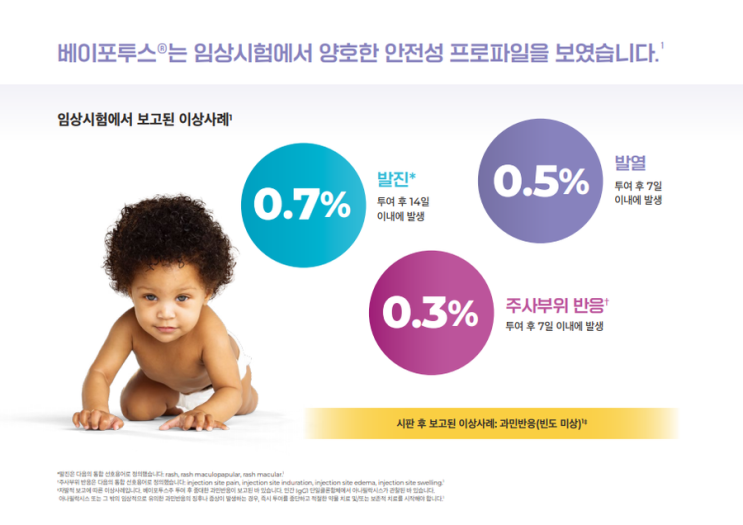
What parents worry about most is probably ‘side effects after the shot’. Beyfortus is a passive immunization that gives finished antibodies, so fever like the kind seen after regular vaccines is very rare, and large clinical trials and the Korean MFDS approval data both showed a good, stable safety profile.
-
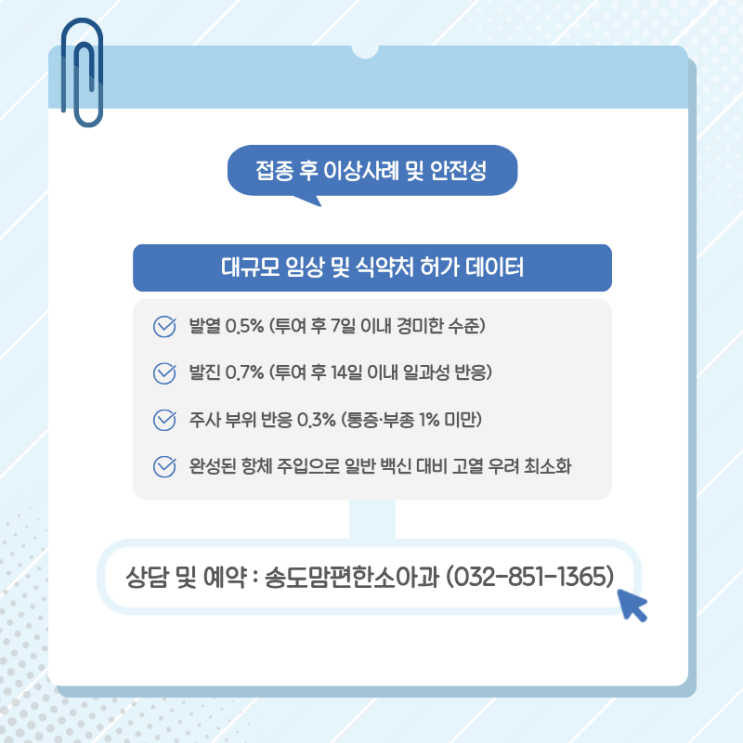
Fever: 0.5% (within 7 days after the dose)
-
Rash: 0.7% (within 14 days after the dose)
-
Injection site reactions (pain, swelling): 0.3% (within 7 days after the dose)
💉 Main adverse events after Beyfortus (under 1%)
|
Adverse event |
Observation period |
Rate |
Notes |
|
Fever |
Within 7 days after the dose |
0.5% |
Mostly mild and passes quickly |
|
Rash |
Within 14 days after the dose |
0.7% |
Low frequency, fewer than 1 in 100 |
|
Injection site reaction |
Within 7 days after the dose |
0.3% |
Brief pain and swelling that go away on their own |
Most reported reactions were mild and short-lived, seen in fewer than 1 in 100 babies (under 1%), and no new safety concerns were found in large real-world use either.
SONGDO ANSHIN vaccination and clinic information
From newborns and infants facing their first RSV season to high-risk children (24 months and under) who need to prepare for a second season, if you would like advice on RSV prevention for your child, please contact the clinic anytime. We will explain everything kindly and in detail.
-
Main building & Safe Care Center : Pediatric care, well-child checkups, vaccinations
-
Annex : Precocious puberty and growth clinic / Obesity clinic for adults and teens / IV room
-
📞 Phone : 032-851-1365
-
📍 Location : 2F, Landmark City Central The Sharp shopping arcade, 68, Landmark-ro, Yeonsu-gu, Incheon
