
Tirzepatide (Mounjaro) and Diabetes Prevention! An Analysis of the Latest 3-Year NEJM Follow-up Research

Among the medications drawing the most attention in obesity and diabetes treatment today, Mounjaro (generic name: tirzepatide) clearly stands out.
Developed as a dual agonist that activates not only GLP-1 but also the GIP hormone at the same time, it goes beyond simply reducing weight, demonstrating a dramatic improvement in HbA1c and even the potential to prevent diabetes.
Today, SONGDO ANSHIN Obesity Clinic uses large-scale data from the NEJM (New England Journal of Medicine), which followed thousands of people for several years, to provide an in-depth analysis of the real effects of Mounjaro (tirzepatide) in treating and preventing diabetes.
(※ This post is part of a two-part paper review series: Part 1 (diabetes treatment and prevention). The following Part 2 covers changes after stopping the medication and side effects.)
|
💡[Key Summary] NEJM findings at a glance • Treatment effect: In a study that followed about 13,000 people with diabetes and cardiovascular disease for roughly 4 years, Mounjaro lowered HbA1c nearly twice as much as an existing GLP-1 injection (−1.66%p vs −0.88%p). Its cardiovascular protection was comparable to that of the existing injection. • Prevention effect: When adults with obesity and prediabetes received the medication for 3 years, only about 1 in 100 (1.3%) progressed to diabetes. Among those who received placebo (a dummy drug), 13 in 100 (13.3%) did. • Metabolic improvement: About half of the prevention effect came from weight loss, and the other half came from improvement in glucose metabolism itself. |
Why does this topic matter?

HbA1c (glycated hemoglobin) reflects your average blood sugar over the past 2~3 months. Generally, below 5.7% is considered normal, 5.7~6.4% is ‘prediabetes,’ and 6.5% or higher is diabetes.
Prediabetes is not yet diabetes, but it is a ‘warning light’ stage in which many people go on to develop diabetes if nothing is done. Once diabetes develops, it requires lifelong management, so stopping it at this stage is more important than anything.
Tirzepatide is a once-weekly injection that mimics the action of two hormones released from the gut after meals (GIP and GLP-1). It helps insulin secretion when blood sugar rises and reduces appetite to support weight loss. In Korea, it is approved for uses including blood sugar control in adults with type 2 diabetes and weight management in adults with obesity.
Which studies did we review?
Of 3 recent large-scale studies published in world-renowned medical journals (NEJM and the JAMA family), we first examine the studies on Mounjaro’s effects on diabetes treatment and prevention: 2 large-scale NEJM clinical studies. (All three studies are randomized controlled trials (RCTs), the most reliable design, in which participants are randomly assigned to groups for comparison.)
|
Category |
Study (Journal) |
Participants |
Compared with |
Duration |
|
Treatment |
SURPASS-CVOT (NEJM 2025) |
With cardiovascular disease: 13,165 adults with type 2 diabetes |
Dulaglutide 1.5mg (existing GLP-1 injection) |
Median approx. 4 years |
|
Prevention |
SURMOUNT-1 3-year (NEJM 2025) |
Adults with obesity + prediabetes 1,032 people |
Placebo (dummy drug) |
176 weeks of treatment + 17 weeks off-treatment observation |
(※ The doses used in the three studies, 5~15mg, are all currently available in Korea.)
Result 1. Diabetes treatment – lower blood sugar, with heart protection maintained

▶️ SURPASS-CVOT (NEJM 2025)
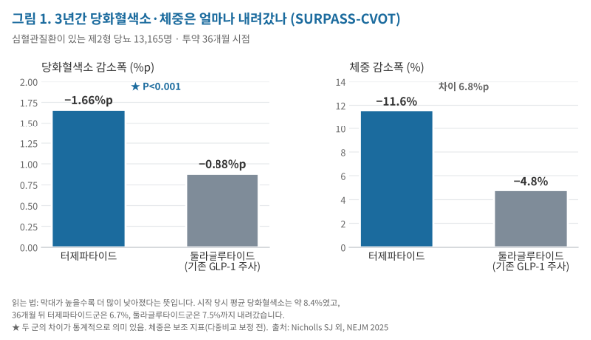
This study divided about 13,000 people with diabetes who already had cardiovascular disease, such as a heart attack or stroke, into two groups.
One group received tirzepatide (up to 15mg), and the other received an existing GLP-1 injection with already-proven cardiovascular benefits (dulaglutide 1.5mg).
These were patients whose diabetes was not easy to manage, with an average diabetes duration of about 15 years and an average starting HbA1c of 8.4%.
|
Measure (36 months or entire period) |
Tirzepatide |
Dulaglutide |
Meaning |
|
Change in HbA1c |
−1.66%p (→ 6.7%) |
−0.88%p (→ 7.5%) |
Nearly 2× greater reduction |
|
Change in body weight |
−11.6% |
−4.8% |
Difference of 6.8%p |
|
Cardiovascular events (cardiovascular death, heart attack, stroke) |
12.2% |
13.1% |
Non-inferiority demonstrated (HR 0.92) |
|
All-cause death |
8.6% |
10.2% |
16% lower (HR 0.84, secondary analysis) |
|
Decline in kidney function (high risk of chronic kidney disease, eGFR) |
−5.72 |
−8.90 |
Slower decline in kidney function |
※ Table 1. Key results of SURPASS-CVOT. An HR (hazard ratio) below 1 means lower risk. eGFR unit: mL/min/1.73m²
|
💡Key Points • The existing injection is also an effective drug, but tirzepatide lowered HbA1c nearly twice as much over 3 years. The average of 6.7% falls within the usual diabetes management target (below 7%). • Its heart and blood vessel protection was confirmed as ‘comparable to or better than a proven existing injection.’ However, it was not statistically proven to be ‘superior.’ • Positive signals were also seen for death and kidney measures, but because these were secondary analyses, further confirmation is needed. |
Result 2. Diabetes prevention – 99 out of 100 people avoided diabetes over 3 years

▶️ SURMOUNT-1 3-year study (NEJM 2025)
1,032 adults with obesity and prediabetes received tirzepatide (5·10·15mg) or placebo for 3 years (176 weeks). All participants also followed dietary control and exercise. After the 3 years of treatment ended, everyone stopped the medication and was observed for 17 more weeks.
|
Measure |
Tirzepatide |
Placebo |
Meaning |
|
Change in body weight (176 weeks) |
−12.3% (5mg) / −18.7% (10mg) / −19.7% (15mg) |
−1.3% |
Greater weight loss with higher doses |
|
Progression to diabetes (176 weeks, on treatment) |
1.3% |
13.3% |
Risk reduced by about 93% (HR 0.07) |
|
Progression to diabetes (193 weeks, 17 weeks after stopping) |
2.4% |
13.7% |
Risk reduced by about 88% (HR 0.12) |
|
Return to normal blood sugar (on treatment) |
Up to 94.5% |
60.4% |
Most returned to normal blood sugar |
Table 2. Key results of SURMOUNT-1 at 3 years. Return-to-normal rates are the highest values by dose
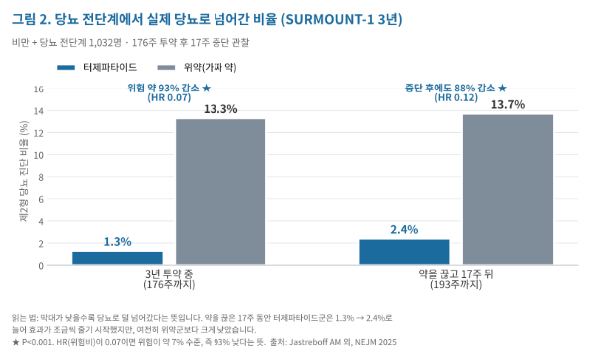
What deserves attention is what happened after stopping the medication. Even within the short period of 17 weeks, weight began to rise again (by about 7% on average), and the proportion diagnosed with diabetes increased from 1.3% to 2.4%. Of those who had returned to normal blood sugar, 15.5% went back to prediabetes. The researchers interpreted this as suggesting that long-term treatment is likely needed to maintain the benefits.
There is another interesting point. In an additional analysis, about half of the diabetes prevention effect was related to weight loss, while the other half was independent of weight. This suggests the drug works both through weight loss and by improving glucose metabolism itself.
|
💡Key Points • 98.7% (752 of 762) of those who received tirzepatide for 3 years remained free of diabetes. • Even after stopping the medication, the effect did not disappear immediately, but a reversal began within 17 weeks. |
SONGDO ANSHIN Obesity Clinic Care Information

Diabetes and prediabetes should be managed with long-term metabolic health as the goal, rather than through short-term fixes.
If you have any questions about Mounjaro (tirzepatide) treatment or managing metabolic conditions, please feel free to visit us anytime for a consultation with a specialist.
-
📞 Inquiries: 032-851-1365
-
📍 Obesity Clinic location: 2F, Units 204 & 205, Building 201 shopping mall, Landmark City Central The Sharp, 68 Landmark-ro, Yeonsu-gu, Incheon
🔗 Recommended SONGDO ANSHIN paper reviews to read together
If you’d like to learn how GLP-1 obesity and diabetes medications (Mounjaro, Wegovy) may go beyond weight loss and blood sugar control, see the latest large-scale findings that they may even lower the risk of cancer progression and metastasis in the post below!
👇 [Paper Review] Diabetes/Obesity drugs Wegovy & Mounjaro (GLP-1): Can they slow cancer progression and metastasis too?

📚 References
1. Nicholls SJ, Pavo I, Bhatt DL, et al.; SURPASS-CVOT Investigators. Cardiovascular Outcomes with Tirzepatide versus Dulaglutide in Type 2 Diabetes. N Engl J Med. 2025;393:2409-2420.
2. Jastreboff AM, le Roux CW, Stefanski A, et al.; SURMOUNT-1 Investigators. Tirzepatide for Obesity Treatment and Diabetes Prevention. N Engl J Med. 2025;392(10):958-971.
3. Horn DB, Linetzky B, Davies MJ, et al. Cardiometabolic Parameter Change by Weight Regain on Tirzepatide Withdrawal in Adults With Obesity: A Post Hoc Analysis of the SURMOUNT-4 Trial. JAMA Intern Med. 2026;186(2):157-167. doi:10.1001/jamainternmed.2025.6112
(Reference) Aronne LJ, Sattar N, Horn DB, et al. Continued Treatment With Tirzepatide for Maintenance of Weight Reduction in Adults With Obesity: The SURMOUNT-4 Randomized Clinical Trial. JAMA. 2024;331(1):38-48.
SONGDO ANSHIN
※ This article explains academic papers in plain language for the general public and does not replace medical advice.
