
No Runny Nose or Cough but a 40°C Fever? Can You Still Get Influenza After the Flu Shot? (Influenza A Symptoms & Tamiflu vs Peramiflu IV Treatment)

As we move into the September change of seasons, with cool breezes morning and evening, we have seen a sharp rise in patients and parents coming in bewildered by a sudden very high fever of 39~40°C without any of the typical cold symptoms such as a runny nose or cough.
Can it really be influenza with no cough or runny nose?
Influenza vaccination only started yesterday, so is influenza A going around already?
Judging by what we see in our exam rooms, influenza A has moved beyond a pre-epidemic holding pattern and is occurring steadily, mainly among children and adolescents whose immunity has dropped because of the wide day-to-night temperature swings of the changing season.
In particular, following a change in the Korea Disease Control and Prevention Agency guidelines, free influenza vaccination for children aged 6 months to 14 years (all those eligible for either 1 or 2 doses) and for pregnant women began in full as of yesterday (September 21).
With the influenza vaccination season underway, many people are coming in with a sudden high fever, so particular care is needed.
Today we will lay out clearly everything from the characteristics of influenza A symptoms that begin without a runny nose or cough, to how to cope at home when a 40°C fever strikes, to Tamiflu vs Peramiflu IV treatment.
|
📌 [3 Key Points About Influenza A]
|
“I thought it was just a cold?” The trap of influenza A symptoms that start without a runny nose

When we hear the word influenza we usually picture respiratory symptoms such as a sore throat, cough and runny nose, but the influenza A going around recently looks different in its early stage.
1️⃣ An isolated high fever at the start: A high fever of 38.5℃~40℃ or above shoots up suddenly, with no warning signs such as a runny nose or cough.
2️⃣ Respiratory symptoms that appear later: Cough, runny nose and sore throat come on only 24~48 hours after the fever begins.
3️⃣ Gastrointestinal and systemic symptoms: Young children may show vomiting, abdominal pain, poor appetite and marked lethargy instead of the whole-body aches adults describe.
Take care not to assume it is simply seasonal body aches because there is no runny nose. Leaving it alone can mean missing the golden time for treatment.
Tamiflu (oral medicine) vs Peramiflu (IV): a complete comparison

What parents agonize over most after an influenza diagnosis is exactly this choice of treatment. It is important to select the best option for the child’s age, symptoms and ability to take medicine by mouth.
|
Category |
Oral medicine (Tamiflu, etc.) |
Injection (Peramiflu IV) |
|
How it is given |
Taken by mouth twice a day for 5 days |
A single intravenous infusion (about 15~30 minutes) |
|
Advantages |
Less of a burden, as no IV needle is inserted |
Treatment is complete after just one dose, and the fever comes down quickly |
|
Disadvantages |
The bitter taste may cause refusal; a repeat dose is needed if the child vomits |
Pain from the needle, and a relatively higher cost |
|
Recommended for |
Children who take medicine well and can swallow it calmly |
Children who spit medicine out because of frequent vomiting, or who need the fever brought down quickly |
💡 Specialist tip
Oral Tamiflu must be taken for the full 5 days even after the fever comes down, in order to prevent viral resistance. Peramiflu, by contrast, completes treatment with a single injection, making it a good alternative for families who fight a battle every time they give medicine, or for those who need to recover quickly.
What to do when a ’40°C fever’ hits in the middle of the night
It is easy to panic when the thermometer reads 40°C. Here are the essential rules for coping safely at home with a high fever.
1️⃣ Correct antipyretic doses and alternating them
Give acetaminophen-type and ibuprofen/dexibuprofen-type medicines as distinct categories. If the fever has not come down 2 hours after a single-ingredient antipyretic, you may consider alternating with the other category. (Always stay within the total permitted dose per 24 hours)
2️⃣ Cautions when sponging with lukewarm water
Remove some clothing and gently wipe the chest and abdomen with a towel soaked in lukewarm water of about 29~30°C.
(※ Caution: if the child feels chills, with cold and shaking hands and feet, stop the sponging at once, keep the child warm, and wait until the fever has fully risen before continuing.)
3️⃣ Fluids to prevent dehydration
A high fever causes large losses of body water. Give lukewarm water or an electrolyte drink in small amounts, frequently.
⚠️ Come in for emergency care without delay if you see these symptoms!

If any of the following accompany the fever, do not watch and wait at home. Seek pediatric care immediately.
-
When a fever of 39~40°C lasts more than 24 hours despite an antipyretic
-
When the child cannot make eye contact, is severely lethargic, or is clouded in consciousness
-
When a febrile seizure occurs (the eyes roll back or the limbs stiffen)
-
When the child cannot take any drink or food at all and urine output drops sharply (no urine for more than 6 hours)
❓ Frequently asked questions (Q&A)
Q. When is a rapid influenza antigen test most accurate?
A. The virus detection rate is high from 6~12 hours after the fever begins. However, if the temperature shoots up sharply to 39~40°C at the outset or systemic symptoms are clear, the test can be done immediately after an examination by a specialist, even before 6 hours, so that an accurate diagnosis can be reached.
Q. Can you still catch influenza after being vaccinated?
A. Yes. Even after vaccination, infection is possible if the virus subtype actually circulating differs from the strain in the vaccine you received. That said, in people who were vaccinated, the proportion who go on to a fever above 40°C or to severe complications is greatly reduced.
💡[Related reading]
“The flu shot you were planning on this year may not be available?”
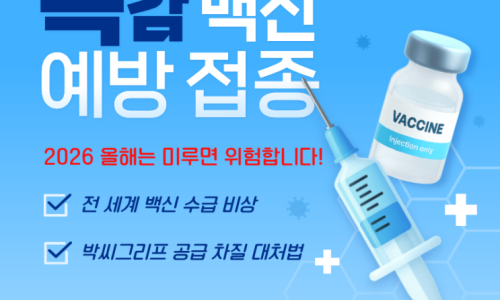
This year’s influenza vaccines face concerns about a global supply disruption, because the WHO strains were completely replaced. Rather than waiting for a particular imported vaccine (such as Vaxigrip), what matters most is getting vaccinated on time, whenever vaccination is available to you. If you are curious about this year’s influenza vaccine supply situation and vaccination tips, please see the post below as well.
👉 2026 Influenza Shot Alert! A Vaccine Supply Shortage? Don’t Put Off This Year’s Influenza Vaccination!
A sudden high fever! Come in for a rapid test & individualized care

SONGDO ANSHIN main building injection room / test room
With a sudden high fever, quickly identifying the cause and treating it early is the key.
In particular, free influenza vaccination for children and pregnant women began yesterday (September 21), so we recommend using Ansim Center advance booking or Ddocdoc same-day registration to be vaccinated at the right time and be ready for the coming winter influenza season.
At SONGDO ANSHIN, we are always ready, with rapid influenza testing and individualized care, to help your child find quick relief from a high fever. If you have any questions about an abnormal temperature or your child’s health, please feel free to visit us at any time.
