
Does baby fat all turn into height? The real effect of obesity on growth | The correlation between obesity and growth hormone

Hello? This is SONGDO ANSHIN speaking.
When we counsel families in the exam room, “Baby fat all turns into height later, so it’s fine”is something we often hear. It comes from a wish for the child to eat well and grow up healthy, so it’s a sentiment we fully understand.
But when we look deeper from a medical standpoint, this saying needs to be applied to today’s children with a bit of caution. That is because in our era of abundant nutrition, ironically, excessive weight can become a factor that hinders a child’s growth.
Today, drawing on key domestic and international medical papers, we take up the question ‘Does fat really turn into height?’ and give it a scientific answer. In particular, we’ll look at how a higher body mass index (BMI) suppresses growth hormone secretion, explaining the evidence step by step.
📖 Fat does not turn into height.
[A summary of medical papers on the effect of obesity on adolescent growth hormone]
|
“I’m worried because my child has gained too much weight, and I’m even more worried that their height won’t grow along with it.” |
This is something we hear very often in the exam room. To give the conclusion first, it is a fact that severe obesity in adolescence reduces growth hormone secretion. And the fact that the more weight gained (the higher the BMI), the more it decreases, has been proven by several studies. Let me organize what parents may be curious about in an easy way.
To put the conclusion first: obese adolescents secrete less growth hormone

The key conclusions in this field of research are the following three.
• With obesity, less growth hormone is released even at rest, and even when stimulated it doesn’t rise well.
• The more weight gained, the more severely it decreases. In other words, the degree of obesity and the degree of growth hormone suppression are proportional (a dose-response, dose-dependent relationship).
• Fortunately, when weight returns to normal, growth hormone secretion also recovers.
👉 This is a very well-established fact in the medical community, consistently confirmed for nearly 30 years from the 1990s to now.
🔗 [Worth reading together]
“Then does my chubby child need a precocious puberty test?”
Obesity not only reduces hormone secretion,
but can also advance puberty and cause the growth plates to close early.
In a previous post,
the correlation between obesity and precocious puberty, and the insurance criteria for the GnRH test,
we organized in detail, so be sure to check it out!

The more weight gained, the more growth hormone decreases: a decisive study
The most striking study is a paper published in 2009 by a research team at the University of California (Galassetti et al.).
This study divided 48 obese pubertal adolescents into three groups according to the degree of obesity and compared them with 42 normal-weight adolescents. All of them did cycling exercise, and growth hormone levels were measured from the blood right after exercise.
The result was clear. As obesity became more severe, the growth hormone response consistently decreased. In simple terms, this means that the more severe the obesity, the less growth hormone was released, step by step.
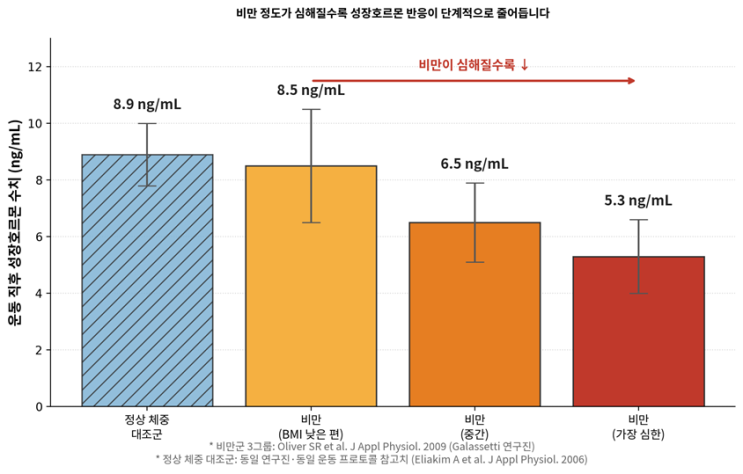
[Figure] Changes in growth hormone levels right after exercise according to the degree of obesity
It’s also important that the same pattern was seen whether the children were in early or late puberty. In other words, no matter which stage of puberty they were in, the formula “severe obesity = decreased growth hormone” applies all the same.
Why does obesity suppress growth hormone?

Several reasons act together. Organized in an easy way, it’s like this.
1️⃣ When there is too much fat in the blood
When fat cells increase, the fat components floating in the blood rise. These fat components send signals to the hormone-regulating center in the brain, causing it to make less growth hormone.
2️⃣ When insulin is chronically high
With obesity, insulin, which regulates blood sugar, is released far more than usual. When chronically high insulin persists, the pituitary gland does not secrete growth hormone well.
3️⃣ Changes in the appetite hormone (ghrelin)
Ghrelin, known as the “hunger hormone,” actually also plays a role in stimulating growth hormone secretion. But in people with obesity, ghrelin is released in smaller amounts than normal. As a result, the stimulation of growth hormone also weakens.
4️⃣ When the brain’s signal balance is broken
In the brain’s hormone-regulating center, the “secretion-triggering signal” and the “blocking signal” for growth hormone work in balance. In an obese state, the blocking signal becomes stronger and the response to the secretion signal becomes dulled.
👉 All of these processes combine, and as a result a state in which less growth hormone is released is created.
“But my child is overweight and yet grows tall well?”

This is the point that confuses parents the most. Even in the exam room, we often hear “They say obesity prevents height growth, but my child is actually on the taller side compared to peers.”
In fact, obese children often grow taller faster than their peers before puberty. A review published in an international journal in 2025 also clearly organizes this point.
The reason is this. Growth hormone itself decreases, but the actual “height-building substance (IGF-1)” that the growth hormone produces in the liver remains normal or even elevated. This is because insulin stimulates the liver to produce more IGF-1. Also, a substance called leptin released from fat cells acts directly on the growth plates, helping height to grow.
But the problem occurs in puberty. Obese children have a strong tendency to start puberty early. In particular, the risk of precocious puberty is higher in girls. When puberty comes early, at first it may look like height is growing fast, but at the same time bone age advances quickly, and the growth plates close early. As a result, the final spurt of height growth in late puberty shrinks, and the final adult height often ends up smaller than expected.
💡 One-line summary: Obese children may appear to grow tall well when young, but as they go through puberty their peers catch up, and in the end it is not uncommon for them to finish at an average or below-average height.
The good news: it is a reversible change

The decrease in growth hormone caused by obesity is not permanent damage. Already in 1995, the Danish Rasmussen research team reported that after substantial weight loss, the 24-hour pattern of growth hormone secretion recovers to normal, and blood IGF-1 levels also normalize. The same result has since been confirmed in several follow-up studies.
This is a truly important message for parents. Having obesity now does not mean your child’s growth hormone is permanently broken. Appropriate weight management and lifestyle improvement alone can revive a child’s growth potential.
In closing: managing obesity is managing growth

If we organize what we’ve shared today at a glance, it’s like this.
• Adolescent obesity, especially super-severe obesity, clearly suppresses growth hormone secretion.
• The more weight gained, the more severe the degree (a dose-response relationship).
• At a young age it may actually look like height grows well, but because puberty comes early and the growth plates close early, the final adult height ends up at a loss.
• Fortunately, reducing weight also restores growth hormone secretion.
Advice from SONGDO ANSHIN

Obesity is not simply a matter of body shape; it is a factor that determines the golden time of a child’s growth plates. Rather than the vague hope that “it will turn into height later,” it is important to accurately check your child’s current BMI status and establish proper lifestyle habits now.
Our SONGDO ANSHIN carefully looks after weight management, growth plate testing, and even hormone balance for children’s healthy growth. If you are concerned about your child’s growth, we recommend coming in anytime to consult with our specialist medical staff.
For your child’s precious height growth, SONGDO ANSHIN will be with you!
📖 References
Galassetti P, et al. Dose-dependent relationship between severity of pediatric obesity and blunting of the growth hormone response to exercise. J Appl Physiol. 2009;108(1):128-136.
Scacchi M, Pincelli AI, Cavagnini F. Growth hormone in obesity. Int J Obes Relat Metab Disord. 1999;23(3):260-271.
Reinehr T, et al. The Effect of Childhood Obesity on Growth: Interpretation of Growth Hormone Provocation Tests. Horm Res Paediatr. 2025.
Hawkes CP, Grimberg A. Impact of body mass index on growth hormone stimulation tests in children and adolescents: a systematic review and meta-analysis. Crit Rev Clin Lab Sci. 2021;58(8):608-624.
Lee J, et al. Influence of body mass index on the growth hormone response to provocative testing in short children without growth hormone deficiency. J Korean Med Sci. 2013;28(9):1351-1355.
Rasmussen MH, et al. Massive weight loss restores 24-hour growth hormone release profiles and serum insulin-like growth factor-I levels in obese subjects. J Clin Endocrinol Metab. 1995;80(4):1407-1415.