Wegovy, Mounjaro and GLP-1 Obesity Drugs: Beyond Simple Weight Loss to ‘Cancer Prevention and Metastasis Suppression’?

Hello? This is the SONGDO ANSHIN Obesity Clinic.
Today we would like to share some very interesting news about GLP-1 class obesity treatment drugs.
You are probably already well aware that drugs like Wegovy and Mounjaro are enjoying explosive popularity worldwide. Recently, at ASCO 2026 (the Annual Meeting of the American Society of Clinical Oncology), the world’s largest cancer conference held in the United States, research findings were announced one after another suggesting that these drugs may play a major role not just as ‘weight-loss drugs’ but in ‘cancer prevention and progression suppression’ as well, drawing great attention.
What exactly were the research findings? From here, we summarize the key content for you.
Beyond weight-loss drugs, now even ‘cancer’?
GLP-1 obesity drugs and the new possibilities shown in the anticancer field
A review of papers presented at the 2026 American Society of Clinical Oncology (ASCO)
|
Today’s key points Well known as Wegovy and Mounjaro, GLP-1 class drugs this is showing notable signals now in cancer too, following weight loss and cardiovascular and kidney protection, the cancer field are showing notable signals here as well. According to two studies presented at ASCO 2026, GLP-1 users had an approximately 30% lower risk of developing breast cancer, and in patients who already had cancer, the risk of metastasis (progression to stage 4) was up to half as low. However, both studies were ‘observational studies,’ so they have not confirmed that GLP-1 is a direct ’cause’ — even so, these are results well worth having expectations for. |
Why would a ‘weight-loss drug’ be linked to cancer?

Obesity itself is known to raise the risk of at least 13 types of cancer. As body fat increases, insulin and blood sugar in the body rise and a chronic inflammatory state continues — and this environment becomes fertile soil for cancer cells to grow.
GLP-1 drugs (glucagon-like peptide-1 receptor agonists)were originally diabetes and obesity treatments, but beyond reducing weight and stabilizing blood sugar, they also have powerful anti-inflammatory and immunomodulatory actions. This is precisely why researchers have expected that ‘GLP-1 might be able to affect cancer too.’
If the GLP-1 story so far has expanded from ‘weight → cardiovascular → kidney,’ then ASCO 2026 presented ‘cancer’ as the next chapter. Below, we will take a careful look at the two key studies.
How was it discovered? (Research methods at a glance)

Both studies analyzed actual medical records (real-world data) on a large scale. Rather than experiments deliberately administering a new drug, they compared people who had already used GLP-1 with those who had not, observing the differences in outcomes.
|
Category |
① Breast cancer incidence study |
② Cancer metastasis study |
|
Presentation |
McDonald et al. (University of Pennsylvania) |
Orland et al. (Cleveland Clinic) |
|
Subjects |
111,646 overweight/obese women aged 45–80 |
12,112 stage 1–3 cancer patients (worldwide) |
|
Comparison |
GLP-1 use vs. non-use |
GLP-1 vs. DPP-4 inhibitors |
|
What was examined |
Rate of newly diagnosed breast cancer |
Rate of cancer progressing to stage 4 (metastasis) |
Result ① Women using GLP-1 had less breast cancer.
The University of Pennsylvania research team analyzed the records of about 110,000 overweight/obese women who had undergone breast imaging exams (mammography/MRI). In a comparison with conditions matched to be similar (matched analysis), the breast cancer risk in the GLP-1 use group was about 30% lower than in the non-use group (odds ratio 0.70, p<0.0001 — meaning a result unlikely to be due to chance).
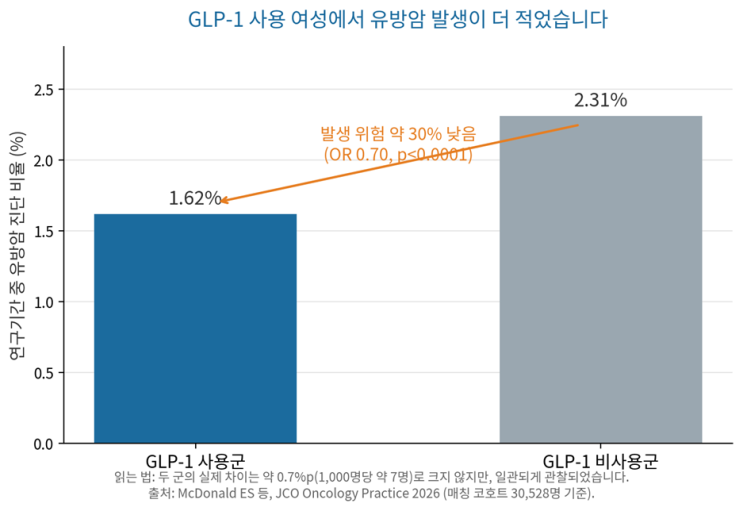
[Figure 1] Breast cancer incidence rate in the GLP-1 use group vs. non-use group (matched cohort of 30,528)
|
Key points • In relative terms the risk dropped by about 30%, but the actual difference in numbers is only about 7 per 1,000 people, which is not large. • Still, what matters is that it appeared consistently in a large scale of 110,000 people — the research team is preparing a full-scale clinical trial to verify this. • Existing methods of reducing breast cancer (preventive surgery, tamoxifen, etc.) carry a heavy burden, but GLP-1 has great potential value in that countless people are already using it. |
Result ② Even if cancer is already present, if metastasis can be delayed

The Cleveland Clinic research team went a step further and patients who already had cancer (stage 1–3)examined whether GLP-1 could prevent cancer metastasis (progression to the most dangerous stage 4) in these patients. The comparison group was the DPP-4 inhibitors (a.k.a. gliptins), in the same class of diabetes drugs.
Of the 7 cancer types, 4 types (lung, breast, colorectal, and liver cancer) showed that, compared with the comparison group, the GLP-1 use group’s risk of stage 4 progression was about 38–50% lower. In particular, for breast cancer the metastasis rate was cut in half (20%→10%).
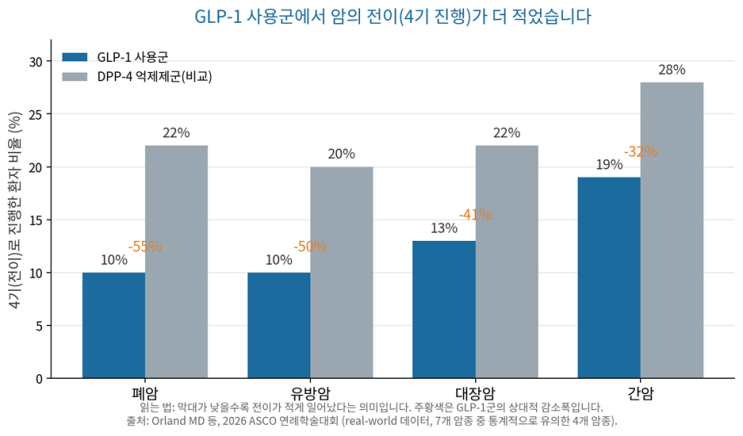
[Figure 2] Stage 4 (metastasis) progression rate by cancer type — GLP-1 vs. DPP-4 inhibitors
|
Key points • In the 4 types (lung, breast, colorectal, and liver), the risk of metastasis was clearly lower. However, the differences for prostate, pancreatic, and kidney cancer were not statistically significant. • In a separate analysis, patients with more GLP-1 receptors on their cancer cells had a 33% lower risk of death (45% for breast cancer), adding a clue that GLP-1 signaling itself may suppress cancer. • The researchers called it ‘a meaningful result that appeared consistently across the four tumors’ and plan to pursue a full-scale clinical trial. |
Summary at a glance
The ‘cancer protection signals’ observed in the two studies, summarized on a single page, are as follows.
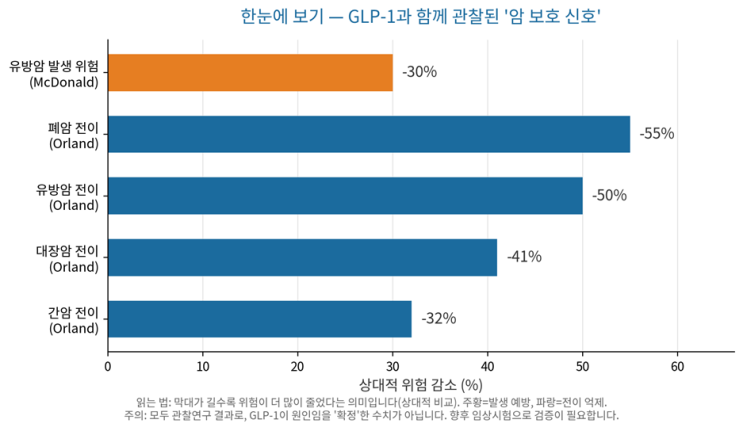
[Figure 3] Risk reduction observed alongside GLP-1 (relative comparison)
|
Item |
GLP-1 group result |
Source |
|
New breast cancer occurrence |
Risk about 30% ↓ |
McDonald 2026 |
|
Lung cancer metastasis (stage 4 progression) |
10% vs 22% |
Orland 2026 |
|
Breast cancer metastasis |
10% vs 20% |
Orland 2026 |
|
Colorectal cancer metastasis |
13% vs 22% |
Orland 2026 |
|
Liver cancer metastasis |
19% vs 28% |
Orland 2026 |
|
Death risk when GLP-1 receptors are high |
33% ↓ (breast cancer 45% ↓) |
Orland 2026 |
What about side effects?
In the metastasis study, the occurrence of side effects in the GLP-1 group and the comparison group was generally similar. In particular, stomach inflammation and pancreatic inflammation, which are often mentioned in connection with GLP-1, did not appear more frequently than in the comparison group. In other words, these results did not confirm any circumstances of taking on a particularly greater risk for the sake of the anticancer signal.
That said, GLP-1 commonly causes gastrointestinal symptoms such as nausea, vomiting, and diarrhea, and suitability differs from person to person. With any drug, whether it suits your own condition must always be discussed with a specialist.
Significance and limitations — high expectations, accurate interpretation
These two studies are a powerful signal showing that GLP-1, beyond being a ‘weight-loss drug,’ can expand into a new field of cancer prevention and cancer progression suppression. It is certainly encouraging that the same direction appeared consistently in real-world data on a scale of hundreds of thousands of people.
|
Points to remember Both studies are ‘observational studies.’ Other factors may be mixed in, such as the possibility that the people who used GLP-1 originally took better care of their health, so we cannot conclude that GLP-1 is the ’cause’ of reduced cancer. The current figures are not ‘confirmed efficacy’ but ‘a promising hypothesis worth verifying.’ A randomized controlled trial to confirm this is scheduled to be conducted, and only when those results come out can we speak of a ‘preventive effect.’ |
Songdo Obesity Clinic closing remarks

Just a few years ago GLP-1 was a ‘diabetes drug,’ soon became an ‘obesity drug,’ and is now evolving into a drug that protects the heart and kidneys, and perhaps a drug that protects us from cancer. Cases where a single drug has shown such broad possibilities are rare.
Of course, this is still only the starting point. But the direction that obesity and metabolic management can go beyond mere numbers on the scale to become ‘an active health investment that lowers cancer risk’ is certainly exciting. For the lifelong health of the whole family, from adults to adolescents for whom managing growth-stage obesity is important, we recommend carefully weighing, together with a specialist, whether GLP-1 is a suitable option for you.
|
Accurate consultation on weight, blood sugar, growth, and metabolic management is available through a consultation with a specialist at SONGDO ANSHIN. |
※ This article is a reconstruction of the 2026 ASCO presentations and publicly available materials for general readers, and does not replace medical advice.
Reference papers
1) McDonald ES, et al. GLP-1 Agonists Are Associated With a Significant Reduction in Breast Cancer Incidence in Women. JCO Oncology Practice. 2026 (2026 ASCO Annual Meeting, Abstract 10506).
2) Orland MD, et al. GLP-1 receptor agonists and metastatic progression of obesity-related cancers. 2026 ASCO Annual Meeting (Abstract 3143). Cleveland Clinic, Taussig Cancer Institute.
💡Articles worth reading together
Before this newly announced ASCO 2026 study on potential anticancer effects, here at SONGDO ANSHIN we had already covered in depth the metabolic-disease protective effects of GLP-1 class drugs.
In particular, if you are curious about the Cleveland Clinic’s previous study analyzing data from 22,000 cancer patients and our clinic’s clinical comments, please check the posting below. You will be able to understand more deeply how GLP-1 protects our body’s metabolic health.
👇[Diabetes and obesity drugs Wegovy and Mounjaro (GLP-1): Can they even delay cancer progression and metastasis?]