About the reports on Wegovy, Mounjaro and the risk of vision loss (FDA warning fact check)

Hello, this is SONGDO ANSHIN Obesity Clinic.
On the morning of November 10, 2026, Korean media reported that the US FDA had required a warning about the risk of vision loss (non-arteritic anterior ischemic optic neuropathy, NAION) to be added to the labels of GLP-1 medicines for obesity and diabetes, such as Wegovy and Mounjaro.
Patients currently being treated with Wegovy or Mounjaro may feel worried, so here are the accurate facts and clinical guidance our director has put together, shared as quickly as we could.
|
💡[Key points of the FDA announcement] ✔︎ The reports are true: On November 9, 2026, the FDA required a caution about a rare optic nerve disease (NAION) to be added to the labels of all GLP-1 medicines. ✔︎ It is very rare in practice: In the FDA’s analysis, the rate over one year was 6.4 per 100,000 people taking the medicine and 3.8 in the control group. That is about 1 extra case when roughly 40,000 people use it for a year. ✔︎ No need to stop on your own: The medicine has not been directly proven to be the cause, and underlying conditions such as diabetes and high blood pressure in middle-aged and older adults also play a large part. If you notice no change in your vision, there is no need to stop treatment on your own. |
Notice on reports about Wegovy, Mounjaro and vision
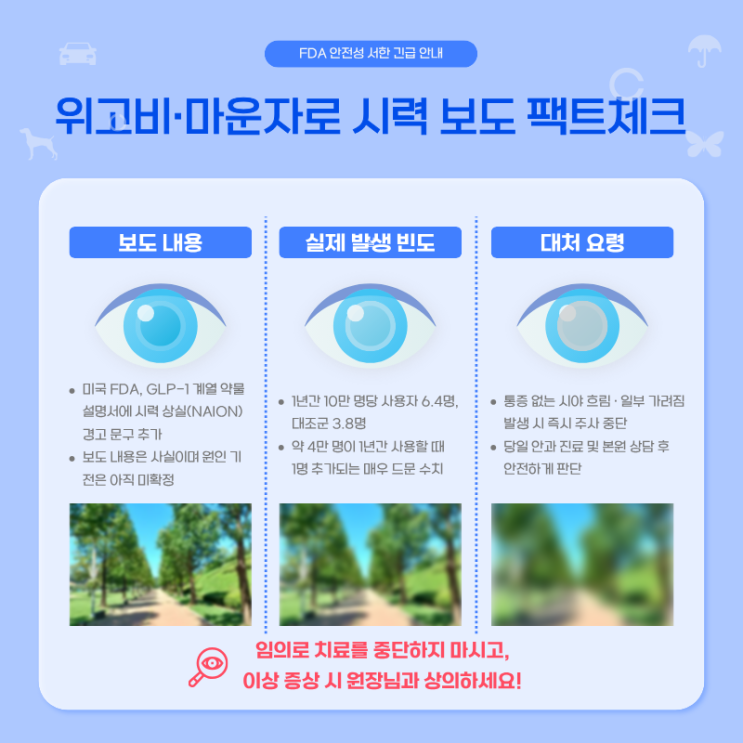
On November 9, 2026, the US FDA required the labels of all GLP-1 medicines, including Wegovy and Mounjaro, to mention a possible increased risk of ‘non-arteritic anterior ischemic optic neuropathy (NAION)’. The reports are accurate, and we have confirmed the same information.
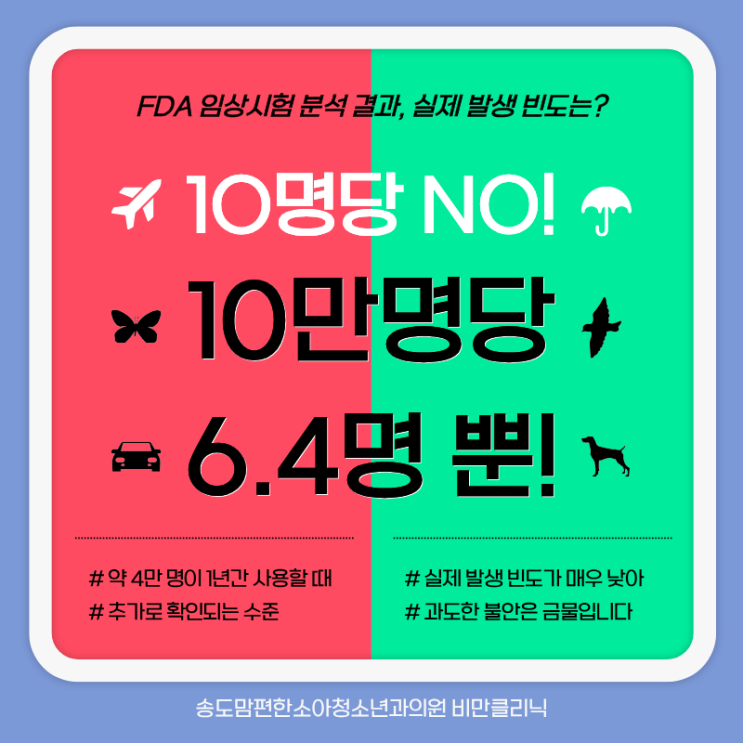
However, the articles left out how often it actually happens, so we would like to add that. The FDA analyzed 126 clinical trials covering about 134,000 people. Over one year, the condition was found in 6.4 per 100,000 people taking GLP-1 medicines and 3.8 per 100,000 in the comparison group. That is about 1 extra case when roughly 40,000 people use the medicine for a year. Only 15 cases were confirmed in total, so the exact level of risk has not yet been established.
The FDA’s conclusion is also that “there may be a rare increase in risk”, and it is not known how the medicine might cause this condition. Most of the evidence this time also comes from adults with type 2 diabetes. NAION mainly occurs in middle-aged and older adults with diabetes, high blood pressure or sleep apnea.
So there is no need to stop treatment based on this announcement alone. Instead, please remember the symptoms below.
-
If one eye suddenly becomes blurry without pain, or
-
part of your vision is blocked or looks dark,
do not take your next injection, and see an eye doctor the same day. Then contact our clinic, and the director will personally discuss the next steps of your treatment with you.
If you have ever been diagnosed with an optic nerve disease or NAION, please be sure to tell us at your visit. We will reassess whether to continue treatment.
When new safety information comes out, we will share it with you as it is, without hiding anything. If you have questions, feel free to ask at your visit. Thank you.
*Source: US FDA Drug Safety Communication (November 9, 2026)
📢 [Coming next] An in-depth review of studies on obesity injections and vision loss
“Wegovy and Mounjaro ‘vision loss warning’ reports, read again through the numbers”
We are preparing tomorrow’s post so that patients can check the facts more objectively, with the actual case numbers left out of the news and a comparison of 3 recent studies.
🔍 A preview of the key medical data in the next post:
1️⃣ The truth about the multiples: why the 4–7 times higher risk reported in an early study (Hathaway 2024) dropped sharply to about 1.2–1.4 times in later large multicenter studies (Cai 2025, Sentinel)
2️⃣ Comparing actual case counts: a graph of the actual NAION rate per 100,000 person-years in people with diabetes vs people with obesity in general
3️⃣ Pooled data from 126 FDA clinical trials (Vilsbøll 2026 and others): checking the number of confirmed cases in the GLP-1 group and the placebo group
Rather than stopping treatment in a hurry after seeing the news, we recommend checking the accurate figures from the medical studies in our next post.
SONGDO ANSHIN Obesity Clinic will always put patient safety first.
-
📞 Phone: 032-851-1365
-
📍 Location: 2F, 68, Landmark-ro, Yeonsu-gu, Incheon