
Wegovy and Mounjaro vision loss warning reports, read again through the numbers
NAION through the US FDA announcement and 3 studies
A fact check on the case rates missing from the vision loss reports!
Hello, this is SONGDO ANSHIN Obesity Clinic.
On November 10, 2026, reports came out that the US FDA had required a warning about the risk of sudden loss of vision and blindness (non-arteritic anterior ischemic optic neuropathy, NAION) to be added to the labels of GLP-1 medicines for obesity and diabetes, such as Wegovy and Mounjaro. Many of our patients on treatment were worried.
Following the fact check notice from our director right after the reports, today we look at the actual case numbers left out of the news and compare 3 recent studies to check “whether it is really 4–7 times more dangerous, as the media reported” and give you the facts in objective numbers.
|
💡[Key conclusions] ✔︎ The reports are true. On November 9, 2026, the US FDA required a caution about a rare optic nerve disease (NAION) to be added for all GLP-1 medicines, including Wegovy and Mounjaro. ✔︎ The rate is very low. In the FDA’s analysis of clinical trials, there were 6.4 cases per 100,000 people per year with GLP-1 medicines and 3.8 in the control group. ✔︎ ‘4–7 times’ is the result of a study at a single hospital. Later large studies found much lower figures, about 1.2–1.4 times. ✔︎ Whether the medicine directly causes it is not yet established. If one eye suddenly becomes blurry without pain, you need to see an eye doctor right away. |
What did the reports say?
👉 [Our director’s notice right after the FDA announcement]

On November 10, 2026, reports came out that the US Food and Drug Administration (FDA) had made a vision loss warning mandatory for obesity and diabetes medicines. For people using Wegovy or Mounjaro, this is worrying news.
The reports match the FDA announcement. However, they left out how often it happens, so we read the FDA original and 3 related studies to fill in the numbers.
The disease in question is NAION (non-arteritic anterior ischemic optic neuropathy). Blood flow to the optic nerve, which connects the eye and the brain, suddenly drops and damages the nerve, so it is sometimes called a “stroke of the eye”. It usually causes a sudden, painless loss of vision in one eye. It mainly occurs in people aged 50 and over who have diabetes, high blood pressure or sleep apnea. According to the FDA, the usual rate in people aged 50 and over is about 2–10 per 100,000 people per year.
The reports and the actual evidence, side by side
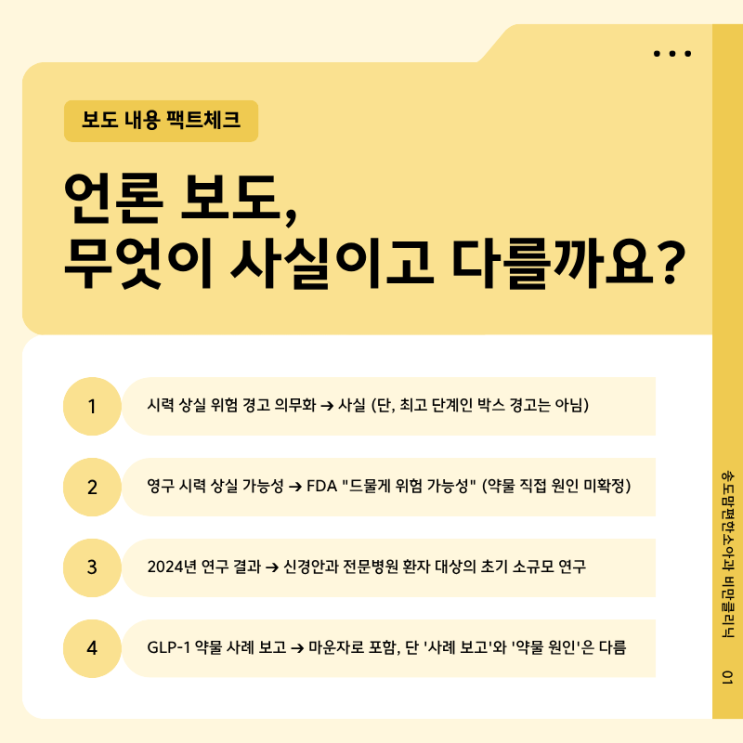
|
What the reports said |
What we found in the FDA original and studies |
|
Vision loss warning made mandatory |
True. However, it is being added to the “Warnings and Precautions” section of the label, not as a boxed warning, the strongest level. |
|
Raises the chance of a disease that causes permanent vision loss |
The FDA’s conclusion is that “there may be a rare increase in risk”. It has not been confirmed whether the medicine directly causes it or how it happens. |
|
A 2024 study found a high chance of the disease |
This study analyzed patients at a single neuro-ophthalmology hospital (4.28 times in patients with diabetes). The FDA also said the study has limitations, and later large studies showed much lower figures. |
|
Cases reported for all GLP-1 medicines |
True. This includes Mounjaro (tirzepatide). However, “cases were reported” and “the medicine is the cause” are two different things. |
|
(Not in the reports) Actual rate |
In an analysis of 126 clinical trials, it was 6.4 cases per 100,000 people per year with GLP-1 medicines and 3.8 in the control group. |
|
(Not in the reports) Whose data |
Most of the evidence is data from adults with type 2 diabetes. There is little direct data on people with obesity who do not have diabetes or on teenagers. |
Which studies did we look at?
We chose one study that first raised the issue, one that rechecked it on a large scale, and one that pooled only clinical trials. We then added the FDA’s own analysis released with this announcement as a reference.
|
Study |
Method |
Participants |
Notes |
|
Hathaway 2024 (JAMA Ophthalmology) |
Analysis looking back at one hospital’s medical records (retrospective cohort) |
710 with diabetes and 979 with obesity among 16,827 patients at a neuro-ophthalmology hospital |
First raised the issue |
|
Cai 2025 (JAMA Ophthalmology) |
Multicenter study combining 14 databases |
37.1 million with type 2 diabetes, 810,000 new semaglutide users |
Large-scale recheck |
|
Vilsbøll 2026 (Br J Ophthalmology) |
Pooled analysis of 112 clinical trials |
96,829 people (64,917 on GLP-1 medicines, 31,912 on placebo) |
Randomized data. Study funded by the manufacturer (Novo Nordisk) |
|
FDA 2026 (Safety communication) |
Pooled analysis of 126 clinical trials and analysis of real-world prescription data (Sentinel) |
134,253 people, plus adults with type 2 diabetes who started treatment in 2019–2024 |
Regulator’s own analysis |
The “how many times” figure varied widely between studies
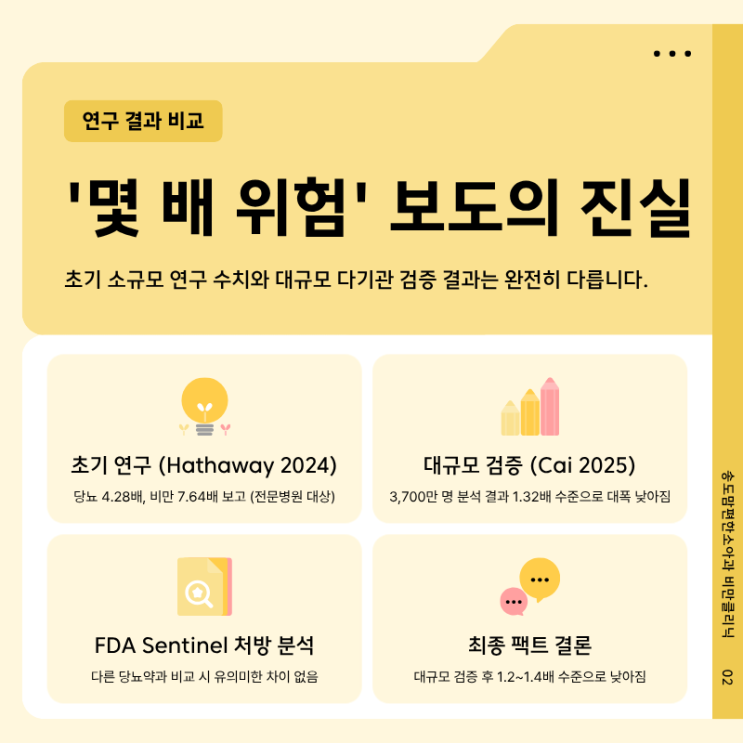
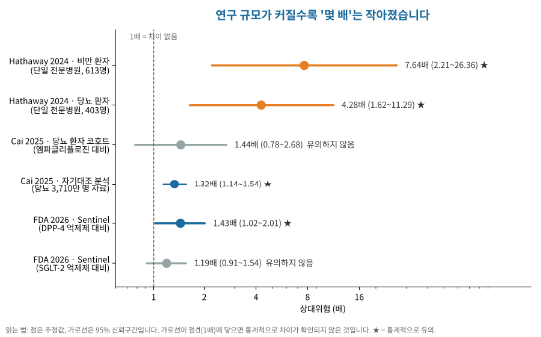
Figure 1. Relative risk by study (how many times more often it occurs in people taking the medicine than in those not taking it)
The 2024 Hathaway study reported a 4.28 times higher risk in patients with diabetes and 7.64 times in patients with obesity who were prescribed semaglutide. But the participants were patients already referred to a specialist hospital for eye or optic nerve problems. That makes it hard to apply directly to ordinary users, and the small number of cases (17 and 20) means the estimates have a wide range. The researchers themselves noted these limitations.
The 2025 Cai study rechecked the same question using data from 37.1 million people with type 2 diabetes. In the analysis comparing periods when the same people used and did not use the medicine, the figure was 1.32 times. In analyses comparing users of other diabetes medicines, most showed no clear statistical difference. Only the comparison with one medicine (empagliflozin) showed a difference of 2.27 times under strict diagnostic criteria. The researchers concluded that any increase in risk is smaller than earlier reports suggested.
The FDA’s analysis of real-world prescription data (Sentinel) was similar. Compared with DPP-4 inhibitor diabetes medicines, it was 1.43 times, and compared with SGLT-2 inhibitors it was 1.19 times, with no statistically confirmed difference.
|
💡[Key points] The 4–7 times first reported fell in later large studies to about 1.2–1.4 times. Still, a signal of somewhat higher risk has appeared again and again across several studies. |
A word from SONGDO ANSHIN Obesity Clinic

The “4–7 times risk of vision loss” in sensational headlines is only a figure from an early small study limited to one specialist hospital. Large multicenter checks and the FDA’s analysis of Sentinel prescription data show that the figure is about 1.2–1.4 times, far lower.
Then “how many people out of 100,000 actually get it in a year?”
In our next post, we will cover the actual number of cases the media did not report and the steps every patient on treatment should know.
[References]
1. Hathaway JT, Shah MP, Hathaway DB, et al. Risk of Nonarteritic Anterior Ischemic Optic Neuropathy in Patients Prescribed Semaglutide. JAMA Ophthalmol. 2024;142(8):732-739.
2. Cai CX, Hribar M, Baxter S, et al. Semaglutide and Nonarteritic Anterior Ischemic Optic Neuropathy. JAMA Ophthalmol. 2025;143(4):304-314.
3. Vilsbøll T, Kumar DA, Aiello LP, et al. Non-arteritic anterior ischaemic optic neuropathy incidence in placebo-controlled clinical trials of liraglutide or semaglutide. Br J Ophthalmol. Published online April 28, 2026. doi:10.1136/bjo-2025-328729
4. U.S. Food and Drug Administration. FDA Requires Safety Labeling Changes for Glucagon-Like Peptide-1 Receptor Agonists (GLP-1 RAs) Due to Potential Increased Risk of Rare But Serious Eye Condition. Drug Safety Communication, November 9, 2026.
※ This article explains academic studies in plain language for the general public and does not replace medical advice.
SONGDO ANSHIN Obesity Clinic
-
📞 Phone: 032-851-1365
-
📍 Location: 2F, 68, Landmark-ro, Yeonsu-gu, Incheon
