
The Riemann Hypothesis Proof Announcement and Height Growth: One Thing That Does Not Change, Even in the Age of AI
The week Korea’s national college entrance exam ended, I spent longer reading a single piece of math news than I did reading the exam coverage. You may wonder what math is doing in a growth clinic article, but when I finished reading, what stayed in my mind was, in the end, children’s height. To state the conclusion first: even if AI changes much of the world, the time when the growth plates close does not change.
What was the news?
On November 20, 2026, Levent Alpöge, a mathematician working at the American AI company Anthropic, posted a four-page note on his personal website. It said that, after working together with the company’s AI, Claude, he believes he has found a proof of the Riemann hypothesis. The proof was not in the form of a paper for people to read. It was written in Lean, a proof verification language in which a computer can check line by line whether each step is right or wrong, and it is said to run to more than 250,000 pages if written out in human prose.
What is the Riemann hypothesis about?
A prime number is a number, such as 2, 3, 5, 7 or 11, that cannot be divided evenly by anything other than 1 and itself. Because every natural number greater than 1 can be made by multiplying primes together, primes are sometimes called the atoms of numbers. The trouble is the spacing at which primes appear. It is so uneven that it is hard to know in advance roughly where the next prime will be.
In a paper of 1859, the German mathematician Bernhard Riemann foresaw that a strict order lies hidden even within this unevenness. His conjecture is that, among the points where an expression called the zeta function becomes 0, the meaningful ones all lie on a single straight line, without exception. If this conjecture is true, it means that the primes are scattered as evenly as they possibly could be within the range that is allowed.
How hard a problem was it?
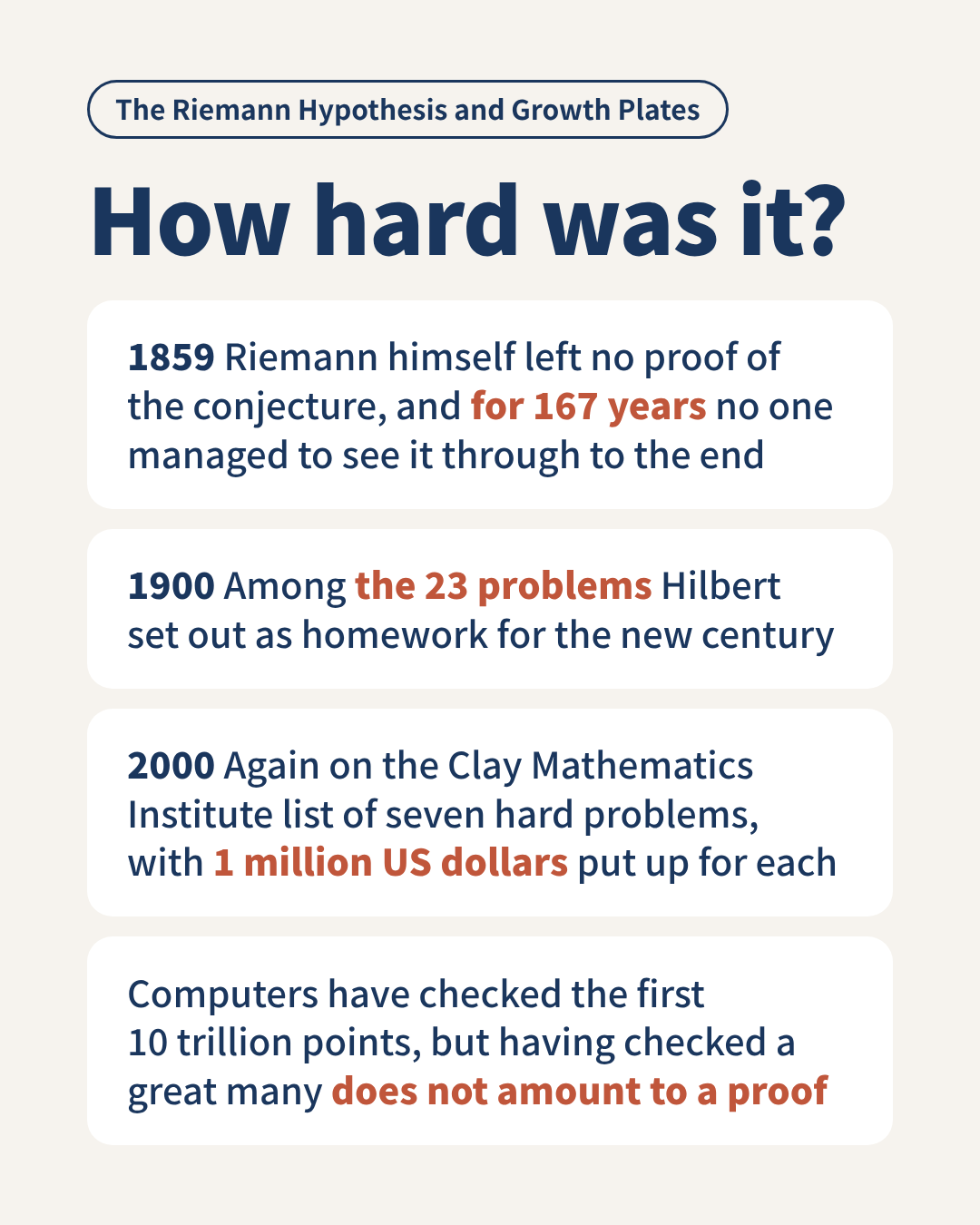
Riemann himself left no proof, and for 167 years afterward no one managed to see it through to the end. It was among the 23 problems that Hilbert set out in 1900 as homework for the new century, and in 2000, 100 years later, it appeared again on the list of seven hard problems for which the Clay Mathematics Institute put up 1 million US dollars each. Of those seven, only one, the Poincaré conjecture, has been officially solved.
Even in a study that used computers to check the first 10 trillion of these points one by one, no case that departed from the conjecture turned up. But the points go on without end, so having checked a great many of them does not amount to a proof.
Has this proof been fully checked?
There are reports that the proof has passed the computer check. It has been reported that when a number theorist at MIT and others ran the published Lean code independently, it passed without errors. What remains is for mathematicians to read and understand that long argument for themselves, and there are projections that this could take anywhere from a few months to a few years. The prize money and official recognition, too, are given only after the proof has been published in an academic journal and has withstood 2 years of scrutiny by the academic community. So for now, it is more accurate to write that a proof has been announced and that verification is still under way.
If the proof is correct, what changes?
Within mathematics, the change is large. A great many theorems have been proved on the condition that the Riemann hypothesis is true, and that condition disappears all at once. It also becomes possible to say how many primes there are up to a given size with a much narrower margin of error.
Everyday life does not change right away. Because primes are used in internet encryption, the worry follows that encryption might be broken, but the usual explanation is that this proof does not go so far as to tell us a way to factor large numbers quickly.
What caught my eye was less the answer than the way it was reached. The mathematician who made the announcement wrote that in the final stretch the AI ran far ahead of him. The ability to do quickly what one has been taught and the ability to solve a problem to which no one knows the answer are different in kind. I read this announcement as a sign that AI is moving beyond being a tool that assists people and is approaching the stage where it thinks for itself and finds something new, that is, the stage that has been given the name AGI.
What will the world look like when our children are adults?
By the time today’s elementary school students go out into society, the world will probably look like something that those of us in the parents’ generation find hard to picture. How people study, what grades mean and what kinds of jobs exist are all hard to gauge by today’s yardstick. It may even become common to make up later, with the help of AI, for the schoolwork one missed at school. This means that even for those who start late, the road for catching up may become wider than it is now.
But why won’t height wait?
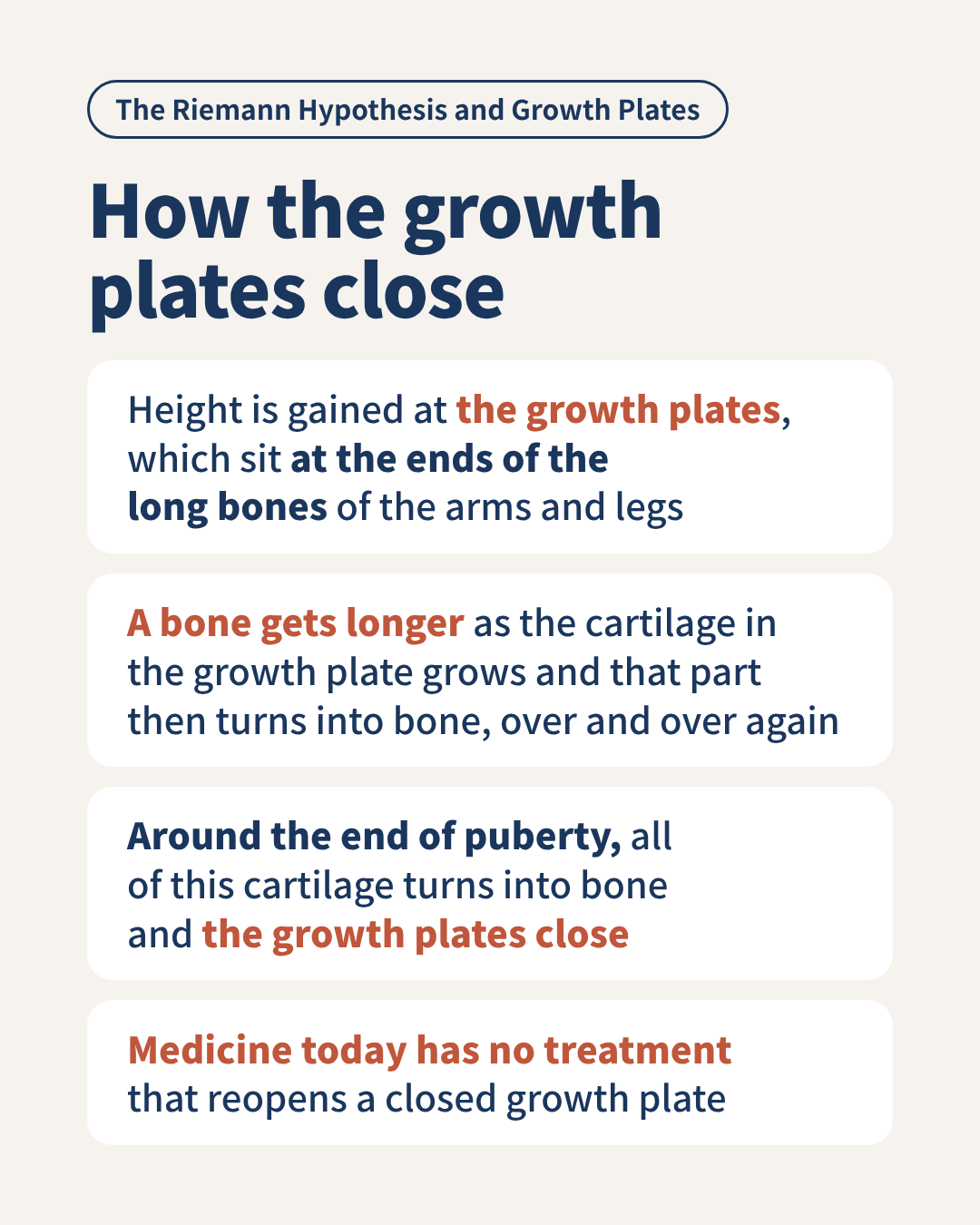
Height is gained at the growth plates, which sit at the ends of the long bones of the arms and legs. A bone gets longer as the cartilage in the growth plate grows and that part then turns into bone, over and over again. Around the end of puberty, all of this cartilage turns into bone and the growth plates close, and after that the bones do not get any longer. Medicine today has no treatment that reopens a closed growth plate.
In effect, schoolwork may come to have a road for catching up later, but height has no such road. Even if AI changes medicine quickly, I think that reversing a growth plate that has already turned into bone will remain unsolved homework longer than anything else.
So are you telling us to get treatment?
No. Whether to have treatment is not something a doctor can decide for you; that choice belongs to the parents and the child. The one thing I want to convey is the fact that the period in which you can choose has an end. So that you can be at ease as you think it over within that period, I will explain things honestly and help with methods that work.
At a glance
- On November 20, 2026, a mathematician at Anthropic announced that he had proved the Riemann hypothesis together with the AI Claude.
- There are reports that the proof has passed the computer check, and confirmation by mathematicians is in progress.
- The Riemann hypothesis is a conjecture from 1859 about how evenly the prime numbers are scattered.
- Even if AI changes what studying and jobs look like, height does not increase after the growth plates have closed.
- Treatment is a choice, but the period in which that choice can be made has an end.
References
- Digital Daily (디지털데일리). Math conundrum “Riemann hypothesis, proved by AI”: Anthropic mathematician says “proved the hypothesis with Claude”. 2026-11-22. (in Korean)
- News S (뉴스S). 167-year-old math conundrum “Riemann hypothesis”: Anthropic mathematician says “the AI Claude solved it”. Passed MIT verification, but final confirmation is still pending. 2026-11-22. (in Korean)
- IBM Think. Anthropic mathematician claims AI helped solve a 167-year-old math mystery. 2026-11.
- Clay Mathematics Institute. Millennium Prize Problems: The Riemann Hypothesis.
- Gourdon X. The 10^13 first zeros of the Riemann Zeta function, and zeros computation at very large height. 2004.
- Amit A. The Overselling of Mathematics. Parabola. 2021;57(1).
- Nilsson O, Baron J. Fundamental limits on longitudinal bone growth: growth plate senescence and epiphyseal fusion. Trends Endocrinol Metab. 2004;15(8):370-4.
- Emons J, et al. Mechanisms of growth plate maturation and epiphyseal fusion. Horm Res Paediatr. 2011;75(6):383-91.