
What Kind of Exercise Will Help My Child Grow Taller? Exercise and Lifestyle Habits for the Growing Years
When I talk with families about height in my office, there is one question I hear again and again: “What kind of exercise will help my child grow taller?” Everyone knows that exercise is good for a growing child, but not many people know exactly how intense it should be, how long it should last, or which activities to choose. Today I would like to go through, step by step and on the basis of research evidence, the kinds of exercise and everyday habits that support height growth and healthy development.
How exercise changes a growing child’s body
Exercise during the growing years does good throughout the body. As the bones receive a moderate amount of stimulation, bone density rises, the bones become thicker and stronger, and muscle mass increases along with them. Children who use their bodies regularly develop better posture and balance, which helps prevent posture problems such as forward head posture (text neck), and their cardiorespiratory endurance builds up naturally. When it comes to keeping a healthy weight, relieving stress, and sleeping deeply at night, nothing quite matches exercise. And above all, it increases the secretion of growth hormone.
Why does exercise increase growth hormone?
Growth hormone is secreted by the pituitary gland, which sits at the base of the brain. Setting medication aside, the natural stimuli that raise this secretion most powerfully are sleep and exercise. During exercise, a variety of signals, such as nerve impulses coming up from the muscles and joints, lactate, and adrenaline, reach the hypothalamus and the pituitary gland in the brain, and growth hormone secretion increases.
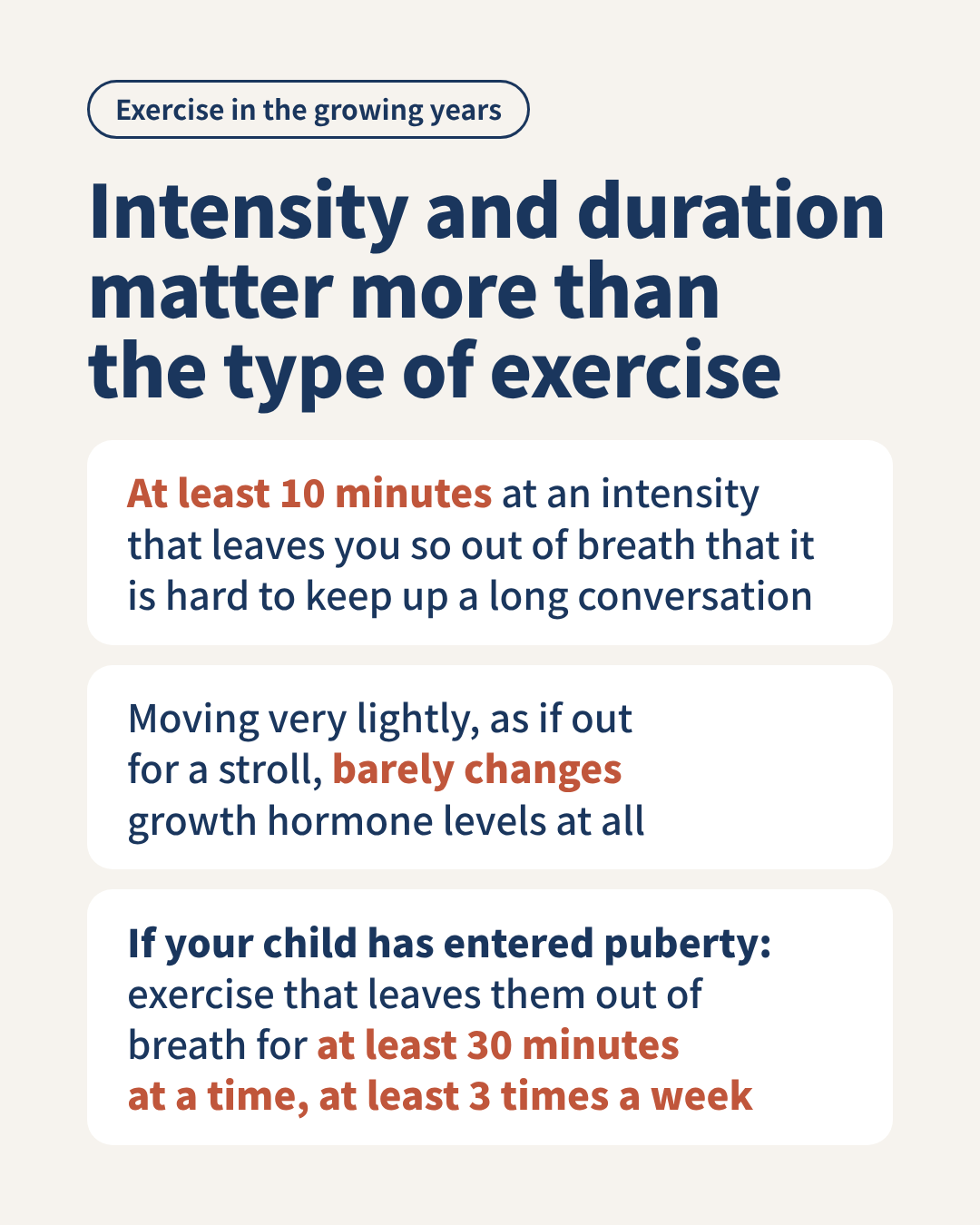
The key here is the intensity of the exercise. Exercise intensity and the amount of growth hormone secreted are almost directly proportional, so the higher the intensity, the more the secretion steadily rises. By contrast, moving very lightly, as if out for a stroll, barely changes growth hormone levels at all. Taken together, the research shows that the stimulus to growth hormone secretion is greatest when you exercise for at least 10 minutes at an intensity that leaves you so out of breath that it is hard to keep up a long conversation with the person next to you, and levels are usually highest toward the end of the exercise or right after it is over.
Puberty is another important factor. Once puberty begins, sex hormones come into play, and the same exercise brings a larger growth hormone response than it did before puberty. In a study that followed girls for 3 years, growth hormone levels after exercise were more than twice as high once breast development had reached stage 3 as they had been before that point. So if your child has entered puberty, I recommend making sure they get exercise that leaves them out of breath for at least 30 minutes at a time, at least 3 times a week.
Is there a kind of exercise that is especially good for growing taller?
This is what many parents are most curious about, but in truth, what matters more than the type of exercise is the intensity and duration I mentioned above. The amount of growth hormone that rises with exercise depends less on which activity was done than on how vigorously and how long it was done.
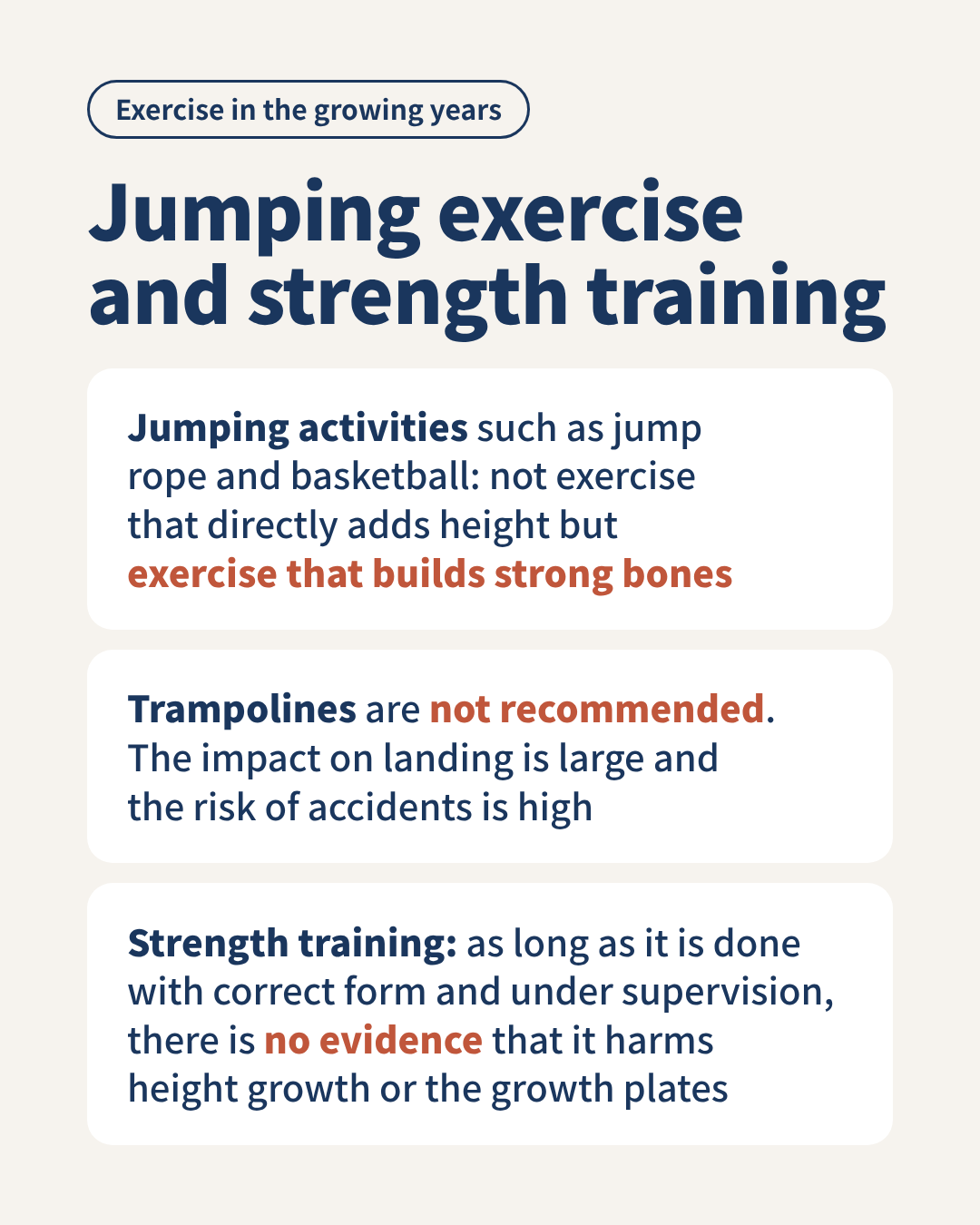
Even so, there is a reason why light jumping activities such as jump rope and basketball are so often recommended. The impact transmitted during a jump stimulates the bones and increases bone density and bone mass. In a study in which children in the early elementary grades did jumping exercises 3 times a week for 7 months, bone mass at the hip and lumbar spine increased about 3–4.5% more than in the control group. However, the two groups grew about the same amount in height over that period. It is more accurate to think of jumping exercise not as exercise that directly adds height but as exercise that builds strong bones.
If possible, jump rope should be done on a dirt playground or on a shock-absorbing mat, in cushioned athletic shoes. Jumping repeatedly on a hard surface lets strain build up in the knee joints, and when a joint is injured, the nearby growth plates can be affected as well.
I do not recommend trampolines. They send children far higher than they could jump on their own, so the impact on landing is large and the risk of accidents such as fractures, growth plate injuries, and neck (cervical spine) injuries is high. Accidents are especially common when several children jump at the same time, and the American Academy of Pediatrics also strongly discourages trampoline use at home.
Does strength training get in the way of growing taller?
In the past, strength training such as weight training was thought to interfere with height growth, but today the established view is that it does not. Strength training is also a high-intensity exercise that greatly increases growth hormone secretion, and as long as it is done with correct form and under supervision, there is no evidence that it harms height growth or the growth plates. In its 2020 recommendations, the American Academy of Pediatrics likewise stated that, with appropriate supervision, children can gain the benefits of strength training from a young age. What interferes with growth is not strength training itself, but training for excessively long hours like an elite athlete while nutritional intake is inadequate.
That said, the approach should differ with the stage of growth. In the elementary school years, exercises that use the child’s own body weight, such as push-ups, squats, and hanging from a pull-up bar, are appropriate; once the pubertal growth spurt has begun, the intensity can be raised little by little with light dumbbells or resistance bands. To be safe, strenuous lifting of the kind that attempts the maximum weight a child can lift in a single effort should be avoided until growth is complete.
Children who are bigger in build but weaker in fitness
Just as important as exercise are everyday lifestyle habits. The biggest problem with children today is that, compared with their parents’ generation, they are bigger in build but their physical fitness has actually declined.
In Korea, children’s height and weight have risen steadily, but height has barely moved since the 2000s, and the increase in body size is more pronounced among boys.
Student fitness in Korea is assessed with basic test items such as the endurance run/walk (cardiorespiratory endurance), the standing long jump (explosive power), and the sit-and-reach (flexibility). Endurance run results are not much different from the past, but the explosive power of middle and high school students, as measured by the standing long jump, has declined overall. As for flexibility, girls have stayed at a similar level, whereas it has dropped noticeably among middle and high school boys.
The answer is a habit of moving together as a family
To bring back lost fitness, children need to spend more time moving and less time sitting. Children who grow up in active households tend to keep moving regularly as they get older, and habits that become second nature in childhood carry on unchanged into adulthood.
It does not have to be anything elaborate. Taking the stairs instead of the elevator, going for a walk with the family or the family dog, and stretching together as a family before bed are more than enough to get started. Set limits in advance on time spent with the TV, the computer, and the smartphone, and if your child has been sitting for a long while, have them get up and move around from time to time.
If your child has obesity, start by adjusting the intensity
For children who carry a lot of weight, the type and intensity of exercise need to be adjusted so that the joints are not overloaded. For a child who is overweight, brisk walking, stair climbing, dancing, badminton, cycling, and swimming are all reasonable choices. In the case of severe obesity, stair climbing and vigorous aerobic exercise can put strain on the knees and ankles, so I recommend swimming first, because it puts little weight-bearing load on the body, together with stretching, calisthenics, and slow walking.
Just as important as exercise is the amount of activity in daily life. Children with obesity often spend long hours lying down; simply cutting back on the habit of lying down, spending more time on their feet, and joining in housework and outdoor activities can make a big difference in how active they are over the day.
Exercise in the growing years: a guide at a glance
- Move for at least 60 minutes every day, at an intensity that leaves your child slightly out of breath or more (walking, jump rope, running, dancing, basketball, soccer, swimming, etc.)
- On at least 3 of those days each week, keep up exercise that leaves your child very out of breath for more than 30 minutes
- Strength training and bone-strengthening jumping exercises, too, on at least 3 days a week each (body-weight exercises for elementary school children; from puberty onward, light equipment, building up step by step)
- Avoid activities with a high risk of injury, such as trampolines and maximum-weight lifting
- Cut down on sitting time and screen time
What matters most is not the type of exercise but finding an exercise your child can enjoy and keep doing. An exercise has to be one they like in order to last, and only then does it become a habit. Choose an activity that suits your child’s weight and athletic ability, and keep it going steadily without overdoing it.
References
- Ministry of Health and Welfare, Republic of Korea. Physical Activity Guidelines for Koreans (2023 revised edition)
- Pritzlaff CJ, et al. Impact of acute exercise intensity on pulsatile growth hormone release in men. J Appl Physiol. 1999;87(2):498-504.
- Godfrey RJ, et al. The exercise-induced growth hormone response in athletes. Sports Med. 2003;33(8):599-613.
- Viru A, et al. Exercise-induced hormone responses in girls at different stages of sexual maturation. Eur J Appl Physiol. 1998;77(5):401-8.
- Fuchs RK, et al. Jumping improves hip and lumbar spine bone mass in prepubescent children: a randomized controlled trial. J Bone Miner Res. 2001;16(1):148-56.
- American Academy of Pediatrics. Trampoline safety in childhood and adolescence. Pediatrics. 2012;130(4):774-9.
- Stricker PR, et al. Resistance training for children and adolescents. Pediatrics. 2020;145(6):e20201011.