Scarlet Fever Is Going Around: Early Symptoms, Strawberry Tongue Rash, and How It Differs from Roseola and Kawasaki Disease

Scarlet Fever: From Early Symptoms to the Strawberry-Tongue Rash
Hello! We are the trusted family pediatrician for Songdo moms, SONGDO ANSHIN.
Recently, our pediatric exam rooms and local parenting communities alike have been in an uproar as scarlet fever spreads at an alarming pace through daycare centers, kindergartens, and elementary schools.
When a child suddenly runs a high fever all night and says their throat hurts terribly, most parents first suspect a simple throat cold, influenza, or COVID-19. But if strange red spots start appearing on the skin over time, or your child’s tongue looks unusually bumpy and red, you must suspect scarlet fever and head straight to a pediatric clinic.
Today, from a pediatric specialist’s perspective, we will thoroughly break down scarlet fever, a topic so many parents search for late into the night: its exact causes, its early symptoms, and how to tell it apart from other rash-causing illnesses.
Why Do Children Get Scarlet Fever? (Causes and Contagiousness)
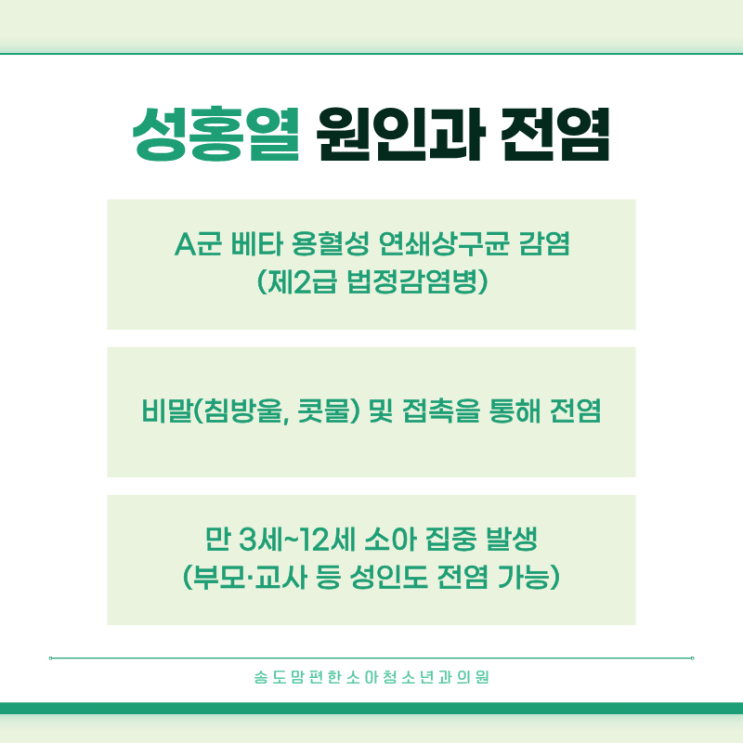
Causes and transmission of scarlet fever
Scarlet fever is not a viral illness. It is caused by infection with a bacterium called Group A Beta-Hemolytic Streptococcus, and it is designated a Class 2 nationally notifiable infectious disease in Korea.
. Once this bacterium enters the body, it releases toxins that cause high fever and the disease’s characteristic skin rash. It spreads mainly through respiratory droplets, such as mucus and saliva released when a patient coughs or sneezes.
It is known for spreading extremely fast in group-care settings such as daycare centers and kindergartens, where children share toys and spend time in crowded spaces.
❓Can adults catch scarlet fever too?
It occurs mainly in children between ages 3 and 12 whose immune systems are still developing, but adults with weakened immunity (especially parents or teachers providing close care to a sick child) can certainly be infected as well.
When adults are infected, the skin rash may be milder than in children, but they often suffer greatly from stabbing sore-throat pain, chills, and full-body flu-like aches.
So if your child is suspected of having scarlet fever, strictly separate dishes and towels at home, and parents should wash their hands frequently and wear a mask.
The 3 Stages of Typical Scarlet Fever Symptoms
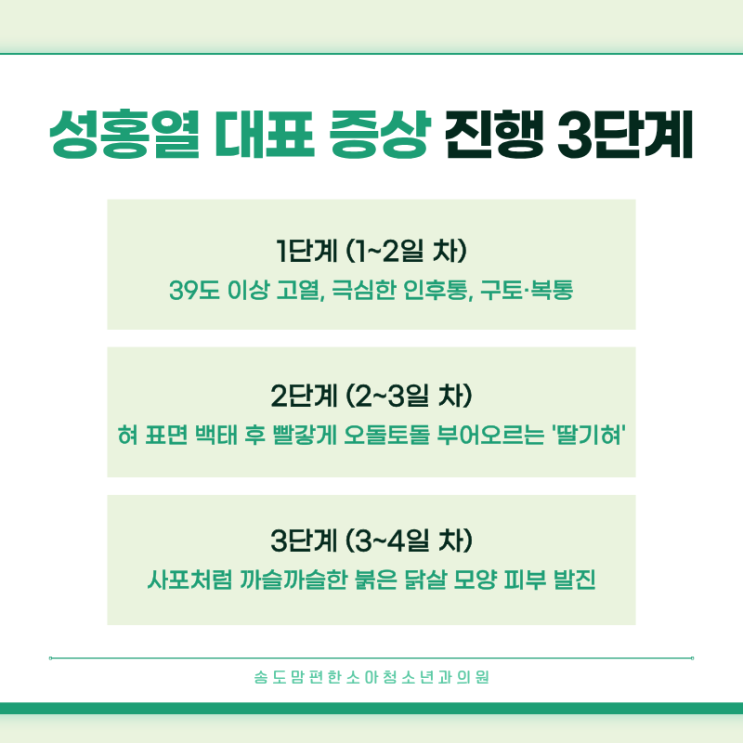
Typical symptoms of scarlet fever
In its early phase, scarlet fever looks so similar to acute tonsillitis or influenza that it is hard to tell apart, but over time, scarlet fever’s three unmistakable signature symptoms appear in the following order.
1️⃣ Stage 1: Sudden high fever, sore throat, and vomiting (days 1~2 of illness)
-
A fever above 39°C spikes without much warning. The tonsils at the back of the throat become red and swollen, and the pain can be severe enough that even swallowing saliva hurts.
-
In young children, the high fever often brings headache and abdominal pain along with nausea or vomiting, so it is sometimes mistaken for gastroenteritis.
2️⃣ Stage 2: The key sign of scarlet fever, ‘strawberry tongue’ (days 2~3 of illness)
-
For the first day or two, a thick white coating builds up on the surface of the tongue.
-
Then around day 3, this white coating peels away almost like magic. The entire tongue turns bright red, and the papillae on its surface swell into a bumpy texture.
-
Because it comes to look like a ripe strawberry, this is medically called ‘strawberry tongue,’ and it is the single most decisive clue that leads a pediatrician to suspect scarlet fever.
3️⃣ Stage 3: A sandpaper-like ‘goosebump-pattern’ skin rash (days 3~4 of illness)
-
About 24~48 hours after the fever begins, fine red spots start to appear, first in places where the skin folds, such as the neck, armpits, and groin, but not on the face.
-
This rash is felt more than seen: running your hand over it feels distinctly rough, like touching sandpaper or goosebumps.
-
Curiously, on the face only the area around the mouth is spared from the rash and looks relatively pale (a sign called circumoral pallor), while only the cheeks flush bright red.
A Frequent Question in Mom Communities: How Is It Different from Other Rash Illnesses?
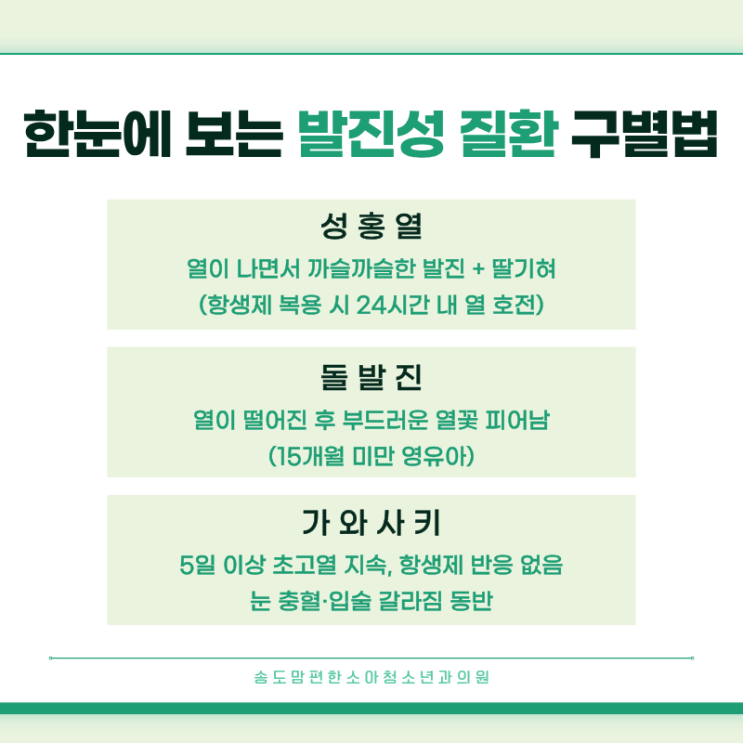
How to tell apart rash illnesses such as scarlet fever, roseola, and Kawasaki disease
When red spots appear on a child’s body, parents tend to panic. Here is a clear comparison of the two conditions most often confused with scarlet fever.
1️⃣ Scarlet fever vs. roseola
-
Roseola: Most common in very young infants under 15 months. A high fever lasts 3~5 days, and then, only after the fever has completely broken, a soft, blossom-like rash appears mainly on the belly and back.
-
Scarlet fever: Most common in children aged 3 and older, and while the fever is still raging, a rough sandpaper-like rash spreads over the whole body along with strawberry tongue.
2️⃣ Scarlet fever vs. Kawasaki disease
-
Kawasaki disease: A vasculitis of unknown cause. Strawberry tongue and a rash do appear, but they come with an extremely high fever lasting 5 days or more, plus red eyes, cracked lips, swollen lymph nodes, and swollen hands and feet. Above all, the fever does not come down at all even with antibiotics.
-
Scarlet fever: Because scarlet fever is bacterial, once a child takes the antibiotics prescribed by a pediatrician, the fever typically starts to drop dramatically within 24 hours.

Scarlet fever is absolutely not an illness that “gets better with rest” like a common cold. Because it is a bacterial infection, it can only be treated safely by taking antibiotics prescribed under an accurate diagnosis by a pediatric specialist.
So how do clinics actually test for scarlet fever, and how should you handle the daycare isolation period and the seemingly complicated public health center registration process?
The questions parents ask most often in our exam rooms are about the difference between the 2 confirmatory tests for scarlet fever, the legal isolation criteria, and the requirements for a return-to-daycare certificate. All of this will be laid out clearly in the very next post, so please stay tuned!
For parents worried about whether the scarlet fever test will hurt, or anxious that the public health center reporting process might be complicated, we will be back soon with a practical, hands-on guide.

SONGDO ANSHIN Director: Dr. An Sehwan, board-certified pediatric specialist (Dr. An)
📊 Recommended reading: our record of last year’s scarlet fever outbreak
Around this same time last year, in July 2025, our clinic also shared urgent information with parents during a major scarlet fever outbreak.
The post we wrote back then, [A Complete Guide to Scarlet Fever: Causes, Symptoms, Testing, Treatment, and Isolation], contains detailed, practical Q&A on what parents ask most often, such as whether it is okay to give a fever reducer before visiting the clinic and whether siblings should be tested too. It is well worth reading alongside this post.
👇 [Read the 2025 Scarlet Fever Outbreak Guide and FAQ]