
Blisters only inside the mouth but not on hands or feet? How to tell herpangina (stomatitis) apart from hand, foot and mouth disease

Hello, this is SONGDO ANSHIN.
In last week’s post, we gave a thorough answer to what many parents most wonder about after hand, foot and mouth disease treatment: the criteria for a full recovery from HFMD and the right timing for issuing a daycare return certificate.
When you’re helping your child brush their teeth or eat in the morning and spot a single red blister inside their mouth, it’s momentarily alarming, and you start to wonder, “Can I still send them to daycare today?” That worry is often where it begins.
When the hands and feet are clear but blisters appear only inside the mouth, it can be hard to tell whether it’s a simple canker sore (stomatitis) or the start of hand, foot and mouth disease.
The reason you can’t simply relax just because there’s no rash on the hands and feet? It’s because ‘herpangina (vesicular stomatitis),’ whose symptoms closely resemble HFMD, is also going around.
Both conditions cause blisters inside the mouth, so they’re easy to confuse, but there are clear differences in the early symptoms and the location of the rash. Today we’ve summarized the key differences that let you tell them apart right away when blisters appear in your child’s mouth, along with the correct early response.
📌 3-Second Key Summary (for busy parents)
|
Category |
Herpangina (vesicular stomatitis) |
Hand, foot and mouth disease (Hand-Foot-Mouth) |
|
Location of blisters |
Deep inside the mouth, near the throat (around the uvula and inner soft palate) |
Throughout the mouth + palms, soles, buttocks, and knees |
|
Fever pattern |
Sudden high fever of 38.5-40°C commonly present |
Mild to high fever (appears together with the rash on hands and feet) |
|
Main symptoms |
Severe throat pain leading to refusal of saliva/water |
Mouth pain and skin rash on the hands and feet |
|
Point to watch |
In the first 1-2 days, blisters on the hands and feet may be absent |
Watch for 2-3 days to see whether additional rash develops on the hands and feet |
There are no blisters on the hands and feet – is it herpangina?

The most decisive differences between HFMD and herpangina are ‘where the blisters (rash) appear’ and ‘the early fever pattern.’
✅ Herpangina (Herpangina / vesicular stomatitis)
-
Blister location: The hands and feet stay clear, and red ulcers and blisters are concentrated only ‘deep inside the mouth near the throat (around the uvula and inner soft palate).’
-
Fever pattern: A sudden high fever (38.5-40°C) is often higher than with HFMD, and the throat pain is so severe that the child struggles to swallow even saliva or water.
✅ Hand, foot and mouth disease (Hand-Foot-and-Mouth Disease)
-
Blister location: As the name suggests, not only inside the mouth but also around the palms, soles, buttocks, and knees, a red blistering rash spreads.
-
Fever pattern: It often passes with only a mild fever, but mouth pain causes heavy drooling and refusal to eat.

Director Dr. An Sehwan, pediatric specialist at SONGDO ANSHIN
💡 On-the-ground tip from the pediatric specialist (Dr. An):
In the first 1-2 days there is no rash on the hands and feet, but there are HFMD cases where blisters appear on the hands and feet from day 3. So even if only mouth blisters are found at the initial diagnosis, you should carefully watch your child’s hands, feet, and buttocks for 2-3 days.
Emergency parenting tips when your child can’t eat at all due to mouth pain
Because of the sores and ulcers in the mouth, hot, spicy, or coarse foods cause intense pain. When your child can’t eat anything, respond like this.
1️⃣ Offer cold, non-irritating foods
Serve foods such as rice porridge, pudding, steamed egg, and plain yogurt after cooling them down.
2️⃣ Use ice cream and ice
When the pain is so severe that the child refuses even water, letting them slowly melt small bits of mild vanilla ice cream or ice chips temporarily numbs the mouth pain and greatly helps prevent dehydration.
3️⃣ Check for dangerous signs of dehydration
If your child has not urinated for more than 6 hours, produces no tears when crying, or is listless and lacking energy, you should visit a pediatric clinic immediately for appropriate care such as IV fluid therapy.
Wondering about the full-recovery determination and daycare return criteria?
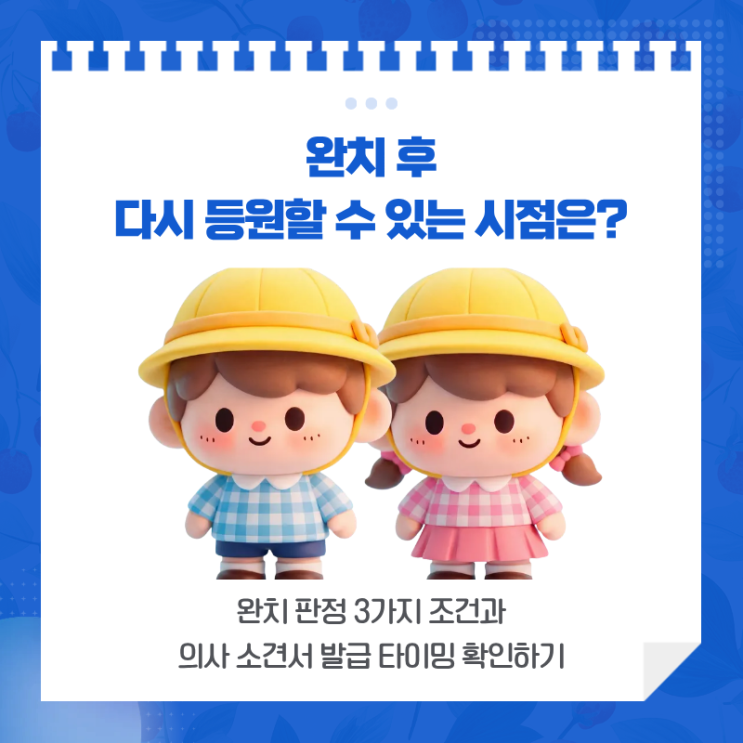
Both HFMD and herpangina are highly contagious viral illnesses, so just as important as early symptom treatment is ‘the isolation period and safe criteria for returning to daycare.’
What you need to submit once your child’s fever has come down and the mouth blisters have healed – the timing for issuing the ‘no-longer-contagious certificate (daycare clearance)’ and the 3 exact recovery criteria– are covered in detail in yesterday’s post below, so please check it as well.
👉 [Recommended reading: HFMD daycare return criteria? A guide to the timing of full-recovery certificate issuance]
SONGDO ANSHIN will always give its wholehearted care so that children can spend a healthy summer without suffering from mouth pain. If your child shows a high fever or mouth blisters, please don’t wait – come in for an accurate diagnosis and prescription.
