
Childhood obesity diagnostic criteria and precocious puberty bone age testing: how to manage without over-treatment (Songdo Growth Clinic)

Hello. Located in Songdo District 8, this is SONGDO ANSHIN.
🔗 Revisit the previous story
In the previous post, we looked at why the saying “baby fat all turns into height” is dangerous, and at the hormonal mechanism by which increased body fat triggers precocious puberty and ends up reducing final adult height.
If you have not read the previous article yet, reading the post below first will make this one much easier to follow.
👉 [Childhood obesity: is it really true that baby fat all turns into height? Go to Part 1]

Today, in this practical follow-up, we will carefully walk you through the exact diagnostic criteria for checking whether your child truly falls under childhood obesity, the essential tests, and how to manage it wisely at home without any over-treatment.
|
💡 Key summary: 3 essentials of childhood obesity diagnosis & daily management 1️⃣ Diagnostic criteria : Unlike in adults, a child is diagnosed with childhood obesity when the value is at or above the 95th percentile for the same age and sex, and detailed testing is then needed. 2️⃣ Three-step detailed testing : Precise InBody analysis ➔ X-ray bone age (skeletal age) reading ➔ essential blood tests allow a systematic assessment without over-treatment. 3️⃣ The right way to manage it : Rather than blindly starving the child, the keys are improving the quality of the diet (cutting out liquid fructose), deep sleep before 10 p.m., and 30 minutes of vertical exercise a day. |
It is not simply a number on the scale!
Diagnostic criteria for childhood obesity
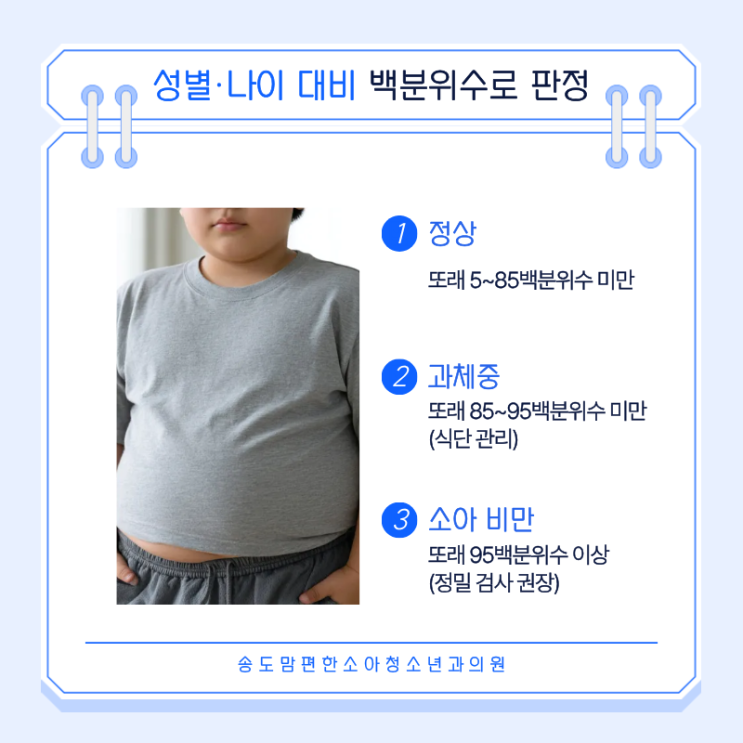
In adults, obesity is defined as a BMI (body mass index) of 25 or higher, but children in their growth years change day by day, so they must never be judged by weight alone or by one fixed number.
In pediatrics, we use the Korea Disease Control and Prevention Agency’s “Child and Adolescent Growth Charts” and diagnose by checking where a child ranks (percentile) among 100 peers of the same sex and age.
|
Category |
Diagnostic criteria (out of 100 peers) |
Medical status and action |
|
Normal weight |
5th percentile or above to below the 85th percentile |
Growing well along a healthy growth curve |
|
Overweight |
85th percentile or above to below the 95th percentile |
At risk of progressing to obesity; dietary management is needed |
|
Childhood obesity |
at or above the 95th percentile |
May trigger precocious puberty and childhood lifestyle diseases, so detailed testing is needed |
🚨 “Growth signals” that make a pediatric visit essential
-
When your child is noticeably chubbier than peers and gaining weight far too quickly
-
Girls: When a breast lump can be felt before age 8, or she feels pain when it is brushed against
-
Boys: When signs of secondary sexual characteristics appear before age 9, such as the testicles enlarging
-
When, along with the signs above, height has suddenly shot up by 7~8cm or more within the past year
Three steps of pediatric detailed testing, with no worry about over-treatment
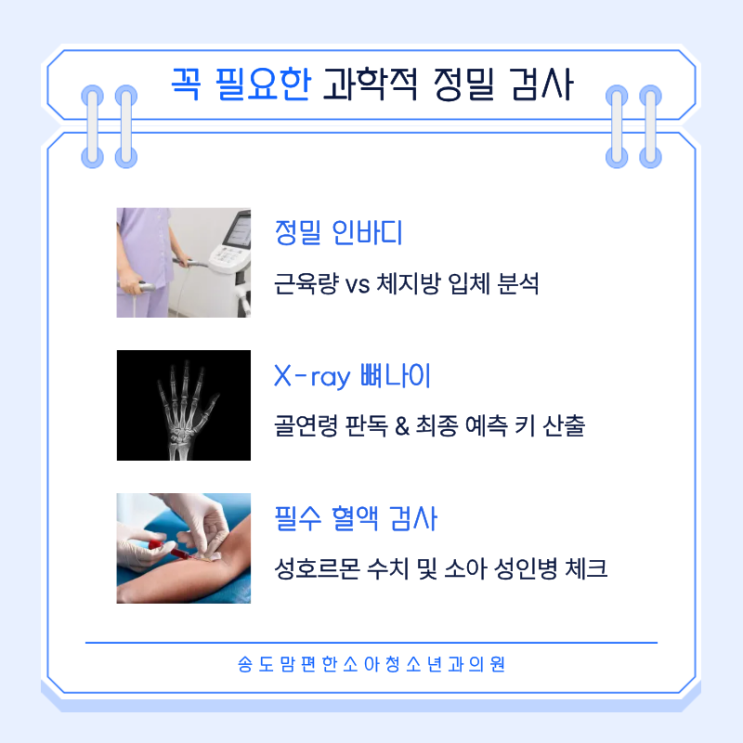
“If we go to the pediatrician, won’t they just push expensive hormone injections or excessive treatment?” Many parents worry about this. At SONGDO ANSHIN, we proceed step by step with only the tests that are truly necessary, based on objective data.
-
Step 1: Precise InBody (body composition) data analysis
Rather than weight alone, we precisely analyze muscle mass, body fat percentage, and abdominal fat ratio. This lets us accurately distinguish a child who weighs more because of a large frame from a child whose excess body fat carries a risk of hormonal disruption.
-
Step 2: X-ray bone age (skeletal age) reading
We take an X-ray of the child’s left wrist to check how far ahead the bone age is compared with the actual age. Through reading by an experienced specialist, we determine whether the growth plates are open or closed and calculate the predicted final height.
-
Step 3: Essential blood tests
Beyond sex hormone levels, we safely check for childhood lifestyle diseases that obesity can bring on, such as hyperlipidemia, fatty liver, and insulin resistance.
Mistakes parents commonly make at home & the right way to manage
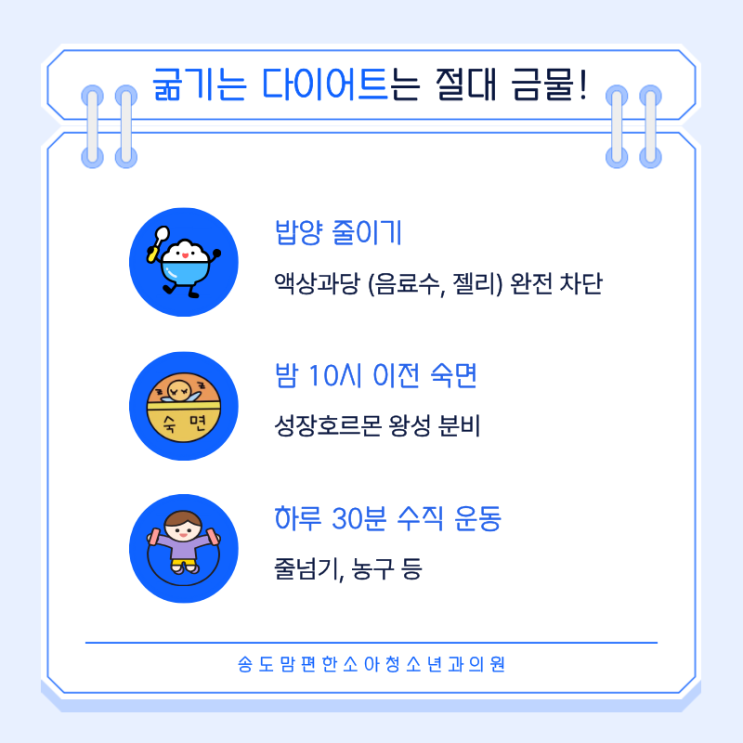
Managing obesity in children must be completely different from adult dieting. The biggest mistake is starving the child or restricting them excessively to a protein-centered diet the way adults do. If you starve a growing child, growth hormone secretion decreases and the child will not grow properly in height.
The key is “keeping weight steady or managing it gently while helping the child grow taller, so that the degree of obesity naturally comes down.”
-
❌ Do not force meal portions down ➔ ⭕ Change the “quality” of the diet
Cutting meal portions too harshly leads to stress and binge eating on snacks or jelly candy. Keep meals as usual, and start by strictly limiting liquid fructose (soft drinks, character-branded juices, ice cream) and fried foods.
-
🌙 Create an environment for deep sleep before 10 p.m.
Growth hormone, which breaks down fat and makes children grow taller, is secreted most actively between 10 p.m. and 2 a.m., when the child has fallen into “deep sleep.” Eating a late-night snack before bed keeps the child from sleeping deeply because of digestion, so the amount of hormone secreted decreases.
💡 “Is your child’s sleep so difficult that you are considering ‘kids melatonin’?”
Many parents whose children cannot fall asleep easily each night consider over-the-counter melatonin sleep supplements made for children.
Melatonin is a natural sleep hormone produced by the body and can help induce sleep, but the appropriate dose and the underlying cause differ from child to child, and there are side effects to watch for, so a consultation with a specialist must always come first.
If you are curious about the academic analysis of melatonin’s effects and safety in children and adolescents, please also see the post below!
👉 [Is it safe to give kids melatonin? Go to the paper analysis of sleep effects and side effects in children and adolescents]

-
👟 30 minutes a day of vertical exercise that stimulates the growth plates
We recommend exercise that stimulates the growth plates vertically, such as jump rope, basketball, or light jogging, at least three times a week. It is the healthiest way to stimulate the growth plates, promote bone growth, and burn body fat.
A closing word from SONGDO ANSHIN

When childhood obesity and precocious puberty are found early, they can be corrected well enough with lifestyle changes alone, without forced injection therapy, and the child’s hidden height can be recovered.
Rather than leaving things to unfounded sayings from those around you, if anything worries you, we recommend visiting a pediatric clinic and checking the growth curve based on data.
This has been SONGDO ANSHIN, always cheering for children’s healthy growth. If you found this helpful, tap [Add as Neighbor] and [Like] to receive our updates. Thank you.
