
Not Growth Hormone Deficient: Can Growth Hormone Injections Still Make a Normal Child Taller?

Hello. This is SONGDO ANSHIN Growth Clinic, located in Songdo District 8.
In Growth Clinic consultations, there is one question many parents wonder about and ask us carefully.
Doctor, we had a detailed workup done and the growth hormone level is normal, with nothing else abnormal.
But our child is so much smaller than peers that we are worried.
Will a child who is not hormone deficient still grow taller with growth hormone injections?
Parents feel a complicated mix of emotions: relieved that their child has no particular illness, yet distressed that the child is smaller than peers and torn over whether to pursue treatment.
Today, SONGDO ANSHIN draws on three representative long-term international medical papers on children without growth hormone deficiency to lay out the real, evidence-based answer!

Will a child who is not growth hormone deficient still grow taller with growth hormone?
Three different studies all pointed to the same place.
|
💡Key summary: the effect of growth injection treatment in children with normal growth hormone Even a child whose growth hormone testing shows nothing abnormal, a ‘normal’ child, gains about 5cm more in adult height on average when treated with growth hormone. This is not mere speculation; three long-term medical studies that differ in design, country, and dose each arrived at this same conclusion. However, there are two facts that must be considered alongside this ‘average 5cm’. 1️⃣ The result (responsiveness) varies enormously from child to child. 2️⃣ Growing taller did not automatically improve the child’s feelings or self-esteem. Therefore, “does growth hormone work?” matters less than “is it really right for my child?” Deciding that first is far more important. |
A normal but small child (Idiopathic Short Stature, ISS)


SONGDO ANSHIN annex, consultation room 1
There is something guardians who come to the Growth Clinic say most often.
“All the tests are normal, so does our child just have to live short?”
In medicine this is called Idiopathic Short Stature (ISS).
‘Idiopathic’ means no medical abnormality or cause could be found. It refers to a child whose height ranks about 2nd or 3rd from the bottom among 100 peers, yet whose growth hormone and thyroid tests are normal and who eats well and grows well without any particular illness.
Since there is no disease, treatment may not seem necessary, but the self-consciousness and discomfort the child feels day to day remain real.
So there has long been debate in the pediatric endocrinology field.
“If we give hormone to a child who is not hormone deficient, will the child really grow taller, or will it just cost money with no effect?”
Answering this question requires large-scale studies that follow children for years until they reach adulthood. The three papers introduced today are exactly those landmark studies.
How did the studies make their comparisons?
The hardest part of height research is setting up the ‘comparison group (control group)’. Even if a treated child grew 5cm, they might have grown that much without treatment.
|
Study |
Comparison method |
Participants |
Follow-up period |
|
Leschek 2004 |
Compared with a sham injection (placebo) ※ Neither doctors nor patients knew |
Ages 9~16, 68 children |
Average 4.4 years (to adult height) |
|
Albertsson-Wikland 2008 |
Compared with untreated children ※ Two doses compared |
Without growth hormone deficiency Children with short stature |
To final height |
|
Ross 2004 |
Psychological testing of the same children who took part in the first study above |
The same children |
The same period |
In particular, the first Leschek study used a ‘double-blind, placebo-controlled’ design in which neither patients nor doctors knew who received the real drug, giving it very high medical reliability.
Result 1. Compared with a sham injection ➔ average +3.7cm of growth
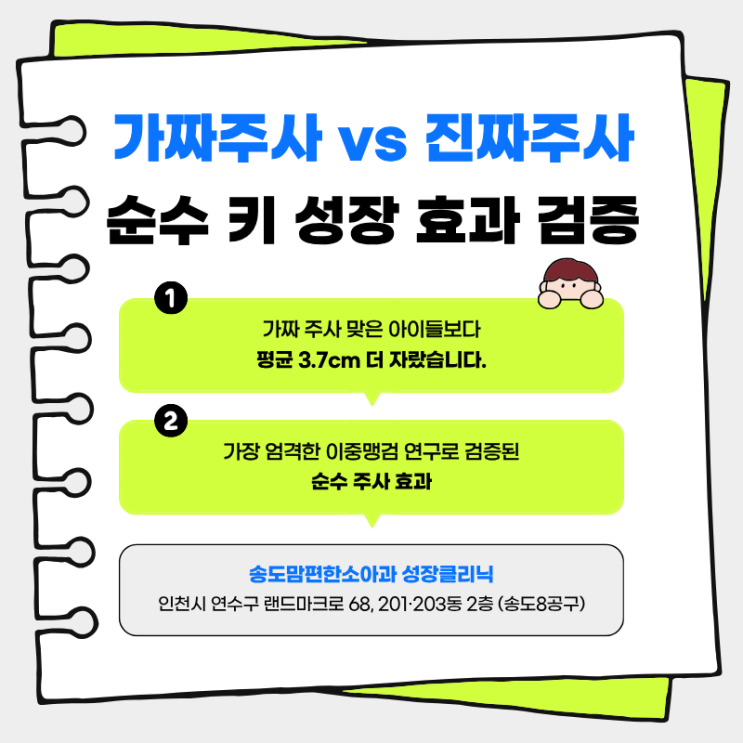
This study compared adult height between children given a sham injection (placebo) and children given real growth hormone.
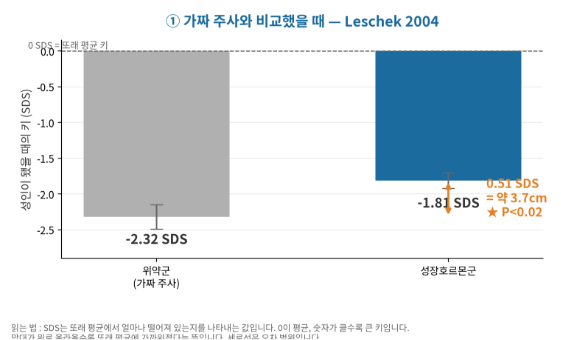
Graph 1. Adult height comparison (Leschek et al., JCEM 2004)
|
Category |
Placebo group (sham injection) |
Growth hormone group |
Difference |
|
Height in adulthood |
-2.32 SDS |
-1.81 SDS |
0.51 SDS = about 3.7cm |
|
Statistical significance |
— |
— |
P<0.02 (not by chance) |
(※ SDS is a standard deviation score showing the difference from the peer average. 0 is average, and -2 SDS is around the bottom 2.3%.)
Children given the sham injection stopped at -2.32, while children given real growth hormone rose to -1.81. The difference is 0.51 SDS, which converted to height is about 3.7cm. Reanalyzing the 62 children treated for 6 months or more gave almost the same figure, 3.8cm.
Children given real growth hormone showed a significant improvement in adult height, a net height gain of about 3.7cm. (Based on a relatively low dose of 0.22mg/kg per week)
|
💡 The important point here! The dose used in this study was about 0.22mg/kg per week, which is low by today’s standards. In other words, 3.7cm is ‘the number when little was used’. This becomes important in the next study. |
Result 2. Compared with untreated children ➔ up to +6.8cm (but it depends on dose)

The Albertsson-Wikland study, conducted in Sweden, followed children long-term until they reached final height and also analyzed differences by dose.
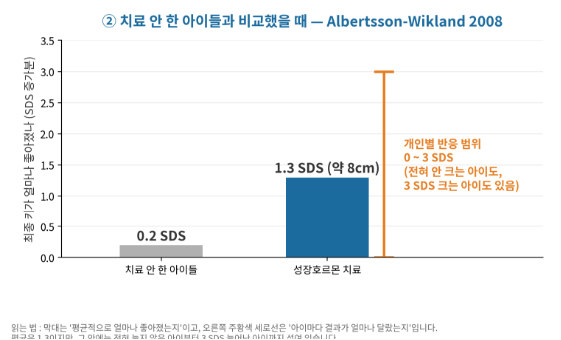
Graph 2. Degree of final height improvement and range of individual response (Albertsson-Wikland et al., JCEM 2008)
|
Category |
Untreated children |
Growth hormone treatment |
|
Final height improvement |
0.2 SDS |
1.3 SDS (about 8cm) |
|
Net treatment effect |
— |
About 1.1 SDS ≈ 6.8cm (estimated) |
|
Range of individual response |
— |
0 ~ 3 SDS |
|
Dose effect |
— |
The more used, the greater |
Treated children improved their final height by 1.3 SDS on average, about 8cm. Untreated children managed only 0.2 SDS. Subtracting that difference, the net treatment effect is about 6.8cm. This is far larger than the earlier study (3.7cm), and the reason is dose. In this study, the more growth hormone was used, the better the result.
|
⚠️ A number you must look at alongside it The average was 1.3 SDS, but individual responses ranged from 0 to 3 SDS. Put simply, some children gained almost nothing while others gained as much as 3 SDS. That was with the same drug, over the same period, used the same way. This is why, in growth hormone treatment, the word ‘average’ is dangerous. An average of 5cm does not mean your child will grow 5cm. Identifying in advance which children respond well matters more than choosing the drug. |
Summary at a glance ➔ up to +6.8cm; three arrows point to the same place
This is the most important message of this article. In addition to the two studies above, there is one more independent literature review that analyzed only the long-term studies. Let us place the three numbers side by side.
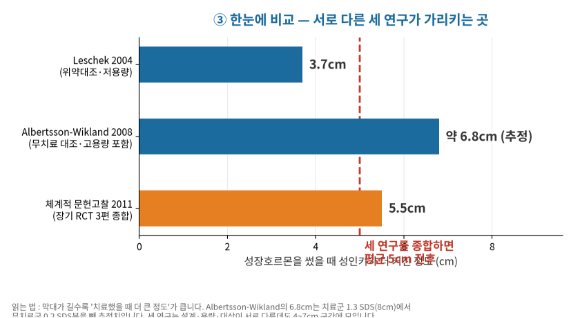
Graph 3. Net adult height gain reported by the three sources
|
Source paper |
Study design |
Net adult height gain |
|
Leschek 2004 (JCEM) |
Double-blind placebo-controlled RCT, low dose |
+3.7cm |
|
Albertsson-Wikland 2008 (JCEM) |
Untreated-control RCT, includes high dose |
About +6.8cm (estimated) |
|
Systematic review 2011 |
Synthesis of 3 long-term RCTs |
0.77 SDS ≈ +5.5cm |
The designs differ, the countries differ, the doses differ, the researchers differ. And yet the three numbers cluster in the 4~7cm range. And right in the middle of that is about 5cm, located in Songdo District 8.
Independent studies arriving at the same answer — this is exactly what it means, in medicine, to say that something has been ‘proven’. That growth hormone raises adult height even in children without growth hormone deficiency is no longer a matter of debate.
|
📌 Key points • Even without growth hormone deficiency, adult height increases by about 5cm on average. Three independent studies agree. • The low-dose study showed 3.7cm; the study including high doses showed about 6.8cm. Dose and timing of initiation decide the result. • However, individual responses range from 0 to 3 SDS. An average is not a prediction for your child. |
Result 3. But will growing taller make the child happier?

What parents worry about most in the consultation room is their child’s psychological self-consciousness.
The third study examined the psychology of the very same children who took part in the first study (the sham injection comparison). The same children, the same period, and psychological testing under the same double-blind conditions. This design was the first of its kind in the field.
The results were a little different from expectations. Among the children with idiopathic short stature in this study, being short in itself was not linked to problems with psychological adjustment or self-concept. Although the growth hormone group did show some tendency toward improvement in problem behaviors, growing taller did not automatically raise the child’s self-esteem.
|
💡 How should we read this result? It would be good to remember two things at once. 1. Being short does not mean the child is unhappy. Small children generally do just fine. 2. But neither does a growth hormone injection grow the child’s heart. In other words, growth hormone is a treatment for height, not a treatment for self-esteem. If a child is feeling self-conscious right now, that part needs its own separate support. Starting injections will not solve it by itself. |
The significance and limits of these studies
-
Significance: A placebo-controlled study (the most rigorous design) exists, follow-up continued to adult height, and different studies reached the same conclusion. There are fewer areas of pediatrics with this much accumulated evidence than you might think.
-
Limit ①: Individual variation is very large. In the second study the response ranged from 0 to 3 SDS. There is still no way to know in advance with 100% certainty which child will respond well. Age, height at the start, the gap from parental height, and the speed of response in the first year serve as clues.
-
Limit ②: In the first study, only 33 participants had adult height measured, which is few. However, reanalyzing all 62 children treated for 6 months or more gave almost the same result, so the conclusion did not waver.
-
Limit ③: To gain 5cm, injections must be given daily for several years. Whether that trade is worthwhile is a question for each family, not for medicine. I believe my part is to give you the numbers you need for that judgment, accurately.
A word from SONGDO ANSHIN Growth Clinic

SONGDO ANSHIN main building

SONGDO ANSHIN annex

“The tests are normal. Is it still all right to use growth hormone?” Looking purely at the evidence, the answer to this question is clear.
Yes, it is used. And adult height increases by about 5cm on average. This is a proven fact.
But the real question comes next.
-
Is my child one who will respond at or above that average?
-
Is now the optimal time to start treatment?
-
Can the child and the parents accept several years of injection treatment?
The three papers do not answer these questions. They can only be answered by seeing the child, reading the bone age, and following the growth curve.
So I hope this article is not read as ‘get growth hormone injections’ . I would rather it read as ‘growth hormone works, and precisely for that reason we must decide all the more carefully whom to use it for’ . If it were a drug with no effect, there would have been nothing to agonize over.
|
📝 In summary Even a child without growth hormone deficiency gains about 5cm more in adult height with growth hormone. The evidence is sufficient. However, results differ greatly from child to child, and height is no substitute for the heart. Your child’s growth curve, bone age, and pubertal progression should be considered together in the decision. Please consult a specialist. |
📚 Reference papers
1. Leschek EW, Rose SR, Yanovski JA, et al. Effect of Growth Hormone Treatment on Adult Height in Peripubertal Children with Idiopathic Short Stature: A Randomized, Double-Blind, Placebo-Controlled Trial. J Clin Endocrinol Metab. 2004;89(7):3140-3148.
2. Albertsson-Wikland K, Aronson AS, Gustafsson J, et al. Dose-Dependent Effect of Growth Hormone on Final Height in Children with Short Stature without Growth Hormone Deficiency. J Clin Endocrinol Metab. 2008;93(11):4342-4350.
3. Ross JL, Sandberg DE, Rose SR, et al. Psychological Adaptation in Children with Idiopathic Short Stature Treated with Growth Hormone or Placebo. J Clin Endocrinol Metab. 2004;89(10):4873-4878.
※ The ‘Systematic review 2011’ in the text is a separate publication that comprehensively analyzed long-term RCTs including the studies above.
SONGDO ANSHIN
※ This article explains academic papers in plain language for the general public and does not replace medical advice.
💡A real growth consultation case worth reading together
“I understand the theoretical effect, but is treatment still meaningful for a middle school student whose bone age has already advanced considerably?”
See the real middle-school growth hormone treatment concerns discussed in our consultation room, and Dr. An Sehwan’s candid answer.
👉[Songdo Growth Clinic] Should middle schoolers still start growth hormone injections now?

?