
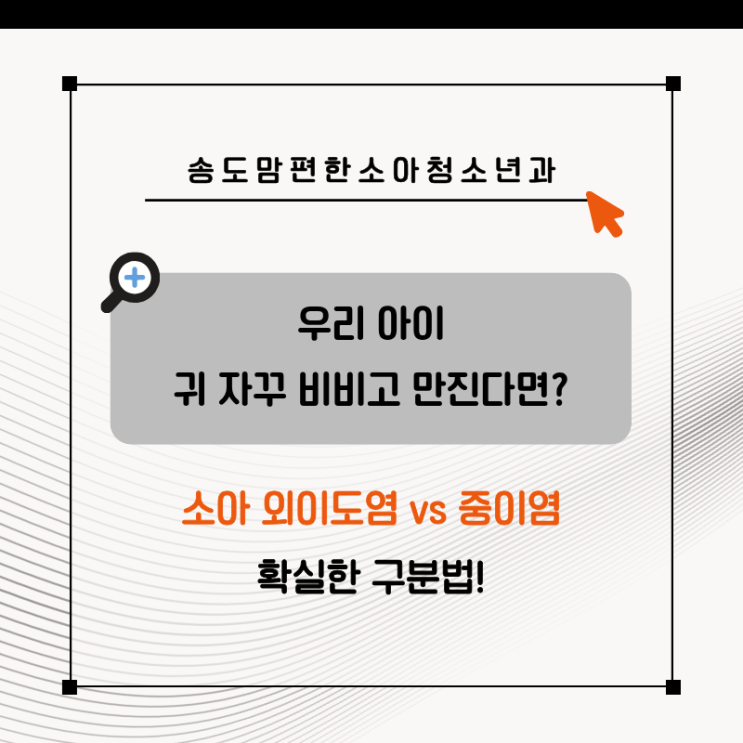
Baby Keeps Rubbing and Touching the Ear! How to Tell Pediatric Otitis Externa from Otitis Media, and What to Do
Hello, this is SONGDO ANSHIN, located in Songdo District 8.
“My child keeps rubbing their ear.”
“Every night they pull at their ear or touch it and cry.”
Young children find it hard to put pain or a stuffy feeling inside the ear into words, so they show their discomfort by rubbing or touching the ear. When this happens, many parents first suspect ‘otitis media’, but cases caused by moisture after a bath or irritation from a cotton swab, known as ‘pediatric otitis externa’, are also very common.
Today SONGDO ANSHIN lays out the leading causes of a child rubbing the ear, how to tell otitis externa from otitis media, and the right way to respond at home, all in easy-to-follow terms.
|
💡 [Today’s key points in 3 lines] 1️⃣ If your child cries out in severe pain when you pull on the outer ear, it is likely ‘otitis externa’; if it comes with a cold or fever and a muffled, blocked feeling, then ‘otitis media’is the more likely cause. 2️⃣ Wiping a wet ear canal with a cotton swab after a bath scratches the thin skin of the canal and invites bacterial infection, so it must always be avoided. 3️⃣ When water or sweat collects in the ear, dry only the opening gently with cool air from a hairdryer or the tip of a soft tissue. |
Ear pain in your child: how do otitis externa and otitis media differ?
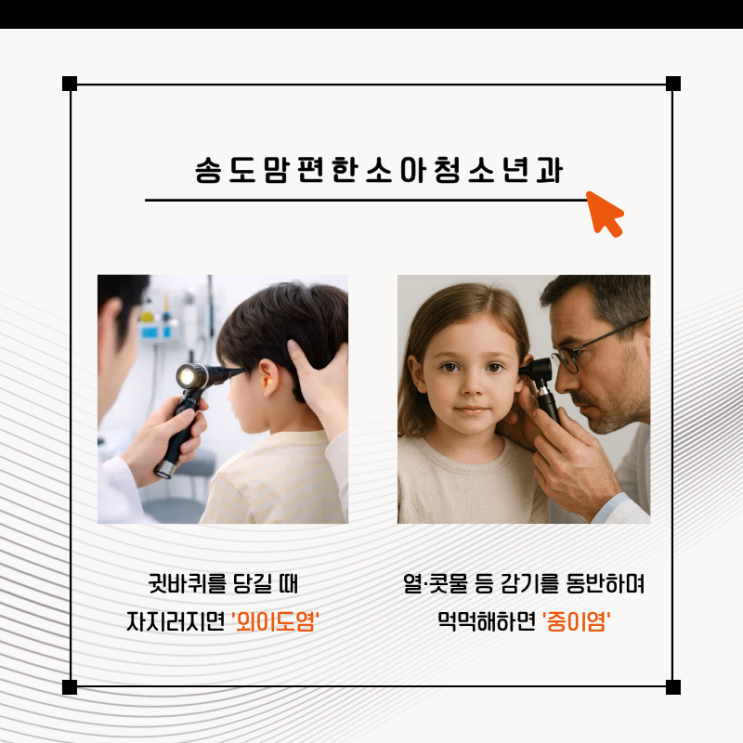
The two conditions that cause ear pain differ clearly in where they occur and in their main symptoms.
|
Category |
Pediatric otitis externa |
Pediatric otitis media |
|
Where it occurs |
From the opening of the ear canal to just outside the eardrum (external auditory canal) |
The space behind the eardrum (middle ear cavity) |
|
Main causes |
Moisture after a bath or swimming, cotton-swab irritation, scratches inside the ear |
Upper respiratory infections such as colds, rhinitis, and adenoid hypertrophy |
|
Characteristic symptoms |
Severe pain when the outer ear (earlobe) is pulled or pressed |
Accompanied by fever, cold symptoms, and a muffled, pressured feeling deep in the ear |
|
Discharge |
May come with discharge or a foul smell at the opening of the ear canal |
If the eardrum perforates, pus-like discharge drains out |
Why you should not use a cotton swab to remove water or earwax from the ear

Many parents reach for a cotton swab when water is left in the child’s ear after a bath or when earwax is visible. A child’s ear-canal skin is far thinner and more delicate than an adult’s, so using a cotton swab is very risky.
-
Micro-tears and bacterial infection: When a swab touches the moisture-softened surface of the ear canal, tiny tears form easily, bacteria get in, and otitis externa follows.
-
Compacting and irritating earwax: Trying to pull earwax out can instead push it deeper inside, blocking the ear canal or irritating the eardrum.
3 steps to dry the ear safely at home

1️⃣ Use gravity: Tilt the head so the ear holding water or moisture faces downward, letting it drain out naturally.
2️⃣ Use the hairdryer’s cool setting: Set the hairdryer to ‘cool air,’ hold it at least 20~30cm away from the ear, and slowly dry the moisture inside from a distance.
3️⃣ Twist a tissue and wipe only the opening: Instead of a cotton swab, twist a soft tissue into a thin point, touch it lightly to the opening of the ear canal, and let it absorb only the water that runs out. (※ Never insert it deep into the ear!)
Come in to the pediatric clinic right away in these cases!
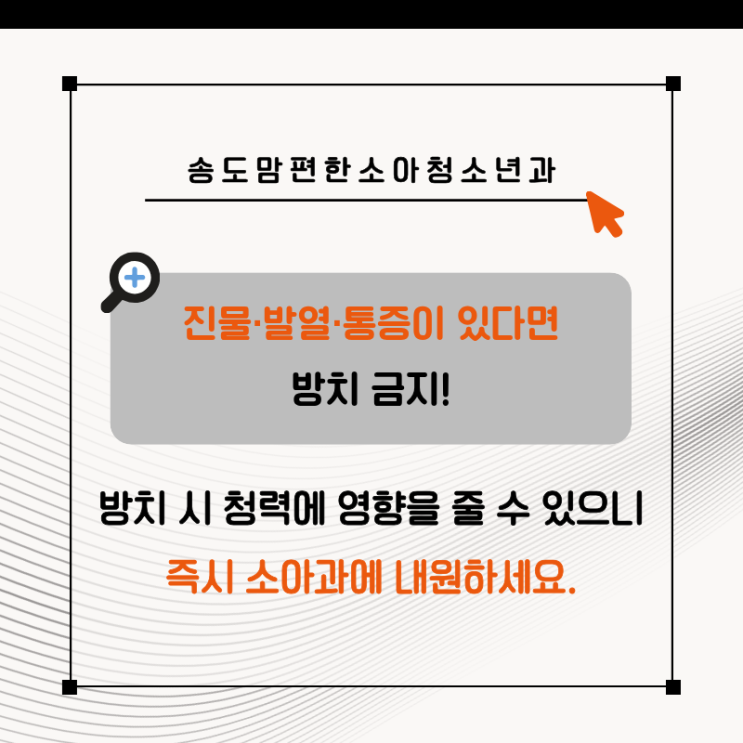
If even one of the items below applies, stop treating it at home and visit a pediatric and adolescent clinic for an accurate examination of the ear with an otoscope.
-
Pain in the outer ear: When your child complains of strong pain as you gently pull the outer ear or press just in front of the ear opening
-
Constant ear rubbing or pulling: When the child cannot sleep at night, keeps reaching for the ear, and cries inconsolably
-
Discharge and foul odor: When yellow or cloudy discharge runs from the ear, or there is an unusual smell
-
Fever and cold symptoms: When ear pain comes with a fever of 38 degrees or higher, or with cold symptoms such as a runny nose or sneezing
🔗 [Ear-condition guides worth reading together]
👉 Left untreated, otitis externa can affect your child’s hearing as well.

A word from SONGDO ANSHIN

SONGDO ANSHIN Main building
Ear pain and ear rubbing in children can involve otitis externa and otitis media together, and without an accurate diagnosis and treatment early on, they can affect hearing or develop into a recurring condition.
If your child keeps touching the ear or seems uncomfortable, please do not hesitate to visit SONGDO ANSHIN for a thorough examination by a pediatric and adolescent specialist.
[SONGDO ANSHIN information]
-
📍 Location: 2nd floor of the Landmark City Central The Sharp officetel commercial complex, 68 Landmark-ro, Yeonsu-gu, Incheon
-
📞 Contact: 032-851-1365
