
Apollo Eye Disease vs. Adenovirus Conjunctivitis: Outbreak Season, Symptoms, Isolation Period, Eye Drop Treatment & School Return Guidelines
Hello, this is SONGDO ANSHIN.
We hope you had a wonderful and bountiful Chuseok holiday! As we reach the end of September, we are entering the season of changing weather ahead of the early-October holidays, a time when infections tend to spread.
With many family gatherings over the recent holiday and bigger swings in daily temperature, we have seen a noticeable rise in worried parents and patients, from children in group settings to adults, visiting us because their eyes suddenly turned red and bloodshot or became crusted with yellow discharge.
“The white of my eye suddenly turned red. Is this contagious Apollo eye disease?”
“Do I need a medical certificate or doctor’s note confirming recovery before my child can go back to daycare, kindergarten, or school?”
In autumn, when daily temperature swings grow larger and immunity tends to drop, contagious eye infections spread steadily through contact at kindergartens, daycare centers, and schools.
Today, SONGDO ANSHIN will walk you through the two most common contagious eye infections, Apollo eye disease and adenovirus conjunctivitis (epidemic keratoconjunctivitis): from how to reliably tell them apart, to clear isolation and school/daycare return guidelines, to practical tips for giving eye drops, all in one easy-to-read overview!
|
💡 [Today’s Key Points in 3 Lines] 1️⃣ Difference in symptoms: Apollo eye disease causes redness that looks like blood pooling in the white of the eye (subconjunctival hemorrhage), while adenovirus conjunctivitis comes with high fever and sore throat, along with heavy yellow eye discharge and eyelid swelling. 2️⃣ Isolation period & school return guidelines: Both conditions are highly contagious, so daycare, school, work for adults, and other outside activities should be avoided until a medical certificate or doctor’s note confirms the patient is no longer contagious. (An isolation period of 1~2 weeks is usually needed.) 3️⃣ Eye drop care: Apply prescribed antibiotic and anti-inflammatory eye drops without letting the bottle tip touch the eye or eyelashes, and never share the drops with the uninfected eye or with other people. |
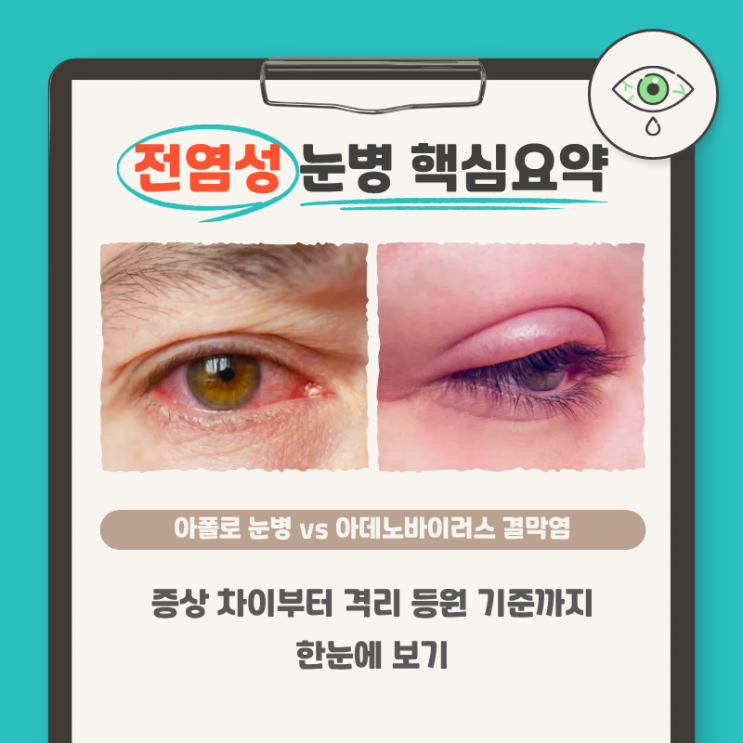
Apollo Eye Disease vs. Adenovirus Conjunctivitis: Key Differences (Outbreak Season & Symptoms)
Contagious eye infections can be distinguished by the causative virus, incubation period, contagiousness, and accompanying symptoms.
|
Category |
Apollo eye disease (acute hemorrhagic conjunctivitis) |
Epidemic keratoconjunctivitis (adenovirus) |
|
Causative virus |
Enterovirus type 70 / Coxsackievirus type A24 |
Adenovirus |
|
Incubation & onset |
1~2 days (onset very quickly after contact) |
5~12 days (onset about a week after exposure) |
|
Characteristic symptoms |
Subconjunctival hemorrhage (red, bruise-like bleeding in the white of the eye) |
Heavy yellow eye discharge, eyelid swelling, with high fever and sore throat |
|
Treatment & isolation period |
About 5~7 days |
About 2~3 weeks (longer course; watch for decreased vision) |
-
Apollo eye disease, meaning and symptoms: It progresses rapidly within 24~48 hours of viral infection, and its hallmark features are subconjunctival hemorrhage, where blood collects in the white of the eye, along with severe eye pain and a foreign-body sensation.
-
Adenovirus conjunctivitis symptoms: It comes with high fever, sore throat, and heavy eye discharge; because the contagious period is long and it spreads easily to adults as well, its course should be monitored carefully.
Exactly How Many Days of Rest? (Isolation Period & School/Daycare Return Guidelines)
Contagious conjunctivitis spreads very quickly through tears, eye discharge, and hand contact, so isolation is the rule until it is confirmed that the patient is no longer contagious.
-
Isolation & contagious period: Strong contagiousness lasts at least 7 days and up to 2 weeks after symptoms appear.
-
When to return to school and daily life: Do not decide on your own to return to daycare, school, or work (for adults) just because the redness or discharge has subsided. Please visit a pediatrician or ophthalmologist and obtain a doctor’s note or medical certificate stating that “the patient is no longer contagious and may resume daily activities,” then submit it.
3 Things Parents Must Know When Giving Eye Drops
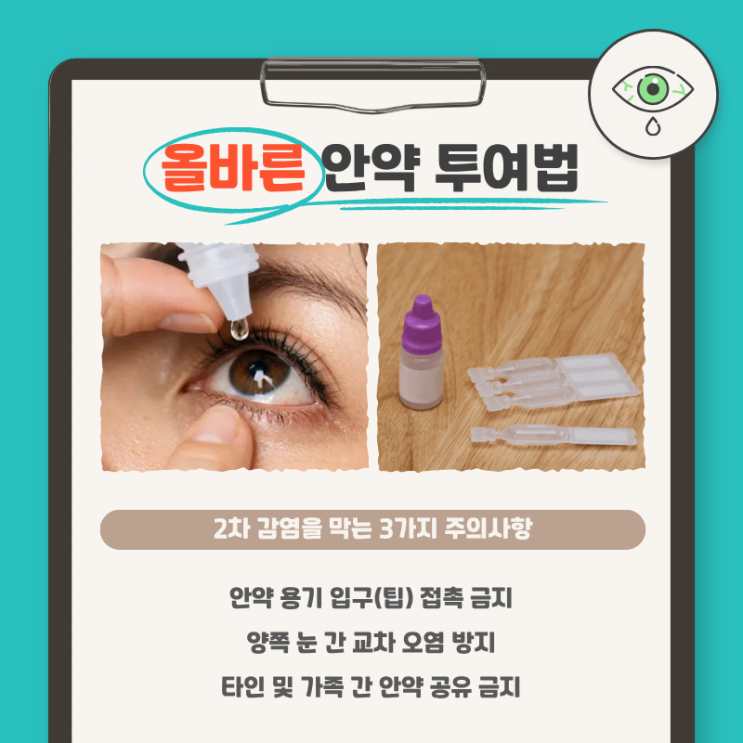
Here are precautions for using the antibiotic eye drops and artificial tears prescribed to treat contagious eye infections.
1️⃣ Never let the bottle tip touch anything
If the tip of the eye drop bottle touches the eyelashes, eyelids, or hands, the entire bottle becomes contaminated with the virus. Hold it about 1~2cm away from the eye when applying the drops.
2️⃣ Prevent cross-contamination between the eyes
When only one eye is infected, if you put drops in the healthy eye after the bottle has touched the infected eye, the virus will be carried straight over.
3️⃣ Never share eye drops with others, other adults, or family members
Using prescribed eye drops together just because a family member or coworker has similar symptoms can cause secondary reinfection. Each person must be examined and use the eye drops prescribed individually for them.
💡 [Recommended Reading]
Childhood Conjunctivitis: What You Need to Know, from Causes and Symptoms to Treatment and Prevention!
From the detailed causes and early symptoms of adenovirus and Apollo eye disease, to how to use artificial tears and antibiotic eye drops, to isolation and prevention rules at home! If you would like more detailed information about childhood conjunctivitis, please also see the post below.
👉 Childhood Conjunctivitis: What You Need to Know, from Causes and Symptoms to Treatment and Prevention!

🩺 [SONGDO ANSHIN Care Information]
If your child has red eyes or yellow eye discharge, or needs care for a contagious eye infection or a doctor’s note or medical certificate confirming recovery, please visit us anytime. Before and after the upcoming October holidays, we will continue to support a safe return to school and daily life with attentive and accurate care.
📍 Location: 2F, Landmark City Central The Sharp Mall, 68 Landmark-ro, Yeonsu-gu, Incheon
📞 Inquiries & Appointments: 032-851-1365
