
RSV Prevention Compared | Why Beyfortus (Direct Infant Antibody) Is More Useful Than Abrysvo (Maternal Vaccine)
Hello, this is the SONGDO ANSHIN Ansim Center.
In autumn and winter, RSV (respiratory syncytial virus), a leading virus that threatens the respiratory health of infants and young children, is a major cause of bronchiolitis and pneumonia and often makes little babies very sick.
Recently, two options have drawn great attention as key RSV preventives: the ‘next-generation direct antibody injection for infants (Beyfortus, nirsevimab)’ and the ‘maternal vaccine given during pregnancy (Abrysvo, RSVpreF)’.
Today, based on the latest large-scale real-world clinical study data from France, we look at the differences between the two preventives and explain in depth why pediatricians in clinical practice recommend ‘Beyfortus’ as the most useful and reliable prevention option!
|
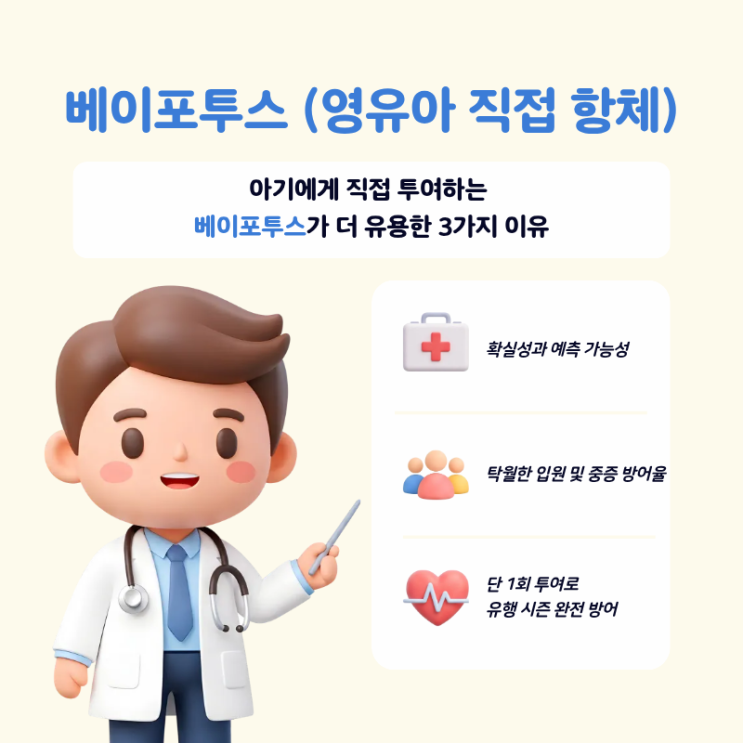
💡 [Key Summary] Why is Beyfortus (direct infant antibody) more useful? 1️⃣ Certainty and predictability: Unlike a maternal vaccine, whose transfer across the placenta can vary with the mother’s immune status or the timing of birth (such as preterm delivery), Beyfortus gives the baby a weight-based, fixed dose of antibody directly, creating an immediate and reliable protective level. 2️⃣ Outstanding protection against hospitalization and severe illness (large real-world study in France): Compared with Abrysvo , it demonstrated excellent effectiveness: a further 26% reduction in RSV-related hospitalization risk, a further 42% reduction in pediatric intensive care unit (PICU) admission risk, and a further 43–44% reduction in the risk of severe illness requiring oxygen therapy or mechanical ventilation. 3️⃣ Full-season protection with a single dose: Given directly to the baby just once at the desired time to match the RSV season (October–March), it maintains strong protection throughout the season. |
How are Beyfortus and Abrysvo different?

|
Category |
Beyfortus |
Abrysvo |
|
Who receives it |
All newborns and infants (injected directly into the baby) |
Pregnant women (vaccinated at 28–36 weeks of pregnancy) and adults (aged 60+ or high-risk) |
|
How it works |
A ready-made RSV monoclonal antibody is given directly (passive immunity) |
After the mother is vaccinated, antibodies pass to the fetus through the placenta (active immunity) |
|
Onset of effect |
100% protective antibodies formed in the body right after the injection |
Some level of antibodies present from birth |
|
Main advantages |
Accurate dosing without maternal or delivery variables; superior protection against severe illness |
Immunity can be prepared before birth; can also be given to adults |
💡 Note: Under the Korean Ministry of Food and Drug Safety (MFDS) approval, Abrysvo is a maternal vaccine that passes antibodies to the fetus through vaccination of pregnant women at 28–36 weeks of pregnancy, and it is also a vaccine to prevent RSV lower respiratory tract disease in adults aged 60 and over and high-risk adults. Beyfortus, on the other hand, gives a weight-based, fixed dose of antibody directly to the baby as a next-generation monoclonal antibody injection.
💡[Recommended Reading: RSV Immunization Guide]
“I understand Beyfortus, but which month is the most effective time for my baby to get it?”
If you are curious, based on KDCA (Korea Disease Control and Prevention Agency) epidemic statistics and large-scale scientific data, about why October and November are the optimal months for immunization, please also check the post below!
👇 When Should My Baby Get the RSV Shot? Why October and November Are Best
[Scientific Data] Analysis of figures from a large real-world clinical study in France
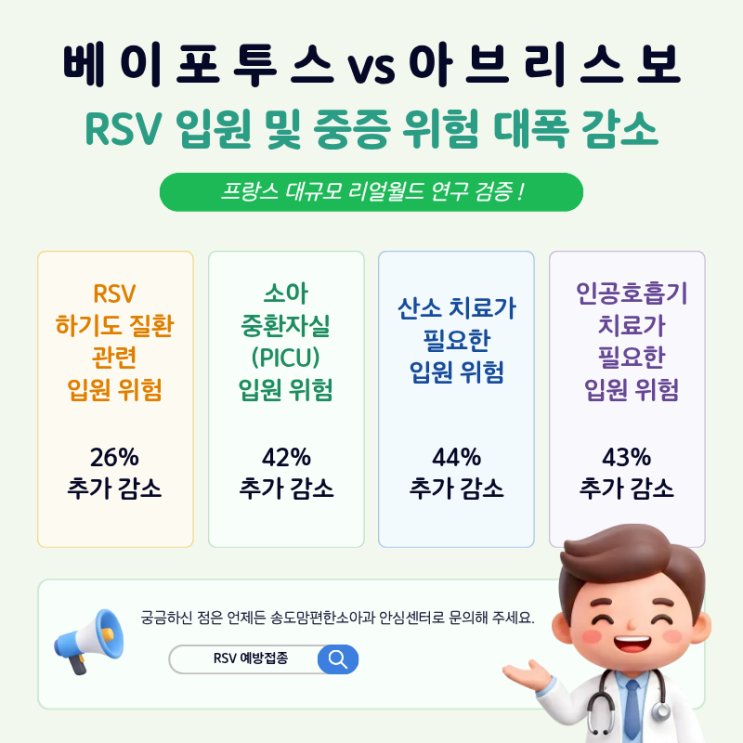
Both preventives are excellent treatments approved by the MFDS, but a large comparative study in France (real-world comparative analysis) that analyzed actual hospitalization data from a total of 42,560 infants showed that infants who received Beyfortus achieved even better prevention outcomes.
|
Outcome (Primary & Secondary Outcomes) |
Beyfortus group vs Abrysvo group |
Risk reduction (Lower Risk) |
|
Risk of hospitalization for RSV lower respiratory tract disease (Primary outcome) |
1.0% (212/21,280) vs 1.3% (269/21,280) |
26% further reduction (HR: 0.74) |
|
Risk of pediatric intensive care unit (PICU) admission |
0.3% (55/21,280) vs 0.5% (101/21,280) |
42% further reduction (HR: 0.58) |
|
Risk of hospitalization requiring oxygen therapy |
0.2% (39/21,280) vs 0.4% (76/21,280) |
44% further reduction (HR: 0.56) |
|
Risk of hospitalization requiring mechanical ventilation |
0.2% (51/21,280) vs 0.4% (89/21,280) |
43% further reduction (HR: 0.57) |
(※ Data source: In a real-world comparative analysis from France, Beyfortus® was associated with a lower risk of RSV hospitalization and severe outcomes compared to RSVpreF)
🔬 Key findings:
In real-world clinical practice, compared with Abrysvo, Beyfortus not only lowered the risk of RSV-related hospitalization by a further 26%, but also substantially reduced the risk of progressing to severe illness requiring PICU admission, oxygen or mechanical ventilation by 42–44%.
Why we recommend Beyfortus
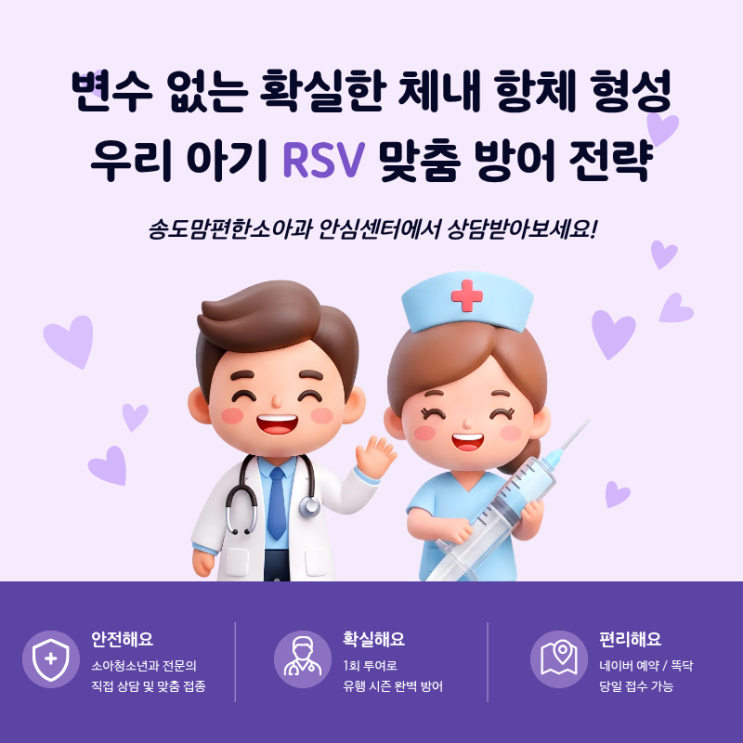
The maternal vaccine (Abrysvo) is also a meaningful prevention option, but Beyfortus, given directly to the baby, removes variability in antibody levels and lowers the risk of hospitalization and severe illness even further, making it a more useful and reliable treatment in clinical practice.
(※ Note: Previously, ‘Synagis’, a first-generation antibody injection that had to be given once a month for a total of 5 doses during the RSV season, was used for high-risk premature babies. Recently, the next-generation antibody injection ‘Beyfortus’, whose strong protection lasts the entire season after just a single dose, has become far more widely used.)
In particular, if you could not get vaccinated during pregnancy, if there are concerns about maternal antibody transfer due to preterm birth, or if you want to give your baby the most reliable and powerful shield during the RSV season, we strongly recommend Beyfortus.
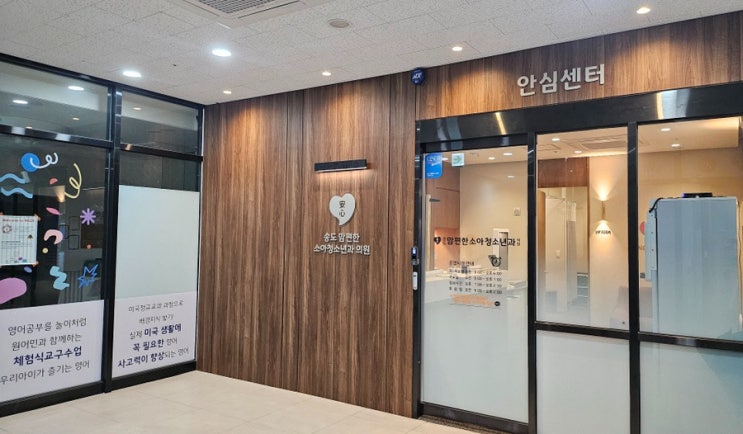
If you have any questions about the timing of your baby’s RSV immunization or Beyfortus, please feel free to visit the SONGDO ANSHIN Ansim Center anytime for a consultation with our pediatric specialists!
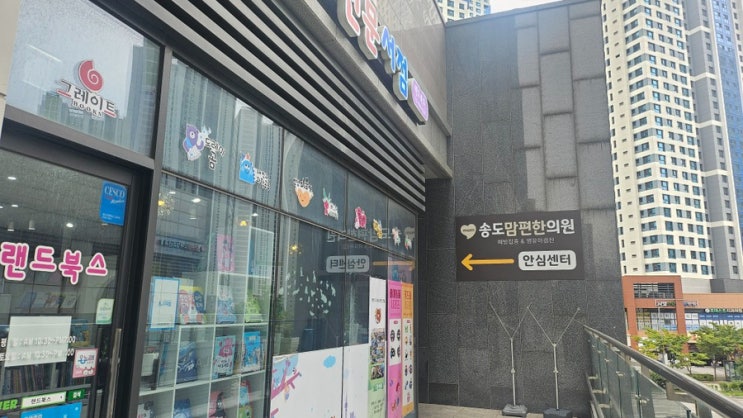
🏥 SONGDO ANSHIN Ansim Center
-
Location: 2F, Units 228 & 229, Building 204 shopping mall, Landmark City Central The Sharp, 68 Landmark-ro, Yeonsu-gu, Incheon
-
Inquiries: 032-851-1365
