
What Happens If You Stop Mounjaro? A Complete Guide to Changes and Side Effects After Stopping

Hello, this is SONGDO ANSHIN Obesity Clinic.
In Part 1, we looked at Mounjaro (active ingredient: tirzepatide) and its excellent diabetes treatment results and 3-year preventive effect (NEJM study). (※ See the related link at the bottom for the Part 1 post)
In the exam room, the questions we hear most often are “How long do I need to keep taking Mounjaro?” and “What happens if I stop the medication?” So what answers is the medical community giving to these questions?
In today’s Part 2, we comprehensively summarize the observational study on stopping Mounjaro published in a JAMA-family journal, along with side effects and even the limitations of the research.
|
💡[Key Summary] Changes After Stopping Mounjaro & Overall Summary
|
Result 3. What if you stop the medication? – Blood sugar returns as much as weight returns

▶️ SURMOUNT-4 (JAMA 2024) and the post hoc analysis (JAMA Intern Med 2026)
SURMOUNT-4 is a study in which 670 adults with obesity or overweight but without diabetes received tirzepatide (10 or 15mg) for 36 weeks and lost an average of 20.9%; then half continued the injections while the other half were switched to placebo without knowing it, and they were followed for 1 year.
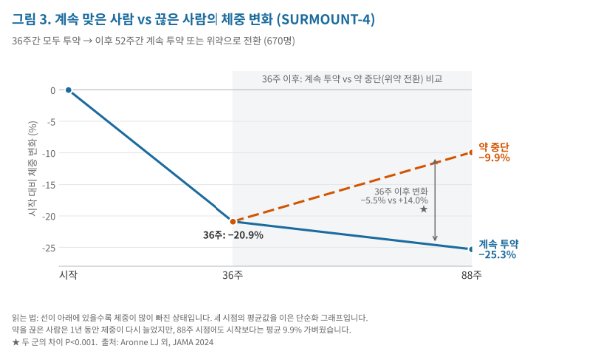
Those who continued lost a further 5.5% over the year, while those who stopped regained 14.0%. Even so, at week 88 those who stopped were still on average 9.9% lighter than their starting weight.
The post hoc analysis* published in 2026 divided the 308 people who stopped the medication into 4 groups according to how much of their lost weight they regained, and examined how their blood sugar, waist circumference, and blood pressure changed.
(※ Post hoc analysis: re-dividing and analyzing the data from an already completed study to answer a new question)
|
Lost weight regained |
Participants |
HbA1c |
Waist circumference |
Systolic blood pressure |
|
Less than 25% |
54 |
+0.14%p |
+0.8cm |
+6.8mmHg |
|
25~50% |
77 |
+0.15%p |
+5.4cm |
+7.3mmHg |
|
50~75% |
103 |
+0.27%p |
+10.1cm |
+9.6mmHg |
|
75% or more |
74 |
+0.35%p |
+14.7cm |
+10.4mmHg |
Table 3. Changes 1 year later (week 88) compared with the time of stopping (week 36). The more lost weight was regained, the more every indicator rose.
|
💡Key Points • 8 in 10 people who stopped the medication (82.5%) regained 25% or more of their lost weight within 1 year. • The more weight came back, the more blood sugar, waist circumference, and blood pressure also reverted. In the group that regained 75% or more, metabolic indicators came close to pre-treatment levels. • Conversely, those who kept their weight off well after stopping (about 18%) maintained most of their improvements in waist circumference, cholesterol, and insulin. However, blood sugar and blood pressure rose somewhat even in this group. |
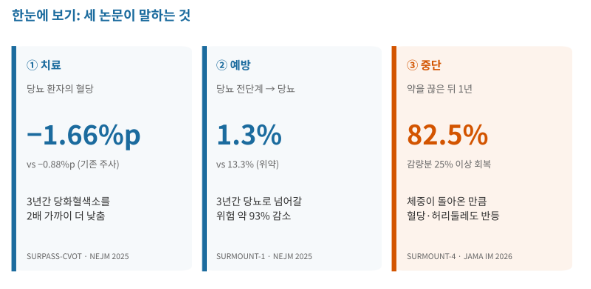
Key Summary of the Three Papers at a Glance

|
Question |
The papers’ answer |
Evidence |
|
Does it lower blood sugar better than existing diabetes injections? |
Yes. Over 3 years, HbA1c −1.66%p vs −0.88%p |
SURPASS-CVOT |
|
Is it safe for the heart? |
Comparable to or better than a proven existing injection |
SURPASS-CVOT |
|
Does it prevent diabetes in prediabetes? |
About 93% lower risk of progressing to diabetes over 3 years |
SURMOUNT-1 |
|
Do the effects remain after stopping? |
Some remain, but weight and blood sugar gradually return |
SURMOUNT-1, -4 |
Table 4. Key summary of the three papers
What were Mounjaro’s side effects like?

The most common side effects were gastrointestinal symptoms such as nausea, diarrhea, constipation, and vomiting. Most were mild to moderate, occurring mainly early in dose escalation and decreasing over time.
|
Item |
SURPASS-CVOT (tirzepatide vs dulaglutide) |
SURMOUNT-1 3 years |
SURMOUNT-4 |
|
Gastrointestinal side effects |
42.5% vs 35.9% |
Most common, mainly in the first 20 weeks (dose-escalation period) |
Most common, mostly mild to moderate |
|
Discontinuation due to side effects |
13.2% vs 10.1% |
More than placebo |
7.0% during the initial 36 weeks (mainly gastrointestinal symptoms) |
|
Serious adverse events |
About 31.8% vs 31.9% (similar) |
No unexpected serious adverse events |
— |
|
Other cautions |
— |
More gallbladder disease than placebo |
— |
Table 5. Comparison of side effects
As is commonly seen with treatments that reduce weight quickly, gallbladder disease such as gallstones may increase. If you have persistent pain in the upper right abdomen, be sure to tell your care team.
Significance and Limitations of These Studies
✅ Significance
• These are large-scale, long-term studies that followed thousands to over 10,000 people for 3–4 years, making them high-quality evidence published in NEJM and JAMA-family journals.
• They went beyond ‘how much does it lower blood sugar’ to answer real clinical questions about the heart and kidneys, diabetes prevention, and ‘what happens if you stop’.
• About half of the diabetes-prevention effect appeared independently of weight loss, suggesting an effect that improves glucose metabolism itself.
✅ Limitations
• The comparator drug in SURPASS-CVOT was dulaglutide 1.5mg. Compared with a higher dose, the difference might have been smaller, and the cardiovascular effect was shown to be ‘comparable or better’, not proven to be ‘superior’.
• SURMOUNT-1 and -4 enrolled adults with obesity but without diabetes, and about 73% of SURMOUNT-1 participants were white. Caution is needed in applying the results directly to Korean patients with diabetes.
• The observation period after stopping the medication was short, 17 weeks to 1 year, so changes over longer periods are not yet known.
• The SURMOUNT-4 post hoc analysis re-divided a completed study, so it is difficult to conclude a causal relationship that ‘blood sugar rose because the weight came back’.
• All three studies were sponsored by the pharmaceutical company (Eli Lilly), and all were conducted in adults. They do not apply directly to children and adolescents.
A Word of Advice from SONGDO ANSHIN Obesity Clinic

Taken together, the three papers send a clear message. Tirzepatide lowered blood sugar in people with diabetes far more than existing injections, and greatly reduced the rate of progression from prediabetes to diabetes. The effect itself is certain.
However, this effect is maintained most strongly ‘while you are taking it’. When you stop the medication, weight gradually returns, and as weight returns, blood sugar and waist circumference return with it. Like blood pressure or cholesterol medication, treating metabolic disease is closer to long-term management than a short-term diet.
That does not mean everyone must keep taking it in the same way. It is important to decide, individually and while watching changes in blood sugar and weight, how to maintain results after reaching your goal and how to carry lifestyle habits along with it. In fact, people who kept their weight off well after stopping preserved a substantial part of the benefits.
|
💡In Summary • Proven effectiveness — Confirmed by large-scale studies in both diabetes treatment and prevention. • Consistent maintenance — Stopping without a plan brings weight and blood sugar back together. • Rather than deciding alone whether to start, continue, or stop, we recommend making the decision in consultation with a specialist, together with regular blood sugar and weight checks. |
🔗 Recommended Mounjaro (Tirzepatide) Research Series to Read Together
“If you are curious about Mounjaro’s diabetes treatment results and 3-year long-term preventive effect (large-scale NEJM clinical trial),
▽ check out the Part 1 post below!
👉 [Part 1] Mounjaro’s Effects and Diabetes Prevention! See the Analysis of the Latest 3-Year NEJM Follow-up Research

📚 References
1. Nicholls SJ, Pavo I, Bhatt DL, et al.; SURPASS-CVOT Investigators. Cardiovascular Outcomes with Tirzepatide versus Dulaglutide in Type 2 Diabetes. N Engl J Med. 2025;393:2409-2420.
2. Jastreboff AM, le Roux CW, Stefanski A, et al.; SURMOUNT-1 Investigators. Tirzepatide for Obesity Treatment and Diabetes Prevention. N Engl J Med. 2025;392(10):958-971.
3. Horn DB, Linetzky B, Davies MJ, et al. Cardiometabolic Parameter Change by Weight Regain on Tirzepatide Withdrawal in Adults With Obesity: A Post Hoc Analysis of the SURMOUNT-4 Trial. JAMA Intern Med. 2026;186(2):157-167. doi:10.1001/jamainternmed.2025.6112
(Reference) Aronne LJ, Sattar N, Horn DB, et al. Continued Treatment With Tirzepatide for Maintenance of Weight Reduction in Adults With Obesity: The SURMOUNT-4 Randomized Clinical Trial. JAMA. 2024;331(1):38-48.
SONGDO ANSHIN
※ This article explains academic papers in plain language for the general public and does not replace medical advice.
