
Can Air Conditioning Cause Diarrhea? Diarrhea and Abdominal Pain Without Fever: How to Tell Summer Gastroenteritis from Air-Conditioning Sickness

As the weather turns sharply hotter, this is the season when the air conditioner runs all day long, both at home and at daycare centers and kindergartens.
That is why, recently, the number of parents asking “Doctor, my child has no fever, but suddenly says their tummy hurts and has diarrhea. Can air conditioning really cause diarrhea? Or could it be gastroenteritis?” and rushing to the clinic has increased noticeably.
In summer, acute gastroenteritis caused by spoiled food or a virus is indeed widespread, but when we actually examine the child, the cause is very often not food at all: it is air-conditioning sickness (a stomach cold) brought on by too much cold air-conditioned air.
“There is no cough at all, so how can a tummy ache with diarrhea be a cold?” For every parent surprised by that, today we will pinpoint the difference between air-conditioning sickness and gastroenteritis in children (so easy to confuse in summer), along with the right way to manage your air conditioner, clearly and simply!
|
💡 Key summary: Diarrhea in a child with no fever! Gastroenteritis? Or air-conditioning sickness?
|
Your child’s symptoms: a guide to telling gastroenteritis from air-conditioning sickness
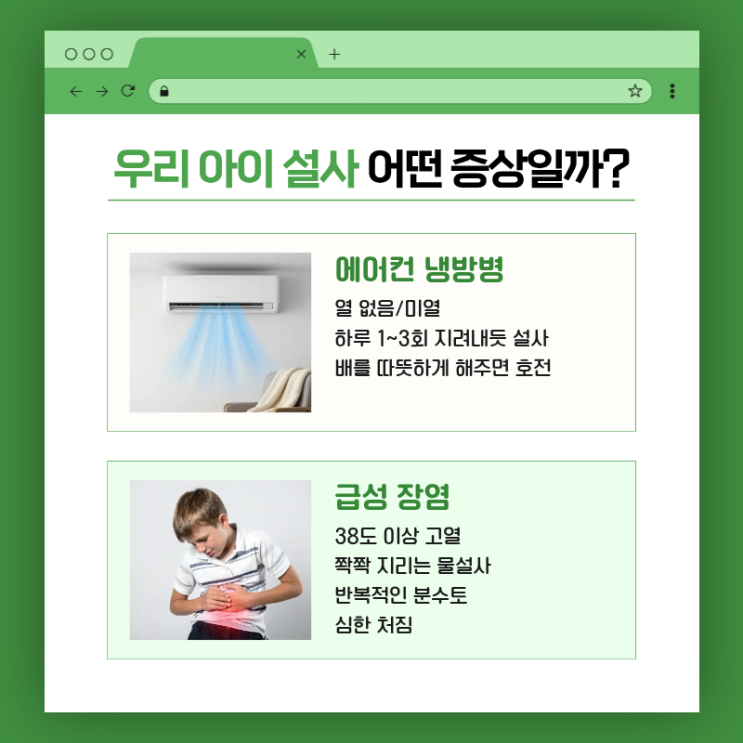
If you observe your child’s symptoms carefully, you can get a fairly clear hint. Pay particular attention to three things: whether a fever is present, the pattern of the diarrhea, and the number of vomiting episodes.
|
Category |
🦠 Bacterial/viral gastroenteritis |
❄️ Air-conditioning sickness (stomach cold) |
|
Cause |
Spoiled or contaminated food, gastroenteritis virus infection |
Extreme indoor–outdoor temperature gap, exposure to cold drafts |
|
Pattern of diarrhea |
The number of episodes per day is very high, with gushing watery diarrhea or mucus-like stools that resemble nasal discharge |
Roughly 1~3 times a day of seeping diarrhea with a nagging ache |
|
Vomiting frequency |
Even with no food eaten, projectile vomiting repeats, bringing up even stomach acid |
Settles after vomiting once or twice, or the child only says they feel queasy |
|
Accompanying symptoms |
A high fever of 38°C or above comes with it, and the child becomes severely lethargic |
Low-grade fever or no fever at all, accompanied by a runny nose and sneezing |
|
Characteristics |
Symptoms worsen as time passes and dehydration sets in |
Turning off the air conditioner and warming the tummy eases the symptoms |
💡 The easiest tip for telling them apart!
Does your child have diarrhea with no fever and a slightly runny nose, say “my tummy aches a bit,” and then settle down soon after some warm water or a gentle tummy massage? If so, rather than gastroenteritis, an upset stomach caused by air-conditioning sickness is far more likely.
🔗 Worth reading together: What to do when your child’s tummy trouble really is “summer gastroenteritis”
If your child’s symptoms point to “real gastroenteritis” rather than simple air-conditioning sickness, early management matters more than anything.
If you would like to know the specific causes of gastroenteritis in children as we explain them in the consultation room, along with a careful way to check for dehydration that is easy to follow at home, ▽ please read our earlier post below as well!
👉 [What causes gastroenteritis in children? Read the earlier post]

How to manage your air-conditioning environment properly in summer
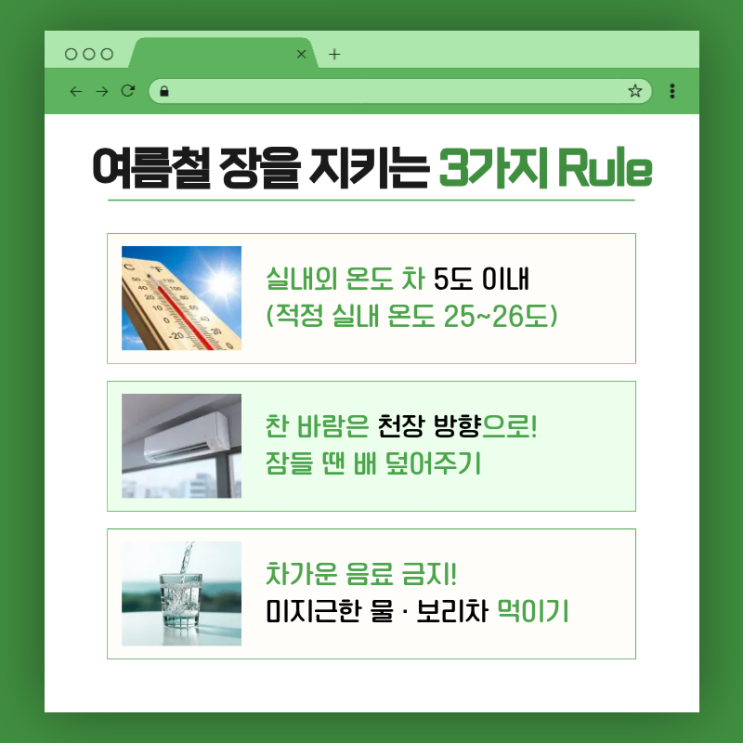
In the consultation room we always urge parents of a child with an upset stomach to follow these summer indoor environment rules.
-
🌡️ Keep the indoor–outdoor temperature difference within 5℃!
If it is over 30°C outside and you set the room to 22~23°C, a child’s body cannot cope. For a home with a baby in summer, the best indoor temperature is 25~26℃, and keeping humidity at 40~60% is ideal.
-
🌀 Always point the air-conditioner airflow toward the ceiling!
When cold air hits a child’s body directly, it leads to an upset stomach or air-conditioning sickness almost every time. Point the airflow toward the ceiling, and when your child falls asleep, use a thin blanket or swaddle to be sure to cover the tummy at least, and you can protect their intestines.
-
🥛 Give “lukewarm water” instead of cold drinks
When it is hot and you give one cold item after another straight from the fridge (cold water, juice, ice cream), the irritated intestines churn even more.
When signs of an upset stomach appear, even though it takes a little effort, give lukewarm water kept at room temperature or warm barley tea little by little and often, to soothe the intestines.
A word of advice from SONGDO ANSHIN

A mild stomach cold caused by air-conditioning sickness improves quickly once the indoor environment is adjusted to be warmer and the child takes the medication prescribed at the pediatric clinic. However, if your child has repeated projectile vomiting, passes noticeably less urine and grows lethargic, or has blood mixed in the stool, this may be acute gastroenteritis or another condition rather than simple air-conditioning sickness, so please come to the clinic without delay.
“What is causing my child’s tummy ache?” Please do not worry about it alone. Whenever anything feels even slightly unclear, feel free to visit SONGDO ANSHIN at any time. We will examine your child carefully so that all our children can enjoy a healthy, cool summer. This has been SONGDO ANSHIN. Thank you.
🩺 [SONGDO ANSHIN Consultation Information]
-
Consultation hours
· Weekdays: 09:00 ~ 20:00 (evening care available)
· Saturday: 09:00 ~ 14:00 (open through lunch)
· Sunday, public holidays: 10:00 ~ 14:00 (open through lunch)
-
Consultation and reservation : 032-851-1365
-
Directions : 2nd-floor retail, Building 203, Central The Sharp Officetel, Landmark City, 68 Landmark-ro, Yeonsu-gu, Incheon
