
Sudden Red Spots on the Body? How to Tell Heat Rash, Post-Fever Rash (Roseola) and Sun Allergy Apart & How to Use Ointments

There is a question we hear often from parents in the consultation room as outdoor activities increase and the weather turns hot.
“Doctor, we were outdoors yesterday and suddenly something red came up all over my child’s body. Is it heat rash?”
“My child had a fever for a few days, and then a rash suddenly broke out all over the body. What should I do?”

As the lingering late-summer heat continues, skin rashes appear frequently.
The problem is that heat rash, post-fever rash (roseola) and sun allergy all look like similar red spots or tiny bumps at first glance.
Only when you know the exact cause can you respond correctly, whether that means cooling the skin, moisturizing, or seeking treatment with a prescribed ointment.
Today SONGDO ANSHIN clearly sums up how to tell the three most common skin rashes apart, along with the practical home-care tips every parent should know!
|
💡[Key Summary: How to Tell the 3 Skin Rashes Apart]
|
Heat rash vs. post-fever rash vs. sun allergy
A side-by-side comparison
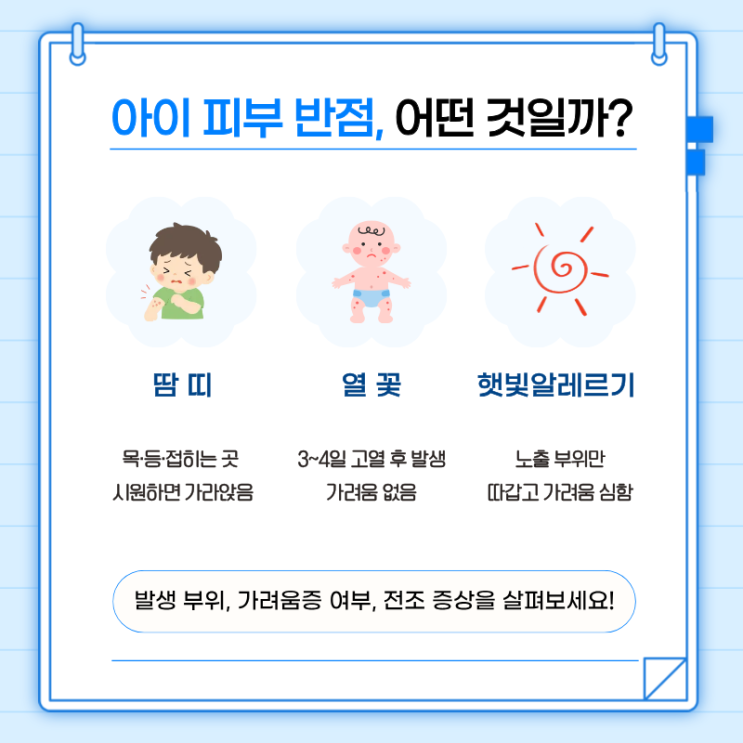
A rash on the skin can be told apart easily by looking at where it appears, whether it itches, and what symptoms came before it.
|
Category |
💦 Heat rash |
🌡️ Post-fever rash (roseola) |
☀️ Sun allergy |
|
Main cause |
Sweat pores blocked by excessive sweating |
A recovery-phase symptom after a viral infection |
Skin hypersensitivity to ultraviolet exposure |
|
Where it appears |
Folds such as the neck, back, armpits and diaper line |
Starts on the face and trunk and spreads to the arms and legs |
Arms, legs and the back of the neck left exposed by short sleeves and shorts |
|
Itching |
Present (the child scratches or is fussy) |
Almost none (the child feels well) |
Severe (stinging or itching) |
|
Key distinguishing feature |
Reddens when body temperature rises and settles when the child cools down |
Appears as the fever comes down after a 38~39°C fever lasting 3~4 days |
Comes up like hives within a few hours after outdoor activity |
From a pediatric specialist
Correct home-care rules for each condition

1️⃣ Heat rash: “keeping cool” is the answer, and powder is a no!
Children have a higher baseline body temperature than adults and a higher density of sweat glands, so heat rash develops easily.
-
⚠️ Caution: The baby powder many families use clumps together with moisture and actually blocks the sweat pores and worsens inflammation, so it should be avoided.
-
✨ Care tip: Keep the indoor temperature cool and wash sweat off often with lukewarm water. Soothing gel gives a good temporary cooling effect, but applying too much can leave the skin dry, so let it absorb and finish with a light lotion.
2️⃣ Post-fever rash: time is the cure, so focus on “moisturizing” and “temperature control”
A post-fever rash caused by roseola and similar illnesses is a natural sign that the illness is running its course.
-
⚠️ Caution: Because a post-fever rash causes no itching or pain, there is no need at all to apply a steroid ointment on your own.
-
✨ Care tip: It usually fades on its own within 3~4 days without leaving a scar. Keep the indoor environment comfortable, and because the skin barrier may be weakened, reapply a gentle, non-irritating moisturizer often.
💡 Wait! What if a high fever comes with a red rash or a ‘strawberry tongue’?
Besides roseola, the recently circulating scarlet fever or Kawasaki disease may also be a possibility.
If you are curious about the difference between a post-fever rash and a scarlet fever rash, please see the post below as well!
▼ [Scarlet Fever: From Early Symptoms to Strawberry Tongue Rash and How It Differs from Roseola]

3️⃣ Sun allergy: calm it with a “cold compress” and block the “ultraviolet rays”
When ultraviolet rays are strong during the day, children with a weak skin barrier can develop hives or red spots after even a short time outdoors.
-
⚠️ Caution: If it is mistaken for simple heat rash and left alone, the itching and pain can keep a child awake all night.
-
✨ Care tip: As soon as symptoms appear, cool the skin down with running cold water or a clean cold towel. When going out, children 6 months and older should always wear a dedicated sunscreen, and dressing them in thin long sleeves to block direct sunlight is the best prevention.

Correct use of skin ointments
(Bepanthen, Lidomex, Lacticare)

Many parents keep these ointments at home as staples and apply them as soon as a rash appears. But each ointment has entirely different ingredients and uses.
-
Bepanthen (non-steroidal dexpanthenol): It helps skin regeneration and soothing, so it works well as supportive care for early heat rash, mild skin eruptions or diaper rash.
-
Lidomex / Lacticare (mild steroid ointments): These are medicines used when itching or inflammation is severe. Applied briefly and precisely for sun allergy or for heat rash that itches enough to be scratched, they are effective, but overusing them without knowing the cause can break down the skin barrier. In particular, there is no need to apply a steroid ointment to a post-fever rash (roseola), which does not itch.
If the rash lasts more than two days even with cool home care, if the child scratches enough to lose sleep at night, or if it starts to ooze, it is safest to get an accurate ointment prescription at the pediatric clinic before it leads to a secondary bacterial infection.
For our children’s soft, healthy skin, we will always examine them carefully and thoroughly.
