[Influenza and COVID-19 Spreading Together] Influenza A arrives a month earlier than last year! September high-fever surge and Twindemic alert (how to tell influenza from COVID-19)
Now that we have entered September, amid the simultaneous spread of influenza and COVID-19, the number of parents rushing to the clinic holding the hand of a child with a sudden high fever has noticeably increased.
Influenza usually begins to circulate in earnest from October onward, but according to the latest announcements from the health authorities and recent news reports, influenza A virus has been detected as much as about a month earlier than last year, and an early-epidemic alert has been raised.
In particular, with suspected influenza cases nearly doubling in just 3 weeks and COVID-19 hospitalizations also more than doubling in 4 weeks, the ‘Twindemic’ – influenza and COVID-19 circulating at the same time, and even cases of dual infection with both viruses at once, are being confirmed one after another in clinical practice.
Today, SONGDO ANSHIN clearly summarizes the latest epidemic trends, the differences in symptoms between the two illnesses, and the response steps every parent should know.
|
📌 [Key summary] The ‘Twindemic’ – influenza and COVID-19 spreading together: remember at least these points!
|
Influenza arriving a month earlier than last year – epidemic trends in the statistics

According to the latest surveillance data released by the Korea Disease Control and Prevention Agency and the Institutes of Health and Environment, the rise in respiratory infections at this change of season is not to be taken lightly.
-
Sharp rise in influenza-like illness cases : The number of suspected influenza patients per 1,000 outpatients soared from 7.0 to 13.3 – nearly double – in only 3 weeks.
-
Rise in COVID-19 hospitalizations : Hospital-level COVID-19 inpatients also more than doubled in 4 weeks (48 → 109 patients), showing a renewed wave.
-
Influenza A detected a month early : According to detection results from the municipal Institutes of Health and Environment, influenza A(H1N1)pdm09 – the virus that typically dominates in winter – was already detected for the first time in late August to early September, about a month earlier than last year (first week of October).
This coincides with the change of season when children return to group settings such as school and kindergarten, so the virus is spreading very quickly.
Influenza vs COVID-19 – how do our children’s symptoms differ?
When the two illnesses circulate together, both come with a fever of 38~40 degrees or higher, but they differ in the details.
📊 [Influenza vs COVID-19 – key symptom comparison]
|
Category |
Influenza (influenza A) |
COVID-19 |
|
Fever pattern |
Sudden very high fever of 39~40℃ |
Fever together with whole-body fatigue |
|
Main respiratory symptoms |
Cough, sore throat, runny nose – like a common cold |
Severe throat pain (hard to swallow even saliva), chest tightness |
|
Distinctive symptoms |
Headache, muscle aches, in young children, accompanied by vomiting and diarrhea |
Extreme loss of appetite, loss of taste and smell |
|
Whole-body symptoms |
Aching all over with a sharp drop in energy |
Severe body aches, as if beaten all over |
💡A note from the specialist
In children and adolescents, influenza commonly brings gastrointestinal symptoms such as vomiting, abdominal pain and diarrhea, not just cough.
COVID-19, on the other hand, often shows up as a child who cannot eat at all, saying “I have completely lost my appetite” or “My throat hurts as if it were tearing”.
“Putting off care while the fever continues can turn serious!” – a dual-infection warning
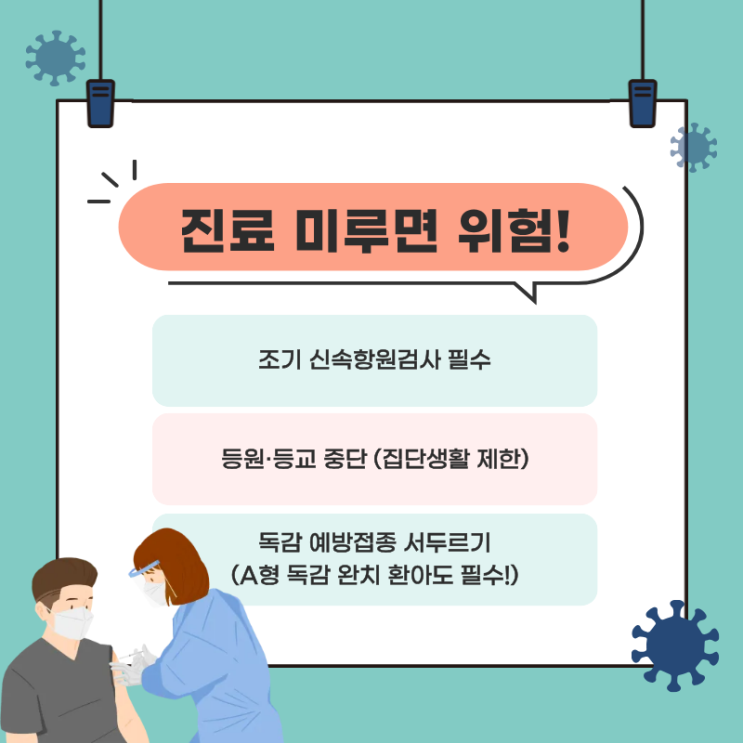
Recently, some parents think “It is probably just a seasonal cold” or “Let us give an antipyretic and watch how it goes” and, after observing at home for a few days, miss the right timing for care.
But when the two viruses circulate at the same time, the possibility of ‘dual infection’ with both illnesses cannot be ruled out.
1️⃣ Early rapid antigen testing is essential
Only by visiting a pediatric clinic early in the fever and having precise influenza and COVID-19 testing can the exact causative virus be identified, so that a suitable antiviral (Tamiflu, Peramiflu, etc.) can be given at the right time.
2️⃣ Stop daycare and school attendance (limit group activity)
Transmission through coughing and sneezing is very strong in the early stage of infection. If your child has a fever and symptoms, stop daycare and school attendance immediately and let them rest.
3️⃣ Hurry with influenza vaccination (essential even for children who have recovered from influenza A!)
Since the influenza virus has arrived a month earlier than last year, getting vaccinated on schedule – through the national free vaccination program and this season’s vaccination timetable, without postponing – is the surest way to prevent severe complications.
In particular, children who have already had influenza A and recovered must still receive the NIP (national free vaccination) that begins on September 28. Influenza B usually follows about 2 months after influenza A circulates, and having had influenza A does not mean immunity to influenza B as well.
To stay safely protected all the way through a renewed influenza B wave this winter, vaccination is essential.
Closing

SONGDO ANSHIN Safe Care Center (Vaccination Center)
Even when an infection in a child or adolescent starts out mild, once case numbers surge as in this simultaneous spread of influenza and COVID-19, the risk of severe complications, febrile seizures and dehydration grows.
If your child shows a sudden high fever, severe throat pain, vomiting or loss of appetite, please do not hesitate to visit us for a specialist’s diagnosis and precise testing.
At SONGDO ANSHIN we have built a system of rapid influenza and COVID-19 testing and individualized treatment, and we will do our utmost to help your child escape the distress of a high fever as quickly as possible.
💡 [Recommended reading]
“No runny nose, no cough – but suddenly a 40-degree fever and nothing else?”
If you would like to know about the unusual symptom pattern of influenza A in children, where high fever erupts with no early warning signs, and about the golden time for Tamiflu and Peramiflu treatment that prevents febrile seizures, please take a look at the post below ▽!
👉 Baby has no runny nose or cough but a 40-degree fever? Summer influenza A symptoms and the Tamiflu golden time