Baby’s fever of 39°C won’t come down after an antipyretic? Alternating-dose intervals & how to handle a febrile seizure (Chuseok holiday clinic schedule)

Your child’s temperature has climbed to 39°C in the middle of the night,
and the antipyretic isn’t bringing it down!
In the middle of the night or at dawn, when a child who had been sleeping soundly suddenly has a hot forehead and the thermometer reads 38.5°C or 39°C, a parent’s heart sinks in an instant and starts to race.
Especially when open clinics and pharmacies are hard to find during the long Chuseok holiday, a sudden high fever in a child brings on worries such as “I gave an antipyretic, so why won’t the fever come down?”, “Should we go to the emergency room right away?”, “What if my child has a febrile seizure?”, and many parents end up lying awake all night.
Today SONGDO ANSHIN covers the safe rules for alternating antipyretics to use when your child’s fever won’t come down, the emergency response to a febrile seizure, which alarms parents most, and our clinic’s schedule during the Chuseok holiday, all explained in clear, easy-to-follow terms.
|
💡[Key summary] Baby’s high fever and the rules for alternating antipyretics 1️⃣ Dosing within the same class : Give an antipyretic with the same active ingredient at intervals of at least 4~6 hours. 2️⃣ Alternating with a different class : Alternate an antipyretic with a different active ingredient at intervals of at least 2 hours (when 38.5°C or above persists). 3️⃣ If a febrile seizure occurs : Lay the child on a flat surface and be sure to turn the head to one side to keep the airway open. 4️⃣ What not to do : While your child is unconscious or having a seizure, never put your hand or an object into the mouth and never force an antipyretic. |
Rules and timing intervals for alternating antipyretics
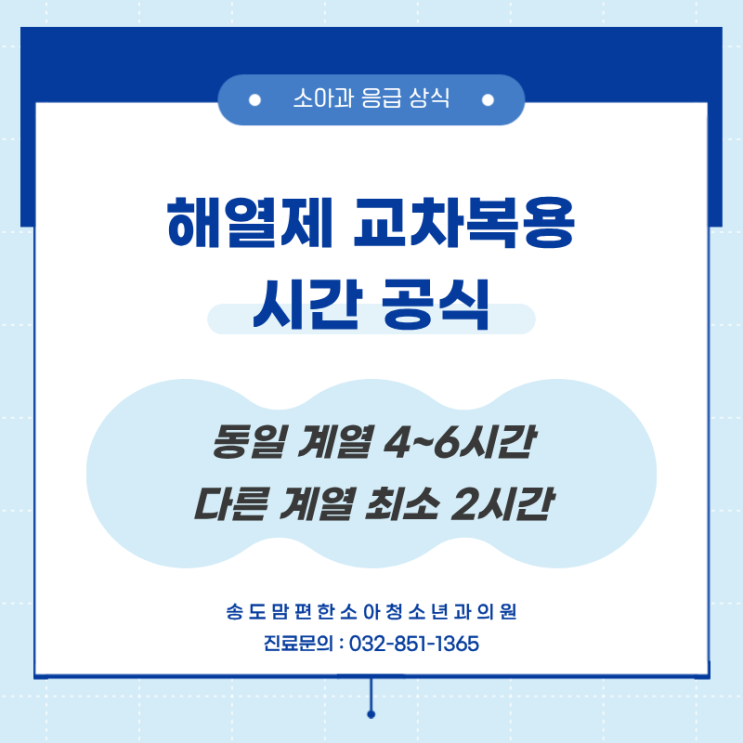
Alternating dosing means giving two antipyretics with different active ingredients in turn when one alone is not bringing the fever down.
📊 [Antipyretic classes and dosing-interval guide]
|
Category |
Acetaminophen class |
Ibuprofen / dexibuprofen class |
|
Representative product names |
Champ Syrup (red), Tylenol, Cetopen, FineQ |
Champ Ibufen (blue), Maxibufen, Ibuprofen |
|
Re-dosing within the same class |
At least 4~6 hours apart |
At least 4~6 hours apart |
|
Alternating with a different class |
At least 2 hours apart (when 38.5°C or above persists) |
At least 2 hours apart (when 38.5°C or above persists) |
-
When giving the same class : leave at least 4~6 hours between doses to stay safe.
-
When alternating with a different class : if a high fever of 38.5°C or above persists 2 hours after the first antipyretic, give an antipyretic of the other class, keeping at least 2 hours between doses.
⚠️ Precautions
Even when alternating, never exceed the maximum daily dose for your child’s body weight (over a 24-hour period).
🚨Emergency steps when a febrile seizure occurs
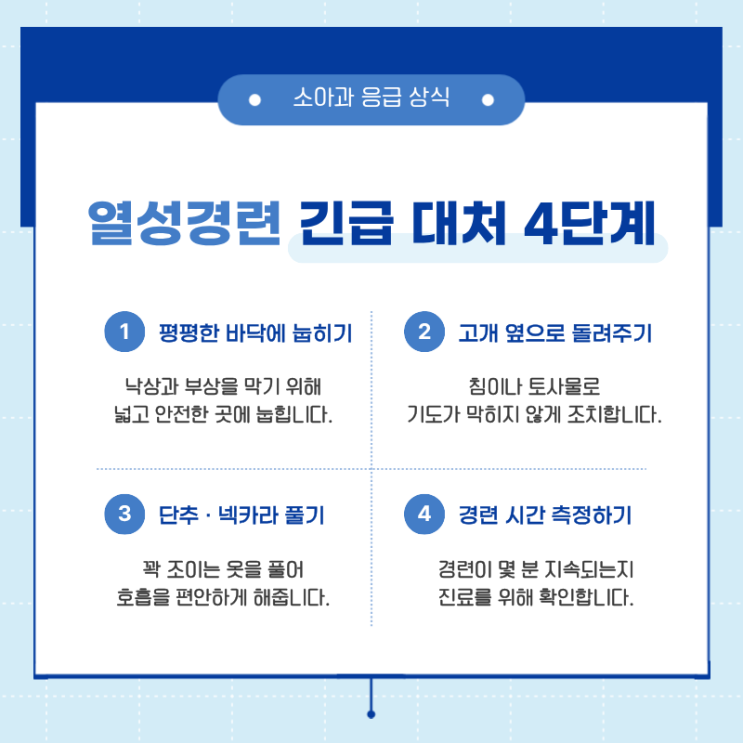
A febrile seizure, which appears in children between 9 months and 5 years of age when body temperature rises sharply, is frightening for caregivers, but in most cases it stops on its own within 5 minutes. What matters most at that moment is a calm response from the parents.
⭕ What you must do
1️⃣ Lay the child on a flat surface : Lay your child safely on a flat, open floor or bed.
2️⃣ Turn the head to one side : Be sure to turn the head to the side so the airway is not blocked. (This prevents saliva or vomit from backing up.)
3️⃣ Loosen clothing : Undo buttons or a tight collar so your child can breathe comfortably.
4️⃣ Time the seizure : Note exactly when the seizure started. (This is the single most important factor when your child is examined.)
❌ What you must never do
1️⃣ Do not put anything in the mouth : Do not put fingers, a spoon, a handkerchief or anything else into the mouth. (It can block the airway or injure the jaw joint.)
2️⃣ Do not restrain the body by force : Do not forcibly hold down or press on the arms and legs of a child who is shaking.
3️⃣ Do not give medicine or water while unconscious : Forcing an antipyretic or water on a child who is unconscious risks it going into the lungs.
When to call 119 or go to the emergency room immediately!
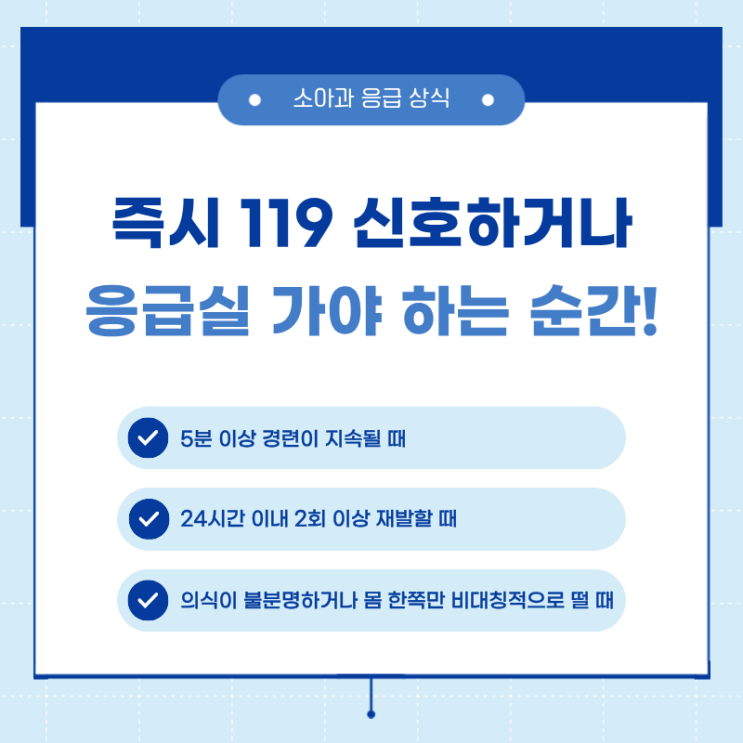
If any of the following happens, get help from emergency medical staff without delay.
-
The seizure lasts longer than 5 minutes
-
Seizures repeat 2 or more times within 24 hours
-
Your child does not regain consciousness after the seizure ends, or breathing is labored
-
Only one side of the body (a hand, foot or the face) stiffens, or the shaking is asymmetric
SONGDO ANSHIN Chuseok holiday schedule
An antipyretic is only a temporary measure that eases symptoms; identifying the underlying cause of the high fever is what matters most. After taking emergency measures, please visit a pediatric clinic so the cause of the fever (otitis media, tonsillitis, a viral infection and so on) can be diagnosed accurately.
To keep inconvenience to a minimum for caregivers during the long Chuseok holiday, SONGDO ANSHIN will keep its weekend clinic hours as usual. Please check the schedule below before you visit.
-
September 24 (Thu) : Closed
-
September 25 (Fri, Chuseok Day) : Closed
-
September 26 (Sat) : 09:00 ~ 14:00 (normal consultations, no lunch break)
-
September 27 (Sun) : 10:00 ~ 14:00 (normal consultations, no lunch break)
If your child develops a high fever or needs to be seen during the holiday, check the Saturday and Sunday hours and come in. You will receive prompt and attentive care.
🔗 [Helpful FAQ on handling a high fever]
“My child has a 39°C fever but is asleep. Should I wake them to give medicine?”
“My child vomited right after taking an antipyretic. Should I give it again?”
The 5 questions parents ask most often in the small hours when a high fever strikes!
A pediatric specialist lays out clear guidance.
👉 [Baby’s high fever of 39 degrees: should you wake a sleeping child for an antipyretic? Everything about when to go to the ER]