
Influenza A: 39–40°C high fever without a cough | Oral Tamiflu vs IV flu injection (Peramiflu) and care after treatment

Hello, this is SONGDO ANSHIN, located in Songdo District 8.
With the cold winds picking up lately, many more children are coming to our pediatric clinic with influenza A (flu).
In particular, “My child has no cough or runny nose, but suddenly has a high fever of 39–40°C.” “My child had an IV flu treatment. When will the fever come down?” Many parents send us questions like these after an anxious night.
Today we look at what parents search for most during flu season: [Flu symptoms without a cough], [Oral medicine vs IV flu injection], [What to do about high fever and dizziness after the IV], and [Why you must watch your child closely for a full day after treatment], explained simply below.
|
💡Summary: acute flu care for children ✔︎ Flu without a cough: For the first 1–2 days it can start with a sudden fever of 39–40°C, headache and muscle aches, with no respiratory symptoms. ✔︎ Flu treatment injection (IV): Children and teens who often vomit their medicine or have trouble taking it can be treated quickly with a single IV injection (Peramivir injection, about 15–30 minutes). ✔︎ Fever that continues after the IV: Even after the antiviral is given, the body’s immune response can keep the fever going up and down for 24–48 hours, so the fever reducers need to be alternated properly. ✔︎ Close watch for 24 hours after treatment: To prevent accidents from delirium, dizziness or hallucinations in the early stage of high fever and antiviral treatment, please stay by your child’s side for at least a day. |
Flu without cough or runny nose? What early symptoms look like
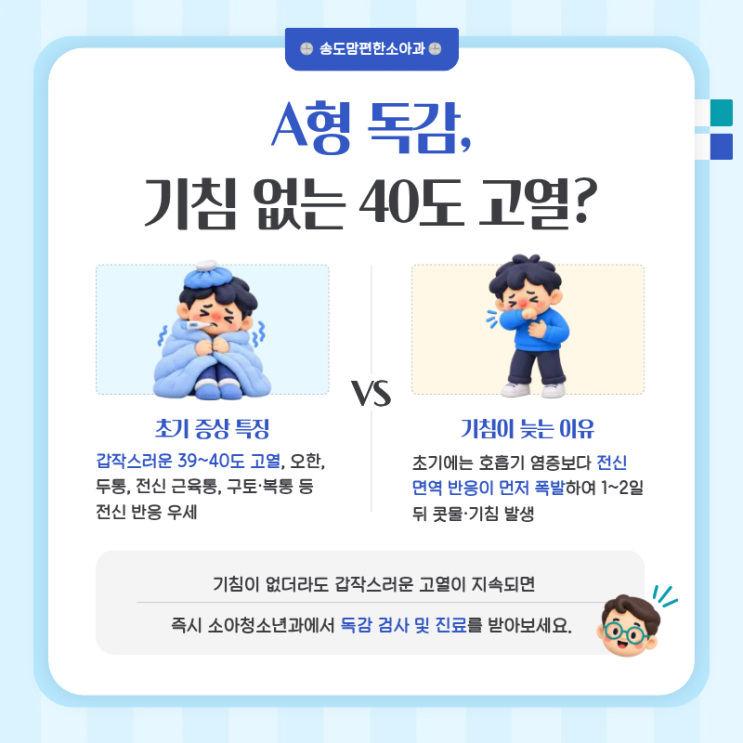
A common cold often starts with a sore throat or runny nose, but influenza A often starts with no respiratory symptoms, just a sudden high fever of around 40°C and whole-body symptoms in many cases.
-
Typical early symptoms: High fever, chills, headache, body aches that leave a child very limp, vomiting and stomach pain
-
Why the cough comes later: In the early stage of infection, the whole-body immune response flares up before any airway inflammation. Cough and runny nose sometimes start 1–2 days later.
So even without a cough, if your child suddenly develops a high fever, it is a good idea to visit a pediatrician for a rapid flu antigen test.
🔗 [Related reading: early flu care]
“A sudden 40°C fever: is it the flu or COVID-19?”
When your child starts running a fever, the best timing for an accurate test and how early symptoms differ from COVID-19: if you want to know more, check the post below ▽
👇 [Early flu symptoms and fever in children: flu vs COVID-19 and when to test]

Oral Tamiflu vs IV flu injection (Peramivir injection) compared

The antiviral drugs used when flu is confirmed come in two main forms: an oral medicine taken for 5 days (Tamiflu and others)and a flu IV given once into a vein (Peramivir injection / Peramiflu) .
|
Category |
Oral antiviral (Tamiflu and others) |
IV flu injection (Peramivir injection/Peramiflu) |
|
Ingredient/drug name |
Oseltamivir |
Peramivir (Peramivir injection) |
|
How it is given |
Twice a day at set times for 5 days |
Single IV injection (IV infusion) |
|
Time required |
Taken at home for 5 days |
About 15–30 minutes |
|
Features/advantages |
Standard oral prescription |
One dose completes treatment, very useful when vomiting often |
|
Recommended for |
Children who take medicine well and can easily swallow pills or syrup |
Children who vomit so much they spit out their medicine, or who need to recover quickly |
※ The IV flu injection (Peramivir premix) is given at a safe, appropriate dose after a board-certified pediatrician carefully assesses the child’s age, weight and overall condition.
High fever of 40°C and dizziness after a flu IV: what to do
“We got a flu IV at the clinic, but at home the fever keeps rising and my child feels dizzy.” Some parents come to us worried like this.
-
Why fever continues after a flu IV: Even when the antiviral starts to stop the virus from multiplying, the inflammation already in the body can make the fever rise and fall for up to 24–48 hours after treatment.
-
Alternating fever reducers: When the fever comes back, alternate the prescribed fever reducers (acetaminophen / ibuprofen types) at the set dose and interval.
-
Fluids and dehydration: When high fever causes fluid loss (dehydration), a child may complain of dizziness or severe tiredness. Give lukewarm water or an electrolyte drink in small sips often, and if your child can’t eat, adding a nutritional IV in our IV room helps a faster recovery.
Why parents should watch closely for at least a day (24 hours) after a flu IV or medicine

After a flu treatment is given (oral medicine and IV alike), it is very important for a parent to stay with the child and watch them for at least 24 hours.
-
Possible abnormal behavior (delirium, hallucinations) and grogginess: High fever from the flu virus itself, combined with early reactions to the antiviral, can make a child groggy or say strange things: delirium, hallucinations, severe dizziness and disorientation may appear.
-
Preventing falls and accidents: A child may feel woozy, stagger and fall, so check the locks on balcony windows and the front door, and for at least 2–3 days, do not leave your child alone; a parent must stay close and care for them.
Flu care at SONGDO ANSHIN

Starting the right treatment within the first 48 hours is key to shortening the illness and preventing complications (otitis media, pneumonia, etc.).
If your child’s high fever continues or you suspect the flu, feel free to visit us for an accurate diagnosis and the right treatment from a board-certified pediatrician.
