
A complete guide to the essential vaccinations you need before international travel, brought to you by Songdo Pediatrics

As the full summer vacation season begins, many people are planning international travel with their children.
From passports, plane tickets, and accommodations to packing… with so much to prepare, easy to overlook an important checklist item that you may surprisingly miss.
That is none other than essential vaccinations before international travel.
Beyond simply avoiding infectious diseases,
Difficulty accessing local medical care, entry restrictions, and quarantine measures. This preparation is essential to prevent problems like these.
Why are vaccinations before international travel absolutely necessary?

Infectious diseases that have nearly disappeared in Korea are still prevalent in some overseas regions.
In particular, those with weak immunity (infants, children, pregnant women, the elderly, and people with chronic illnesses) are at high risk of severe complications if infected.
In addition, some countries require a vaccination certificate upon entry, and if you are not vaccinated, you may face entry denial or quarantine measures.
If you become infected locally, the medical environment may be poor, putting you in a situation where it is difficult to receive proper treatment could occur.
Vaccination before departure is the surest way to protect the health of yourself and your family.
Which vaccinations do you need before international travel?
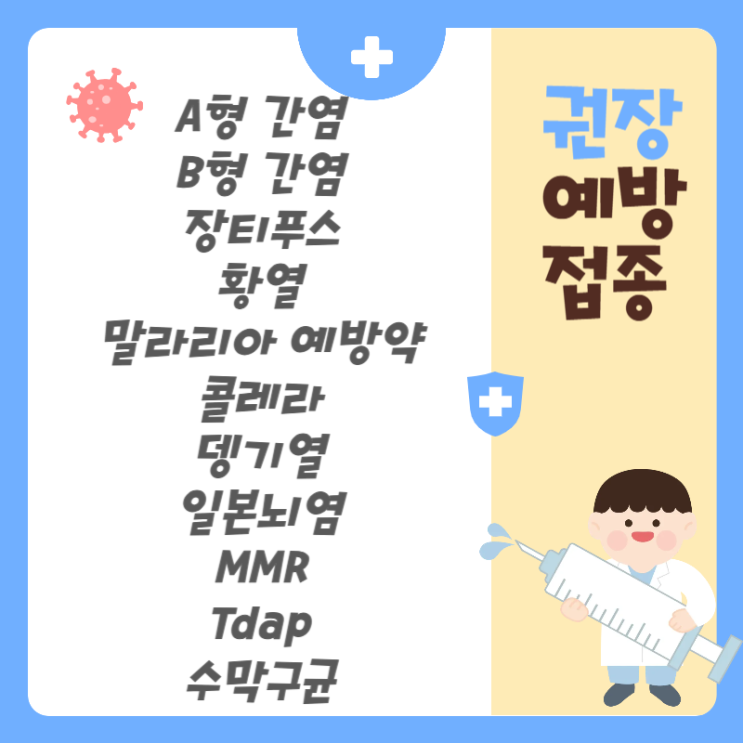
Since the required vaccinations vary depending on the destination country, length of stay, and individual health status, at least 4 to 6 weeks before departure we recommend visiting a nearby hospital for consultation.
The following is a list of the main vaccinations recommended before travel.
|
Vaccination |
Description |
|
Hepatitis A |
A common infectious disease in areas with poor sanitation |
|
Hepatitis B |
Transmitted through contact with blood and body fluids |
|
Typhoid |
Infected through contaminated food or water; prevalent in India, Southeast Asia, Central and South America, and Africa |
|
Yellow fever |
Mosquito-borne; prevalent in some countries in Africa and Central/South America; a vaccination certificate is required upon entry; vaccinate 10 days before departure |
|
Malaria prophylaxis |
Recommended in some areas of Africa, Southeast Asia, and South Asia; begin taking 1 to 2 days before departure |
|
Cholera |
Spread through contaminated water and food; dangerous in areas with very poor sanitation; prevalent in Africa, India, and Bangladesh |
|
Dengue |
No vaccine available; mosquito-borne; insect repellent, long clothing, and mosquito nets are essential |
|
Japanese encephalitis |
Can be contracted in Southeast Asia, China, and other regions |
|
MMR (measles, mumps, rubella) |
Highly contagious droplet infection; recently increasing outbreaks in Europe and Asia |
|
Tdap (including pertussis) |
Droplet infection; vaccination recommended 2 weeks before departure; take care in areas with lots of street food such as Southeast Asia and South America |
|
Meningococcus |
Spread through respiratory routes such as saliva and coughing; prevalent in the US, Europe, the Middle East, and Africa; essential for students studying abroad, long-term residents, and pilgrims; the vaccine differs by country since the prevalent strain varies; it is one of the most fatal acute infectious diseases, with the possibility of death within hours of infection |
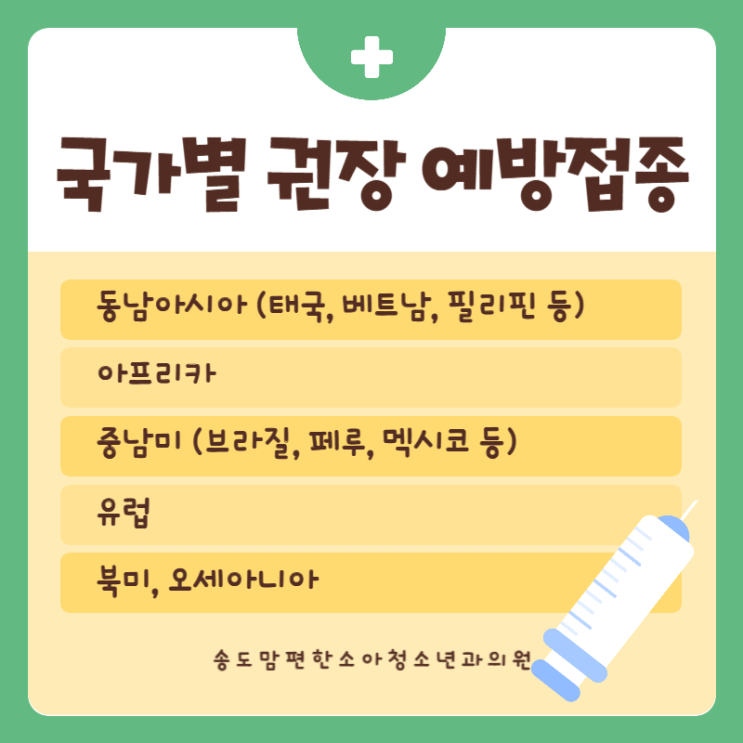
What vaccinations are recommended by country?
|
Region |
Recommended vaccinations |
|
Southeast Asia (Thailand, Vietnam, the Philippines, etc.) |
Hepatitis A, typhoid, Japanese encephalitis; check whether malaria prophylaxis is needed |
|
Africa |
Yellow fever vaccination (international vaccination certificate required), malaria prophylaxis, cholera, hepatitis A, typhoid |
|
Central and South America (Brazil, Peru, Mexico, etc.) |
Yellow fever vaccination (mandatory in some countries), hepatitis A, hepatitis B, typhoid |
|
Europe |
Check basic vaccinations (MMR, etc.); take care in measles outbreak areas |
|
North America, Oceania |
Check whether basic vaccinations are complete; in certain situations consider hepatitis A and hepatitis B |
When should you get vaccinated before travel?
|
Vaccine type |
Recommended timing of vaccination |
|
Measles, hepatitis A, pertussis, meningococcus, typhoid |
At least 2 weeks before departure |
|
Yellow fever |
Vaccination required up to 10 days before departure |
|
Malaria prophylaxis |
Begin taking 1 to 2 days before departure |
|
Shingles, pneumococcus, etc. |
Consider getting vaccinated in advance if a long-term stay is planned |
Some vaccines two or more doses are required, or time until the effect appears is needed, and prophylactic medications taken over a long period also exist.
Therefore, if you have travel plans, check your vaccination schedule as soon as possible is important.

How do I obtain a vaccination certificate (international certificate)?
•The yellow fever vaccination certificate (yellow card)is at a nationally designated authorized institution can only be issued.
• Although our SONGDO ANSHIN is not an internationally certified vaccination institution,
▶ Pre-departure consultation
▶ Vaccination guidance by country
▶ We provide general vaccinations safely all at once.

Final check! Health tips before international travel
• Traveler’s first-aid medications, hand sanitizer, insect repellent, hygiene supplies Pack them
• If you have a fever or unusual symptoms after returning home, your overseas travel history be sure to inform the hospital
• Above all, before international travel, getting all your vaccinations without missing any is the most important.

The excitement of an upcoming international trip,
so that you can travel happily and safely without health worries
from travel first-aid medications to vaccinations
our SONGDO ANSHIN will help you prepare.
This post was written directly by SONGDO ANSHIN for the purpose of providing information, in compliance with Article 56, Paragraph 1 of the Medical Advertising Act.
It was written directly by SONGDO ANSHIN.