
Precocious Puberty Tests: Is Ultrasound a Must in Puberty Care? How to Avoid Overtreatment at the Growth Clinic!
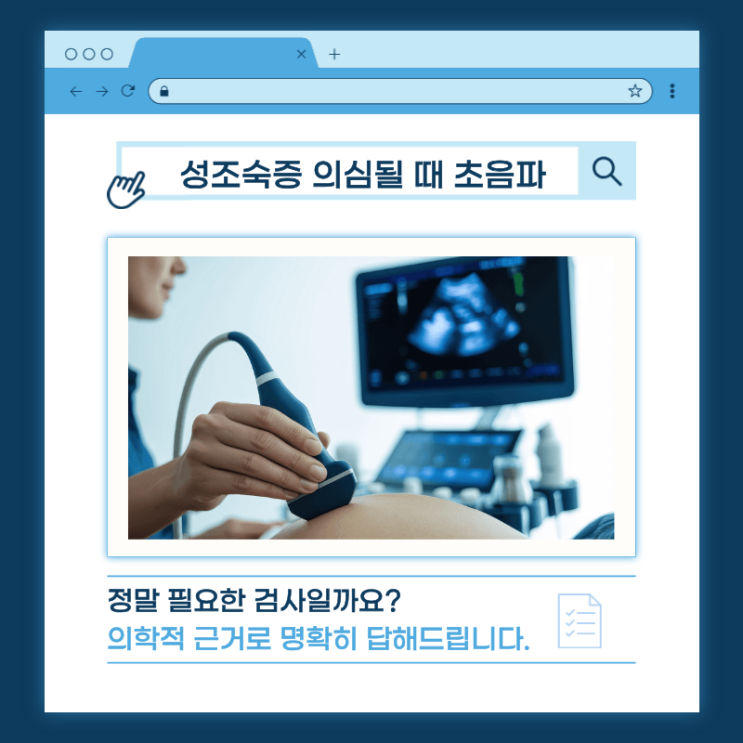
Hello. SONGDO ANSHIN Growth Clinic here.
When a child’s puberty seems to start a little earlier than their peers, parents tend to worry first. These days there is so much information online and so many stories from people around us that many parents ask, even before coming to the clinic, whether they really need a ‘precocious puberty screening package’ or an ‘ultrasound exam.’
However, more testing is not always the right answer. During growth clinic care, tests that are not medically recommended are often bundled into packages and recommended, so caution is needed.
Today, the 2022 official guideline of the Korean Society of Pediatric Endocrinology, we clearly lay out which tests are truly necessary and the criteria for avoiding unnecessary overtreatment.
Key summary: the essentials to know about precocious puberty testing!
In precocious puberty care, breast ultrasound and routine testicular ultrasound are tests the Korean Society of Pediatric Endocrinology’s 2022 guidelines do not recommend. At clinic level, the standard is clinical assessment, a bone age X-ray and basic hormone tests (the first-line evaluation), with referral to a university hospital when findings are abnormal. Ultrasound has a high chance of being over-testing driven by non-covered revenue, so before agreeing to it always confirm its ‘medical necessity’ and ‘whether the result would change the treatment plan’.
[Summary of ultrasound recommendations in precocious puberty care]
|
Type of ultrasound |
Society recommendation |
Diagnostic value and action |
|
Breast ultrasound |
Not recommended |
No added diagnostic value |
|
Testicular ultrasound |
Not performed routinely |
Referral to a university hospital only for findings such as asymmetry or a mass |
|
Pelvic ultrasound |
Supplementary tool |
Used as a supplement after the first-line evaluation when needed |
<Source: 2022 Korean Society of Pediatric Endocrinology official guidelines>
The testing philosophy and promise of SONGDO ANSHIN Growth Clinic (Part 2)
|
The promise of SONGDO ANSHIN Growth Clinic 1. Breast ultrasound and routine testicular ultrasound are not medically necessary in precocious puberty care. They are tests that the 2022 Korean Society of Pediatric Endocrinology guideline clearly does not recommend. 2. We accurately perform the first-line evaluation with clinical assessment, bone age X-ray, and basic hormone tests, and we refer to a university hospital for detailed testing only when abnormal findings are suspected. 3. There is a reality where ultrasound, a non-covered test, is performed routinely out of a profit motive. Our clinic does not perform it, in keeping with the medical evidence, and when it is truly necessary we refer to a university hospital. |
Questions we often hear in the consultation room

“My child’s puberty seems to have started early, and another clinic told me to get a breast ultrasound. Is it really a necessary test?”
“They said we should also get a testicular ultrasound, but SONGDO ANSHIN doesn’t do it. Is it okay to skip it?”
These are the questions parents who visit with suspected precocious puberty ask most often. Many are hesitating because another clinic recommended an ultrasound, or because an ultrasound is included in a ‘comprehensive precocious puberty screening package’ and they wonder whether they should have it done.
Today, based on the 2022 official guideline of the Korean Society of Pediatric Endocrinology, we will honestly explain which ultrasound exams are truly necessary and which are not recommended.
Our growth clinic’s care philosophy, once again
The principle of our clinic that we shared in Part 1 is simple.
|
The principle behind test decisions ① If a test has the potential to change the treatment plan → we perform it actively and accurately. ② If a test leads to the same conclusion regardless of its result → we do not recommend it. |
We will explain how this principle applies in precocious puberty care, together with the official recommendations of the Korean society.
[Re-read Part 1]
Why won’t you do a blood test for our short child? A Songdo pediatric growth clinic without overtreatment
“Is it possible to assess growth without a blood test?”
If you are curious about the growth clinic’s testing principles, ▽ please refer to the previous post.
What the Korean Society of Pediatric Endocrinology 2022 guideline says
In 2022, the Korean Society of Pediatric Endocrinology (KSPE) revised and published the precocious puberty care guideline for the first time in 11 years.
This official guideline, composed of 8 key questions and 27 recommendations, is the standard for our clinic’s care.
Recommendation 2-5 — Breast ultrasound (Strong)
|
KSPE 2022 official recommendation “Breast ultrasound is not recommended for the diagnosis of precocious puberty (Do not, Strong).” Rationale: Breast ultrasound has no advantage over other testing methods and provides no additional diagnostic value. |
This is the official position agreed upon by Korean pediatric endocrinologists. The phrase “not recommended” is the strongest rejection in the guideline, and the “Strong” grade means the recommendation is based on sufficient evidence.
Pelvic ultrasound — an auxiliary tool
It is stated that pelvic ultrasound (uterus and ovaries in girls) can be used as an auxiliary diagnostic tool in patients suspected of precocious puberty. However, the key is the word “auxiliary.”
Clinical assessment, bone age, and basic hormone tests come first, and pelvic ultrasound serves to reinforce those results. It is not a test performed routinely without a first-line evaluation. It is also a test whose results vary greatly depending on the examiner’s skill.
The standard flow of precocious puberty and puberty care
The standard diagnostic flow according to the KSPE guideline is as follows. The standard is for the clinic to perform only the first-line evaluation and, when abnormal findings are clear, to refer to a university hospital for detailed testing.
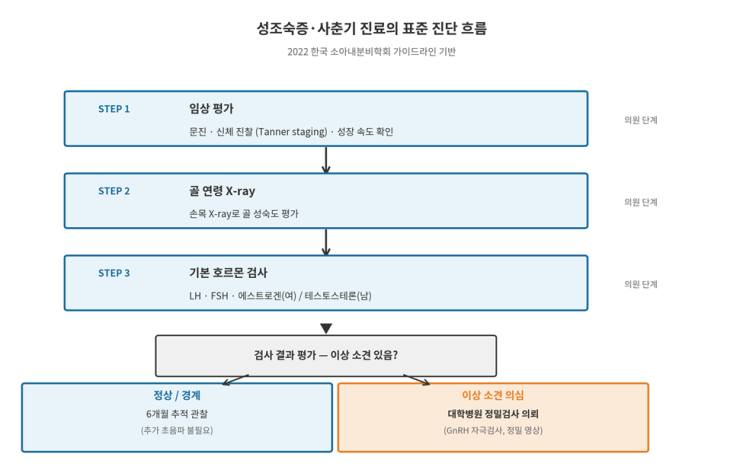
[Graph 1] The standard diagnostic flow of precocious puberty and puberty care. After the first-line evaluation at the clinic stage, refer to a university hospital when abnormal findings appear.
|
Key points The three elements of the first-line evaluation — clinical examination, bone age X-ray, and basic hormone tests. These are the standard tests performed at the clinic stage. Ultrasound (especially breast ultrasound) is not a component of this first-line evaluation. If abnormal findings are suspected in the first-line evaluation, the medical standard is not to add an ultrasound at the clinic but to refer to a university hospital for detailed testing. |
When is testicular ultrasound necessary?
Routine testicular ultrasound in boys is also not medically recommended. However, it is necessary in cases with clear clinical clues such as the following.
• Asymmetry in the size of the two testicles — when one is clearly larger
• A palpable nodule or mass in the testicle
• Suspected peripheral precocious puberty on hormone tests (LH, FSH suppression + testosterone elevation)
• Accompanying neurological symptoms
In such cases, a testicular tumor (such as a Leydig cell tumor) must be ruled out, so detailed imaging is necessary. However, this is not an area for the clinic to perform alone, but one that requires integrated evaluation by imaging specialists and pediatric endocrinologists at a university hospital.
In other words, the situations where testicular ultrasound is necessary almost exactly match the situations where referral to a university hospital is necessary. Testicular ultrasound performed routinely simply on suspicion of rapid pubertal progression has very low diagnostic value.
Summary: recommendations by ultrasound test
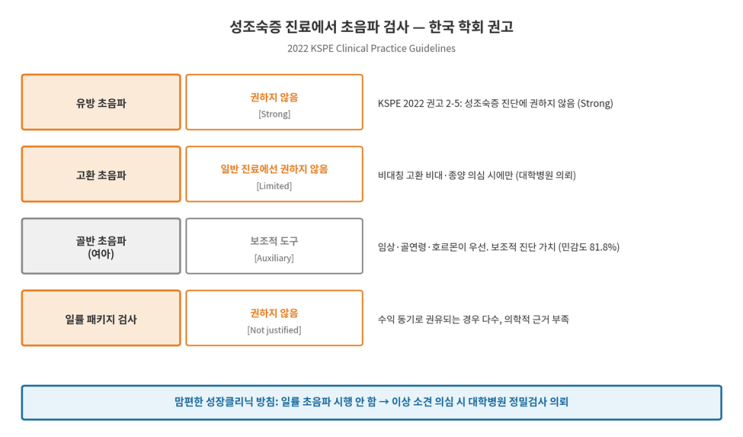
[Graph 2] Summary of the Korean society’s recommendations by ultrasound test in precocious puberty care.
But why do many clinics perform it routinely?
This is a part we must address honestly. There are several reasons why tests that are not medically recommended are frequently performed in actual practice.
▶ Non-covered test — profit motive
Ultrasound is a non-covered test not eligible for health insurance. A single exam costs 80,000–150,000 KRW, and bundling it into a package generates even larger revenue. This is the background for why some clinics automatically include ultrasound in a ‘comprehensive precocious puberty screening package.’
▶ “While we’re at it, let’s check everything” package marketing
A package design that checks all possibilities at once gives parents a sense of reassurance, but medically it conflicts with the principle of targeted testing. As a result, in most cases it only increases the cost burden while the diagnostic plan stays the same.
▶ A response to parents’ anxiety
This is the pattern of adding tests as a way of responding to the natural feeling of parents that “more testing must be more accurate.” However, medically it is the targeting of tests, not the quantity of tests, that determines diagnostic accuracy.
▶ The burden of referral
When abnormal findings are suspected in the first-line evaluation, referral to a university hospital is the medical standard, but there can be a tendency to avoid the administrative burden of referral and to finish all tests within the clinic.
That is why SONGDO ANSHIN Growth Clinic
Our clinic’s policy is faithful to the medical evidence.
● Accurate first-line evaluation
We accurately perform clinical examination (including Tanner staging), bone age measurement by wrist X-ray, and basic hormone tests (LH, FSH, estrogen or testosterone). This is the standard at the clinic stage.
● We do not perform ultrasound
We do not perform breast ultrasound, routine testicular ultrasound, or routine pelvic ultrasound. This is a decision based on the Korean society’s guideline recommendations.
● Referral to a university hospital when abnormal findings appear
If true precocious puberty is suspected in the first-line evaluation, or if another cause such as a tumor is suspected, we do not add an ultrasound at the clinic but refer to the pediatric endocrinology department of a university hospital. Detailed imaging and detailed evaluations such as the GnRH stimulation test are carried out in one place.
● The meaning of the “SONGDO ANSHIN” promise
That parents do not spend time in the exam room, but receive accurate care exactly when it is truly necessary — that is the meaning of “SONGDO ANSHIN.”
A guide for parents: what if another clinic has recommended an ultrasound?

When another clinic recommends a breast, testicular, or pelvic ultrasound, we suggest asking the following three questions.
|
Three good questions to ask ① “Is this ultrasound exam a test recommended by the Korean Society of Pediatric Endocrinology guideline?” ② “How would the treatment plan change depending on the result of this ultrasound?” ③ “If there are abnormal findings, wouldn’t a referral to a university hospital be necessary?” |
If the doctor answers these three questions specifically, then it is right to have the test done.
If the answer is vague or along the lines of “let’s just take a look,” it is not too late to think it over once more.
In closing: the promise of Songdo Growth Clinic
In precocious puberty care as well, our promise is the same.
1️⃣ We do not recommend tests that the Korean society’s guideline does not recommend.
2️⃣ We perform the first-line evaluation accurately and without omission.
3️⃣ We refer truly necessary detailed tests to a university hospital — where the patient can receive the best care!
In precocious puberty and puberty care, the meaning of the name “SONGDO ANSHIN” becomes even clearer. Parents are reassured by the fact that our clinic follows the Korean society’s recommendations exactly, and reassured by the trust that, when truly necessary, they can receive the most appropriate care through referral to a university hospital.
If you are worried that pubertal development seems fast, or if you want to check once more whether an ultrasound exam recommended by another clinic is truly necessary, please come anytime. We will perform the first-line evaluation accurately and, if necessary, help with referral to a university hospital at the appropriate time.
Reference papers
1. Kim SJ, Kim JH, Hong YH, et al. 2022 Clinical practice guidelines for central precocious puberty of Korean children and adolescents. Ann Pediatr Endocrinol Metab. 2023;28(3):168-177. (Korean Society of Pediatric Endocrinology, KSPE)
2. Carel JC, Eugster EA, Rogol A, et al. Consensus statement on the use of gonadotropin-releasing hormone analogs in children. Pediatrics. 2009;123(4):e752-762.
3. Grand T, Hermann AL, Gérard M, et al. Precocious puberty related to Leydig cell testicular tumor: the diagnostic imaging keys. Eur J Med Res. 2022;27:55.
※ This article is an easy-to-understand explanation of the official guideline of the Korean Society of Pediatric Endocrinology for the general public, and does not replace medical advice.
