
Should Your Baby’s Syrup Medicine Go in the Refrigerator? A Complete Guide to Storing Antibiotics and Fever Reducers
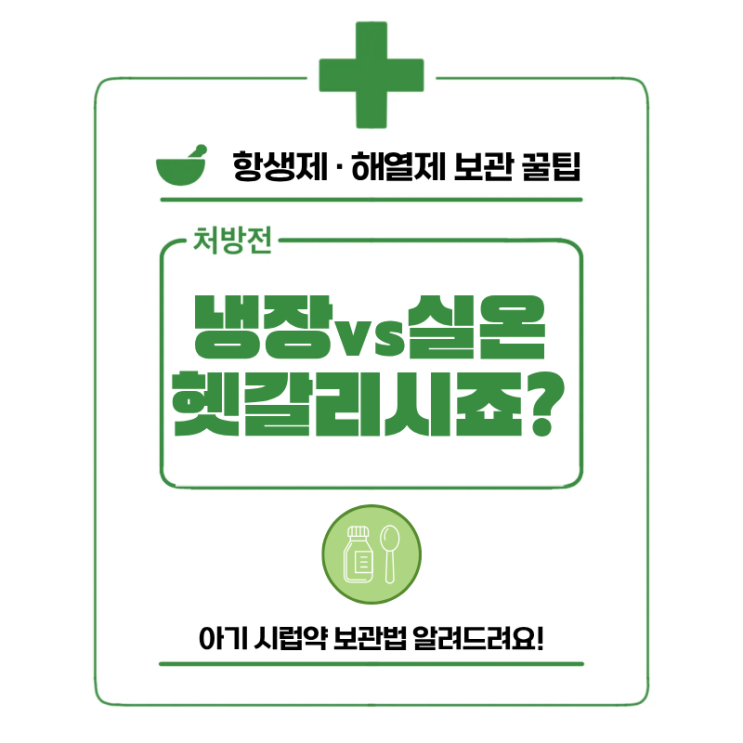
Hello. Located in Songdo District 8, this is SONGDO ANSHIN.
When you finish a pediatric visit and come home from the pharmacy with a whole bundle of medicine, it is easy to miss the pharmacist’s instructions while you are busy tending to your child.

You get home, line up the bottles and think, “Was this antibiotic supposed to go in the refrigerator?”, “Should the fever-reducing syrup go in too?” Every parent has had that moment of confusion and searched online.
The syrup medicines prescribed for children are stored completely differently depending on their ingredients. Stored the wrong way, they can lose potency or their ingredients can change, so special care is needed. Today SONGDO ANSHIN gives you a complete guide to storing the pediatric syrup medicines that cause so much confusion!
|
💡 Key summary : baby syrup medicine, refrigerated vs. room temperature in 3 lines 🧊 Refrigeration required (2~8℃) Amoxicillin-class antibiotic syrups such as ‘Augmentin’ must be kept on the inner shelf of the refrigerator to maintain their potency. 🏠 Room-temperature storage as a rule (1~30℃) Fever reducers (acetaminophen, ibuprofen) and ordinary cold syrups form sediment when refrigerated, so keep them at cool room temperature. ⚠️ Exception antibiotics Azithromycin-class antibiotics such as ‘Zithromax’ are in fact meant for room-temperature storage. Be sure to check the guidance printed on the envelope or the medicine bottle! |
Antibiotic syrups that must be refrigerated (2~8℃)

Some of the antibiotics prescribed for otitis media, urinary tract infection, bronchitis and the like must be kept cold to retain their potency.
-
Main ingredients : amoxicillin-clavulanate class (e.g. Augmentin, Amoclan), clarithromycin class (e.g. Klaricid)
-
Why refrigeration : Left at room temperature, the active ingredient breaks down, the color turns brown and potency drops sharply.
-
Tip on where to store : The door side (door pocket) goes through large temperature swings every time the door opens and closes, so rather than the door, the inner shelf of the refrigerator is the safest place to keep it.
Never in the refrigerator! Syrup medicines for room-temperature storage (1~30℃)
Many parents absent-mindedly put medicine in the refrigerator thinking they are ‘keeping it fresh’, but for the medicines below refrigeration actually ruins them.
|
Type of medicine |
Main product/ingredient |
Storage method and cautions |
|
Fever-reducing syrup |
acetaminophen (Champ Pink, Tylenol, etc.) ibuprofen, dexibuprofen (Maxibupen, etc.) |
room-temperature storage When refrigerated, the ingredients clump together or separate into layers, so the potency of each dose becomes uneven. |
|
Ordinary cold medicine |
runny nose, cough, phlegm and cough-suppressant syrups, etc. |
room-temperature storage As a rule, most should be kept at cool room temperature. |
|
Exception antibiotics |
Zithromax (azithromycin class) |
room-temperature storage When refrigerated, the medicine thickens and turns extremely bitter, so the child refuses to take it. |
Worth reading together: the shelf life of compounded syrup medicine
Keeping prescribed compounded medicine for a long time without a second thought carries a high risk of bacterial growth. If you are curious about the recommended shelf life of compounded syrup medicine and how to dispose of it safely, see the earlier post below ▽!
🔗 [How Long Does Leftover Baby Cold Medicine Last? Shelf Life of Compounded Syrup Medicine and Dosing Tips FAQ]
Practical dosing tips from SONGDO ANSHIN!

The method we recommend most is to take a marker as soon as you bring the medicine home and write, in large letters on the surface of the bottle, ‘Refrigerate’ or ‘Room temperature’. This one small habit keeps your child’s medicine safe to take.
If your child’s symptoms persist or a specialist’s care is needed, please feel free to visit SONGDO ANSHIN at any time.
(※ This post was written to provide reliable medical information and does not advertise any particular product. For an accurate diagnosis of your child’s individual symptoms, please be sure to consult a pediatric specialist.)

🩺 [SONGDO ANSHIN – Consultation Information]
-
Consultation hours
• Weekdays _ 09 : 00 ~ 20 : 00 (evening consultations available)
• Saturday _ 09 : 00 ~ 14 : 00 (open through lunchtime)
• Sunday, public holidays _ 10 : 00 ~ 14 : 00 (open through lunchtime)
-
Inquiries : 032-851-1365
-
Directions : 2F commercial floor, Building 203, Landmark City Central The Sharp officetel, 68 Landmark-ro, Yeonsu-gu, Incheon
