
When to Test for Precocious Puberty: Does a Puberty Hormone Test Have to Come Right Away?
When is a puberty hormone test really needed?
SONGDO ANSHIN Growth Clinic — our testing philosophy and promise, Part 4

|
💡The SONGDO ANSHIN Growth Clinic promise 1. Even when a child looks like puberty is arriving early, we do not begin with hormone tests (LH, FSH, sex hormones). We judge first by physical examination and bone age. 2. If puberty is progressing gradually and bone age is normal, rather than testing, observation at 3–6 month intervals comes first. This is the order recommended by the precocious puberty diagnostic guidelines. 3. We do not alarm you with a single hormone value, nor rush into treatment. We test only the children who genuinely need it, and we do it accurately. |
A worry we often hear in the exam room
My child seems to be going through puberty earlier than other children the same age.
Shouldn’t we have a hormone test done?
As attention to precocious puberty has grown, many parents come to us worried by even the slightest sign of puberty. And some places recommend a whole battery of hormone tests (LH, FSH, estrogen, testosterone) all at once, under the name “precocious puberty testing.”
A parent’s worry is entirely natural. If puberty comes too early, a child’s height can stop increasing sooner. But the right way to answer that worry is not “hormone tests first.” Today we would like to explain when a puberty hormone test is genuinely needed, and when there is no need to hurry.
Testing is not the first step

When puberty appears to be early, care follows a set order. Hormone testing is not the first step in that order. It is the last step, carried out when it is needed.
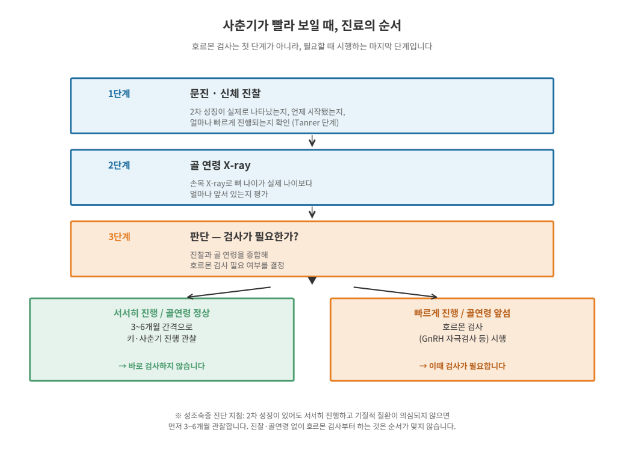
[Figure 1] The order of care when puberty appears early. Physical examination and bone age come first; hormone testing only when needed.
First, a physical examination confirms whether secondary sex characteristics have actually appeared, when they began, and how quickly they are progressing.
Next, a wrist X-ray measures bone age, showing how far ahead the bone age is compared with the child’s actual age.
In most cases these two steps alone are enough to judge whether testing is called for.
Observation comes first in many cases
The precocious puberty diagnostic guidelines put it this way: even if secondary sex characteristics have appeared, as long as they are progressing gradually and no other condition is suspected — do not test right away; first observe height growth and pubertal progression at 3–6 month intervals
|
💡When we observe instead of testing right away • Secondary sex characteristics have appeared, but progression is slow and gradual • Bone age is close to the child’s actual age, or not far ahead of it • Height growth velocity is within the normal range |
Conversely, if pubertal progression is clearly rapid, or bone age is markedly ahead of the actual age — in that case we move straight to hormone testing (such as a GnRH stimulation test) without a period of observation. In other words, for a child who needs the test, we perform it accurately and without delay.
The heart of the matter, then, is not “whether to test,” but “whether we can identify exactly which children need testing.”
[Revisit our previous post]
The nutrition and growth assessment to settle before any puberty hormone test!
👉Instead of unnecessary one-size-fits-all packages,
see Part 3 for SONGDO ANSHIN principle of selecting only the tests that are truly needed.

We do not judge by a single hormone value

There is one more important point. A single value from a basal hormone test (baseline LH, FSH, estrogen) drawn once cannot accurately diagnose precocious puberty.
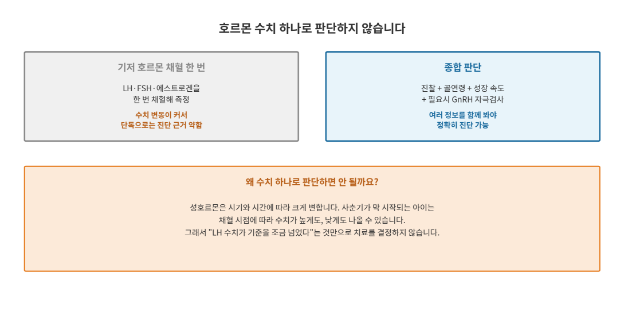
[Figure 2] Because sex hormones vary greatly by stage and time of day, a judgment must combine several pieces of information rather than rest on one value.
Sex hormones change considerably with the stage of puberty and the time of day. In a child whose puberty has only just begun, the same test can come back high or low depending on when the blood was drawn. That is why deciding on treatment simply because “the LH value is slightly above the cutoff” is not sound care.
A definitive diagnosis of true precocious puberty is made with the GnRH stimulation test, and even that must be interpreted together with the physical examination, bone age, and growth velocity. Looking at the whole picture rather than a single value — this is the principle we hold to.
So this is how our clinic works

If you come to us worried about your child’s puberty, here is how we proceed.
● We assess first by physical examination and bone age
We confirm the actual state and pace of secondary sex characteristics by examination, and measure bone age with a wrist X-ray. This is the starting point for our judgment.
● When there is no need to hurry, we observe
If progression is gradual and bone age is within the normal range, we do not recommend unnecessary hormone tests; we watch together at 3–6 month intervals.
● When testing is needed, we do it accurately
If progression is rapid or bone age is advanced and we judge that testing is needed, we carry out confirmatory testing such as the GnRH stimulation test without delay.
A guide for parents

If another clinic has recommended a puberty hormone test, we suggest asking these three questions.
|
💡Three questions worth asking ① “Is there a reason to start with hormone tests, without a physical examination and bone age assessment?” ② “What problems would arise if we did not test now and observed for a few months instead?” ③ “Will treatment be decided on this one test result, or will other information be considered as well?” |
If the doctor answers these clearly, then the test is worth having. If the answers are vague, or amount to “let’s just test and see,” it is also a good choice to start step by step with a physical examination and bone age assessment.
In closing

When you are worried that puberty is arriving early, what matters most is not the number of tests but the right order. Looking first at the examination and bone age, and testing only when it is truly needed — that is how we spare children unnecessary blood draws and parents unnecessary anxiety.
If you are concerned about your child’s puberty, or would like to check whether a recommended test is really necessary, please come in any time. We will look calmly at the examination and bone age first, and decide together.
|
📢In summary • Even when puberty appears to be early, a hormone test is not the first step. Physical examination and bone age come first. • If progression is gradual and bone age is normal, rather than testing, 3–6 months of observation takes priority • We do not decide treatment on a single value, and we test only the children who need it, accurately. |
SONGDO ANSHIN
032-851-1365
※ This article is intended to explain our clinic’s testing approach and does not replace individual medical care. Whether a test is performed is decided through consultation.
