Growth Hormone Stimulation Testing With No Hospital Admission, Done in Our Outpatient Clinic (Songdo Growth Clinic, Part 6)
Growth hormone stimulation testing,
no hospital admission needed; it can be done in our outpatient clinic.
The testing philosophy and promise of the SONGDO ANSHIN Growth Clinic — Part 6
If you have been worrying about your child’s height and are then advised to have a growth hormone stimulation test, the first thoughts that come to mind are usually ‘Do we have to be admitted to hospital?’ and ‘How many days of school will my child have to miss?’
In today’s sixth story about the testing philosophy and promise of the SONGDO ANSHIN Growth Clinic, we would like to tell you about outpatient stimulation testing with no hospital admission.

|
📢 The SONGDO ANSHIN Growth Clinic promise 1. A stimulation test performed when growth hormone deficiency is suspected is normally done during a 2-night, 3-day admission at a university hospital. At our clinic, this test is carried out in the outpatient clinic, with no admission. 2. We split it into two visits, one week apart. Each visit takes only about half a day, which greatly reduces the burden of hospital admission and missed school. 3. The accuracy and safety of the test stay exactly the same. The only thing that changes is the burden carried by the child and the parents. |
What is a growth hormone stimulation test?
If a child is much shorter than peers, is growing slowly and also has a delayed bone age, it may be necessary to check whether enough growth hormone is being secreted. The test carried out in that situation is the growth hormone stimulation test.
Growth hormone is not secreted at a steady rate all day long; it is released in concentrated bursts during sleep and at certain other moments. That is why a single blood draw cannot show whether there is a deficiency. A medication that induces growth hormone secretion is given first, and blood is then drawn several times at set intervals to see how high the hormone level rises.
And for an accurate diagnosis, at least two stimulation tests that work through different mechanisms must be performed. In fact, the health insurance criteria for growth hormone treatment also require that “deficiency be confirmed on two or more stimulation tests.” In other words, treatment is never decided on the basis of a single test.
The trouble is, the test is not easy to get
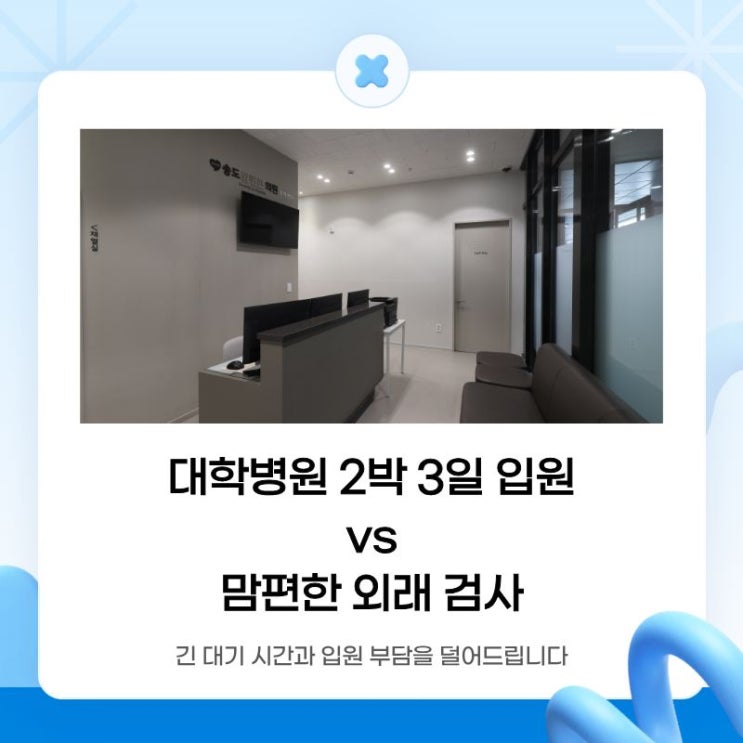
The problem is that having this test done is harder than most families expect.
Some stimulation tests (especially the one using insulin) can cause low blood sugar during the test, so medical staff have to stay beside the child the whole time. For this reason most hospitals admit the child before running the test, and at university hospitals a 2-night, 3-day admission is the norm.
Admission is a burden in itself. The child has to miss several days of school, and a parent has to stay in the hospital as well. In a dual-income family someone has to take time off work, and if there is a younger sibling at home, childcare becomes an issue too.
On top of that, in the Incheon area the places that offer this test are largely limited to university hospitals. As a result, it is not unusual to wait several months just to get an appointment for it.
Height is hard to recover once the right window has passed, and yet precious time slips away while a family waits months for a single test.
We do it on an outpatient basis, split into two visits
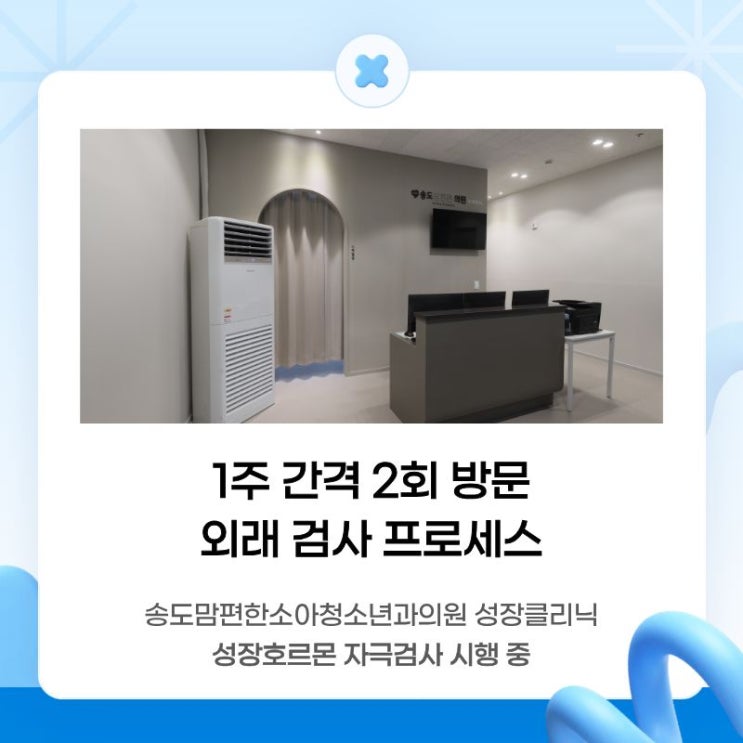
At our SONGDO ANSHIN Growth Clinic, this test is carried out in the outpatient clinic, with no admission. And rather than doing it all in one day, we divide it into two visits, one week apart.
Visit 1: levodopa (oral) / Visit 2: arginine (injection) — about half a day each, then straight home
[※ Note: levodopa is the active-ingredient name of ‘Myungdopa tablets’, the oral test medication introduced in our previous post; it is the same test medication.]
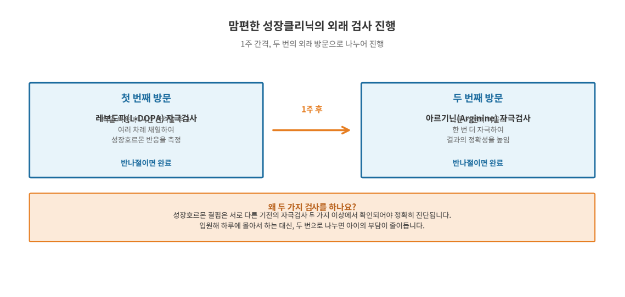
[Figure 1] The outpatient testing format, carried out over two visits one week apart.
At the first visit we perform a stimulation test using levodopa, and at the second visit one week later a stimulation test using arginine.
By splitting these two tests, which stimulate growth hormone secretion through different mechanisms, across two visits, we satisfy the “two or more stimulation tests” required by the health insurance criteria while keeping the burden on the child to a minimum.
Neither of these two tests causes low blood sugar, so they can be performed safely in the outpatient clinic without admission. Each time, the medication is given and blood is then drawn at set intervals, and the test is finished in about half a day. Once it is done, you can go straight home.
What actually changes?
Here is what is the same and what is different between inpatient testing and outpatient testing.
The same accuracy and safety, with the burden of missed school and admission reduced to zero!
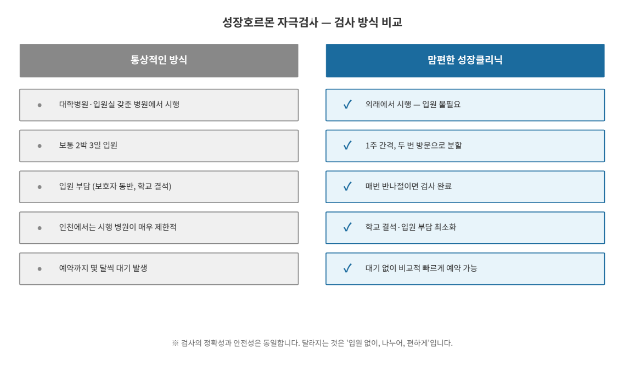
[Figure 2] A comparison between the usual inpatient testing format and our outpatient format.
|
💡This is the key point Accuracy and safety of the test: identical to the usual inpatient approach. What is different: simply that it can be done “with no admission, split into two visits, in comfort”. That is all. There is no need to wait months for an appointment; testing can be started relatively quickly, at the point when it is actually needed. |
Running this test in our outpatient clinic takes a great deal of work on our part. Blood has to be drawn several times at exactly the right moments during the test, and the child has to be watched closely throughout. If we thought only about revenue, it is a test we would not need to offer at all.
Even so, there is one reason we perform this test ourselves. It is because we believe a child should be able to receive everything, from diagnosis through to treatment, in one place and without an undue burden.
That said, it is not a test for every child

There is one last thing we would like to say.
A growth hormone stimulation test is not a test that every short child needs.
Even if a child is shorter than peers, if the growth rate is normal and the bone age is similar to that of peers, in most cases this is not growth hormone deficiency but normal individual variation or constitutional growth delay. In such cases there is no need to perform a stimulation test.
We first make a comprehensive assessment of bone age, growth rate, family history and how puberty is progressing. Only when that assessment suggests growth hormone deficiency do we recommend a stimulation test. Accurate testing without the burden of admission for the children who need it, and no unnecessary testing for the children who do not — that is our principle.
Closing thoughts
If you are worried about your child’s height and have been looking into growth hormone testing, and if you have been hesitating because of hospital admission or a long wait, please come and talk with us.
We will first look calmly at whether the test is really needed, and if we judge that it is, we will carry it out comfortably in our outpatient clinic, with no admission. Your child does not have to miss several days of school, and you do not have to wait months, just to have the test.
|
💡In summary • growth hormone stimulation test is normally a test received during a 2-night, 3-day admission at a university hospital. • At our clinic it is split into two outpatient visits one week apart, with no admission. • The accuracy and safety of the test are identical, and the burden on the child and the parents is greatly reduced. • However, it is not for every child. We recommend it only for children in whom a deficiency is suspected. |
SONGDO ANSHIN
032-851-1365
※ This article is intended to explain how testing is carried out at our clinic and does not replace individual consultation. Whether the test is performed is decided through a consultation.
📢 [Recommended reading]
Wondering about the schedule on test day and the fasting rules for a growth hormone stimulation test?
Now that you have seen the philosophy behind the test and its advantages, our previous post explains in detail the order in which the 2 hours 30 minutes of the actual test day proceed, and what fasting rules to follow beforehand.
👉 Growth Hormone Stimulation Test: Procedure, Fasting Rules and Cost Guide (Myungdopa/Arginine Outpatient Testing, Part 1)