
Growth Tracking Checkups: Every 6 Months or Every 3 Months? (Songdo Growth Clinic, Part 8)

Growth tracking: every 6 months or every 3 months?
The testing philosophy and promise of the SONGDO ANSHIN Growth Clinic — Part 8 (series finale)
As you bring your child to the clinic to keep an eye on their height growth, you may suddenly find yourself wondering: ‘Should we come every 3 months, or every 6 months?’ ‘Won’t my child grow taller if we visit and get tested more often?’ These are very natural questions and concerns.
We know all too well how tiring frequent visits are for children and caregivers, and how burdensome unnecessary tests can be. So today, in the eighth story (series finale) of the SONGDO ANSHIN Growth Clinic’s testing philosophy and promise, we’d like to talk about the right standard for how often growth should be tracked.
|
💡The SONGDO ANSHIN Growth Clinic promise 1️⃣ The basic interval for regular growth tracking is 6 months. To read the true course of a child’s growth meaningfully, a sufficient observation period is needed. 2️⃣ Shortening the interval to 3 months is done in cases such as abnormal findings or when a treatment decision is being made or evaluated, that is, only when there is a clear medical reason. 3️⃣ Having every child visit every 3 months without a clear reason is not standard care. More visits and more tests do not automatically mean more accuracy. Care becomes more accurate when testing is done ‘as much as needed.’ |
Questions we often hear in the exam room

Our previous clinic told us to come every 3 months, so why is it 6 months here?
Doesn’t coming more often mean closer, more careful management?
These are completely understandable questions. The more often you visit and check, the more it feels like you’re receiving thorough, hands-on care.
In today’s post, the last in the series, we’ll explain why 6 months is the most appropriate interval for growth tracking, and in which clear situations we shorten observation to 3 months .
The default is 6 months, and for good reason

The key to growth assessment is not height at a single point in time, but growth velocity (how much a child has grown over a given period). And to measure this growth velocity in a medically meaningful way, securing a sufficiently long period is essential.
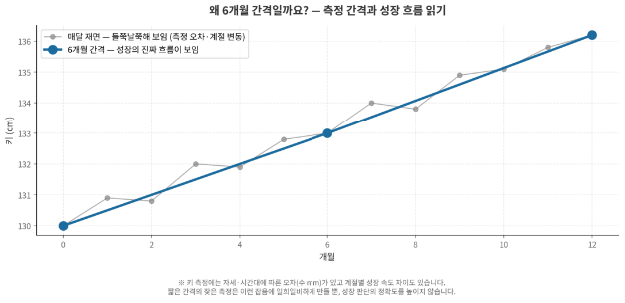
[Graph 1] Frequent measurements at short intervals are thrown off by measurement error and seasonal variation, but at 6-month intervals the true course of growth becomes clear
Measuring a child’s height always involves errors of a few mm, due to differences between morning and evening, posture, or who is measuring. On top of that, a child’s growth velocity also varies with the seasons.
In this situation, measuring height every month or two mixes measurement error with seasonal variation, which easily fuels unnecessary anxiety and worry such as “Why didn’t they grow this month?”
Observing at intervals of about 6 months cancels out this temporary noise and clearly reveals how fast your child is actually growing. 6 months is not a lax interval but the optimal interval for reading growth most accurately.
Shortening to 3 months: when there is a clear reason

Of course, 6 months is not an absolute rule that applies identically to every child.
When there is a clear medical reason to watch a child’s condition more closely, we shorten the tracking interval to 3 months.
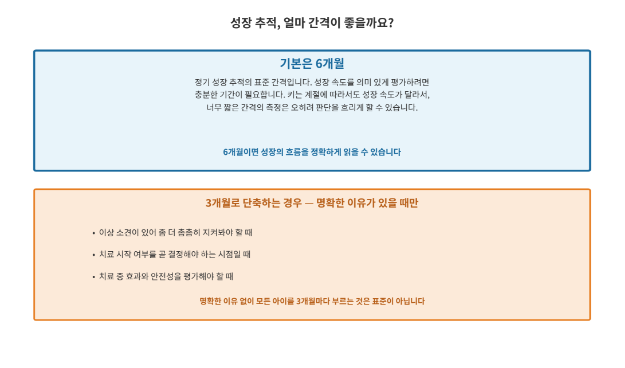
[Graph 2] 6 months by default; shortened to 3 months only when there is a clear reason
|
💡When we monitor at 3-month intervals • When there are abnormal findings, such as slowed growth velocity, that require close observation • When the pace of pubertal progression needs to be checked closely, for example when precocious puberty is suspected • When a decision on whether to start treatment, such as growth hormone treatment, needs to be made soon • When a child is receiving growth hormone treatment and its effectiveness and safety need regular evaluation |
Conversely, having every child visit uniformly every 3 months without such specific reasons can hardly be considered standard care.
Frequent visits cost money and time every time, and they easily come with unnecessary repeated X-rays or tests. Above all, frequent visits in themselves do not make growth assessment more accurate.
SONGDO ANSHIN’s growth-tracking principles
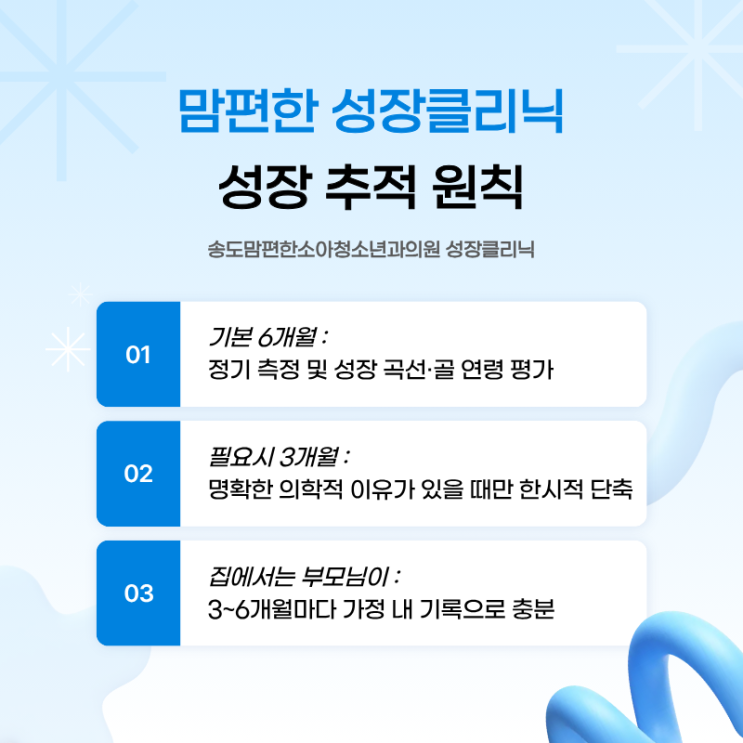
The growth-tracking principles of the SONGDO ANSHIN Growth Clinic can be summarized as follows.
-
6 months by default: Regular growth tracking is done at 6-month intervals, including height and weight measurement, growth-curve assessment, and, when needed, a bone age check.
-
3 months when there is a reason: We temporarily shorten the interval only when there is a clear reason, such as confirming abnormal findings, the point of a treatment decision, or evaluating effectiveness during treatment.
-
At home, it’s up to parents: Between clinic visits, measuring and recording your child’s height at home once every 3–6 months is enough. (This is the growth-trend observation method introduced in Part 5.)
💡[Recommended reading: Part 5] Why isn’t my child growing? 5 things to check before testing
Before starting growth-tracking tests, we’ve summarized 5 key everyday factors that parents should check at home first (sleep, nutrition, physical activity, stress, and growth trends). Before considering unnecessary tests and injections, check out the ▽ Part 5 column first!

Wrapping up the series: we perform only the tests that are needed

With this post, we conclude our eight-part Growth Clinic series.
From basic blood tests to ultrasound, vitamins and minerals, puberty hormones, lifestyle habits, growth hormone stimulation tests, the 15-minute on-site test, and today’s regular tracking interval — there was one single principle running through every post.
|
💡The one principle behind all eight posts If a test could change the course of care → we perform it proactively and accurately. If a test would lead to the same conclusion regardless of the result → we don’t recommend it unnecessarily. It is not the number of tests but how well-targeted they are that determines the quality of care. Performing needed tests decisively, in the way that is most comfortable for the child and parents, and never recommending unnecessary tests indiscriminately — that is the honest promise contained in our clinic’s name, “SONGDO ANSHIN.” |

|
💡In summary • The basic interval for regular growth tracking is 6 months. • For reasons such as abnormal findings or treatment evaluation, we shorten it to 3 months only when there is a clear reason. • Rather than frequent tests and visits, the key is accurate assessment at the right time. • We ease the burden on parents and children by performing only targeted tests backed by sound evidence. |
Closing words

If you have any questions about your child’s height and growth, or have been hesitant because of excessively frequent, repeated tests and visits, please feel free to visit us anytime.
We’ll calmly review together whether tests recommended elsewhere are truly necessary, and guide you to the best testing schedule that won’t stress your child.
Starting calmly with an examination and a bone age test, we will sincerely decide on only the treatments and tests your child truly needs.
※ This post is intended to explain general principles of care and does not replace individual medical consultation. Tracking intervals are determined through consultation based on your child’s condition.
